

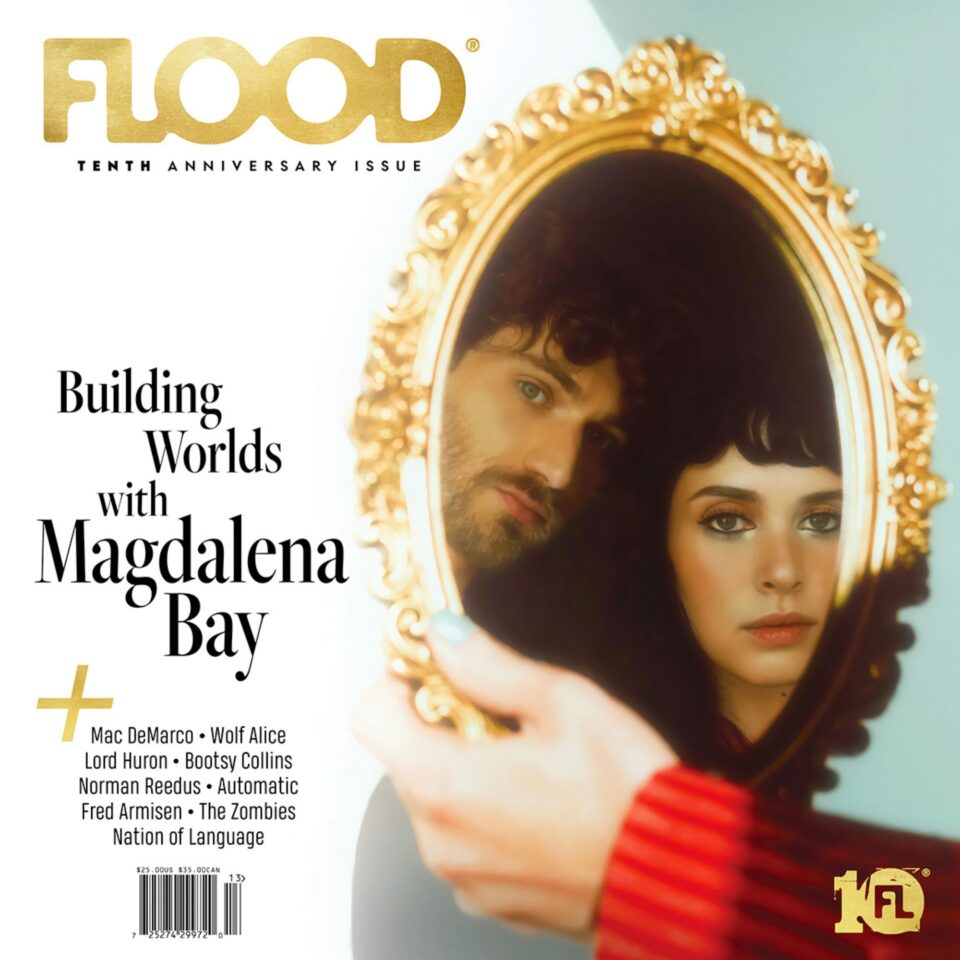
This story appears in FLOOD 13: The Tenth Anniversary Issue. You can purchase this deluxe, 252-page commemorative edition—a collectible, coffee-table-style volume in a 12" x 12" format—featuring Gorillaz, Magdalena Bay, Mac DeMarco, Lord Huron, Bootsy Collins, Wolf Alice, and much more here or at Barnes and Noble stores across the US.
Soft lights strung between palm trees lining the path to Hollywood Forever Cemetery’s lawn illuminate the way to Magdalena Bay’s hometown show for their “Imaginal Mystery Tour.” The lights’ gentle glow gives the picturesque location an otherworldly feel, as if stepping into a magical wonderland. The first glimpse of the synthpop duo’s elaborate stage production confirms it: This is a world of whimsy, reminiscent of Disneyland in the 1970s.
A painted backdrop of fluffy clouds against a blue sky offsets Magdalena Bay’s large-scale stage design. Wings, mirrors, frames, and sunflowers appear throughout, recurring motifs that tie the space together. Two large screens flash saturated, surreal visuals drawn from the duo’s latest album, Imaginal Disk. On this playful, colorful stage, Magdalena Bay’s Mica Tenenbaum and Matthew Lewin move between personas, inhabiting multiple characters as the set unfolds.
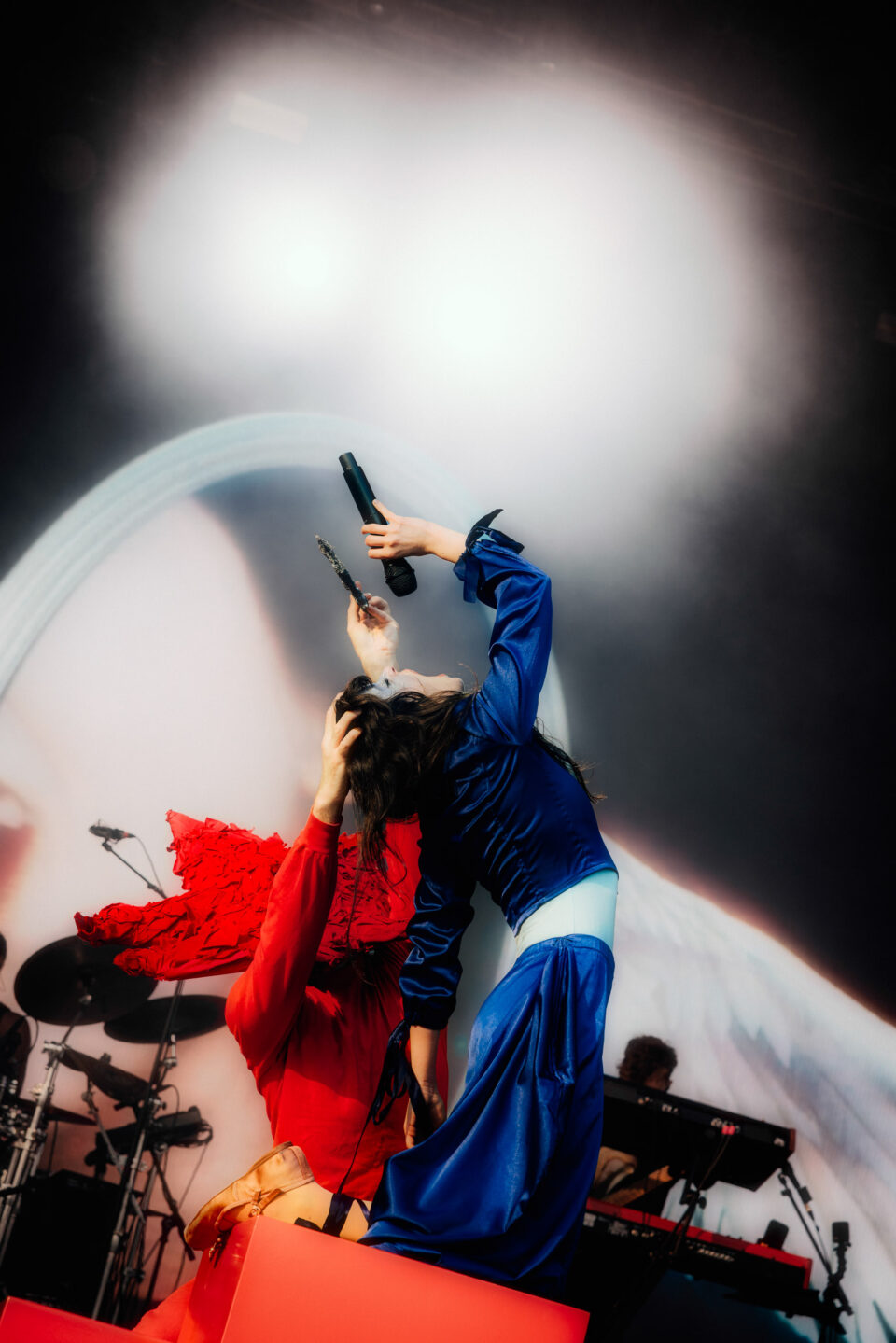
Tenenbaum is a natural performer. She alternates between writhing across the stage and ballet-like movements, her arms waving like branches in the wind—except when she’s brandishing a keytar almost larger than herself. She commands the audience with a single word or a flick of her hand. One moment she’s a sunflower, petals haloed around her face; the next, a wicked queen with flames along her shoulders. She becomes an angel with a majestic wingspan, a celestial ballerina in a blue tutu, a sleek black crow, a genie popped out of a bottle. She perches on a frame, then shifts to a pedestal at center stage, elevating her tiny form so she’s visible from anywhere in the crowd.
Hair & Makeup: Caitlin Wronski Designers: Solène Lescouët, Ancient Future, Yohji Yamamoto, Gert-Johan Coetzee, Sculptor, Wax
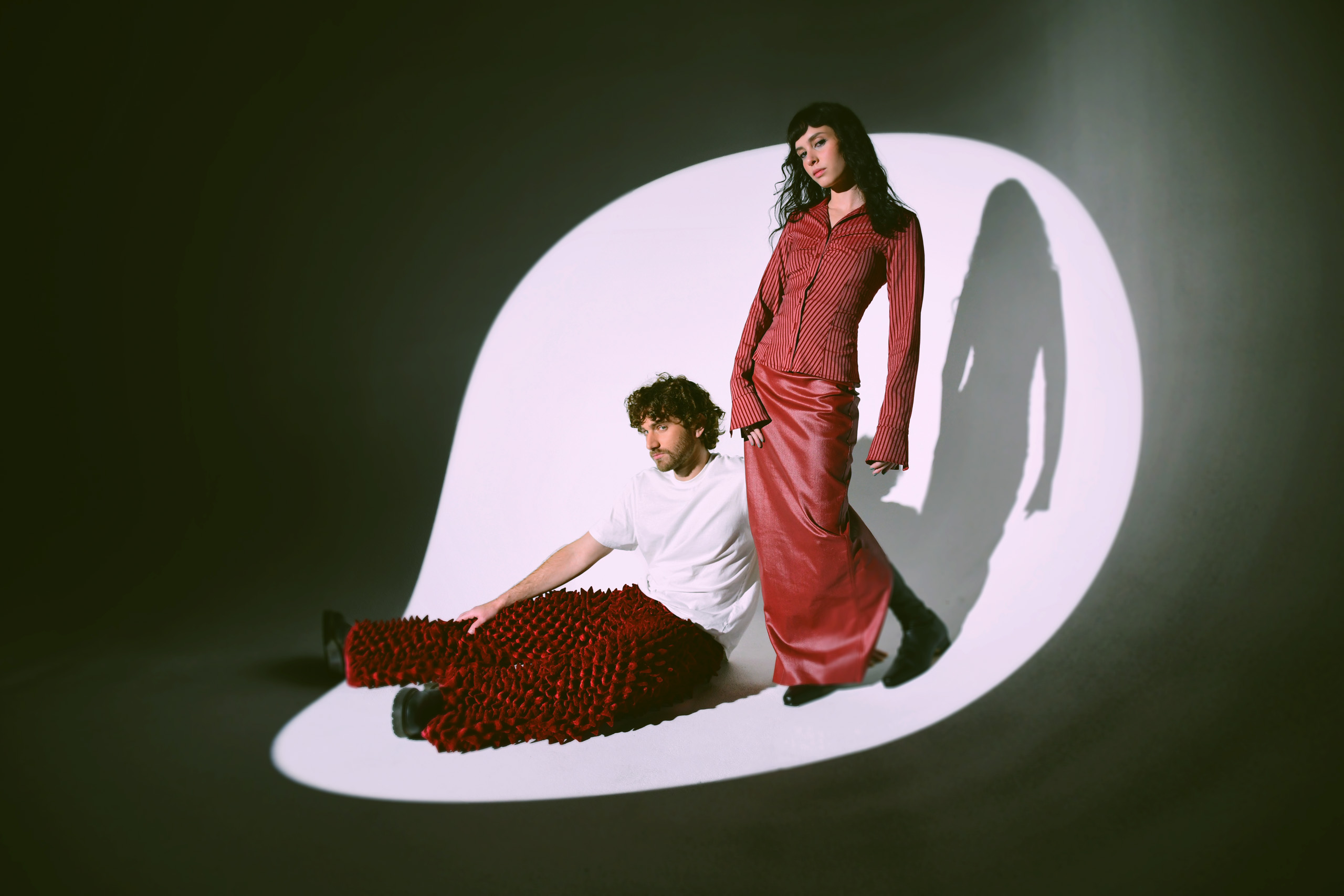
Lewin provides the perfect foil, decked head-to-toe in red, Devo-like—minus the flowerpot, though his guitar (or bass, depending on the song) completes the look. He takes cues from Tenenbaum, a responsiveness that extends off stage as well.
A couple of days before these milestone shows, Tenenbaum and Lewin are at their Los Angeles home, which doubles as their studio. There’s a casual familiarity to them as we chat over Zoom, the kind of presence that feels like friends you borrowed notes from in college or classmates you sat next to in high school. Coincidentally, it was during high school in Miami that they met while participating in the LIVE! Modern School of Music program, eventually forming a prog-rock group called Tabula Rasa.
They sit in beige cushioned swivel chairs. Tenenbaum wears pigtails and an unstructured blue cap, a strappy black top, and glasses. When she jumps up to tend to their dog, her top reveals itself as half of a playful skater dress. Lewin, in a black T-shirt, drifts in and out of the frame, waiting for Tenenbaum to respond before offering his own thoughts, often turning to her as if to signal, “You go first,” then rounding out her ideas with his own.
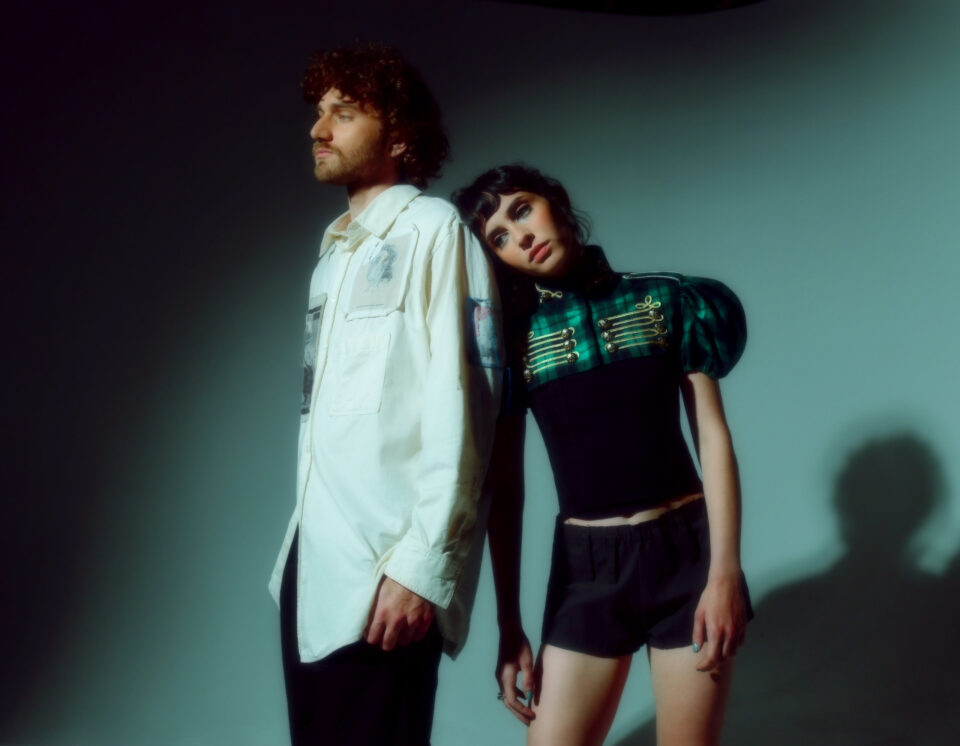
“Formative memories of our lives were being on our parents’ desktop Windows computers, exploring the internet… It’s extremely ingrained into our sensibilities.” — Matthew Lewin
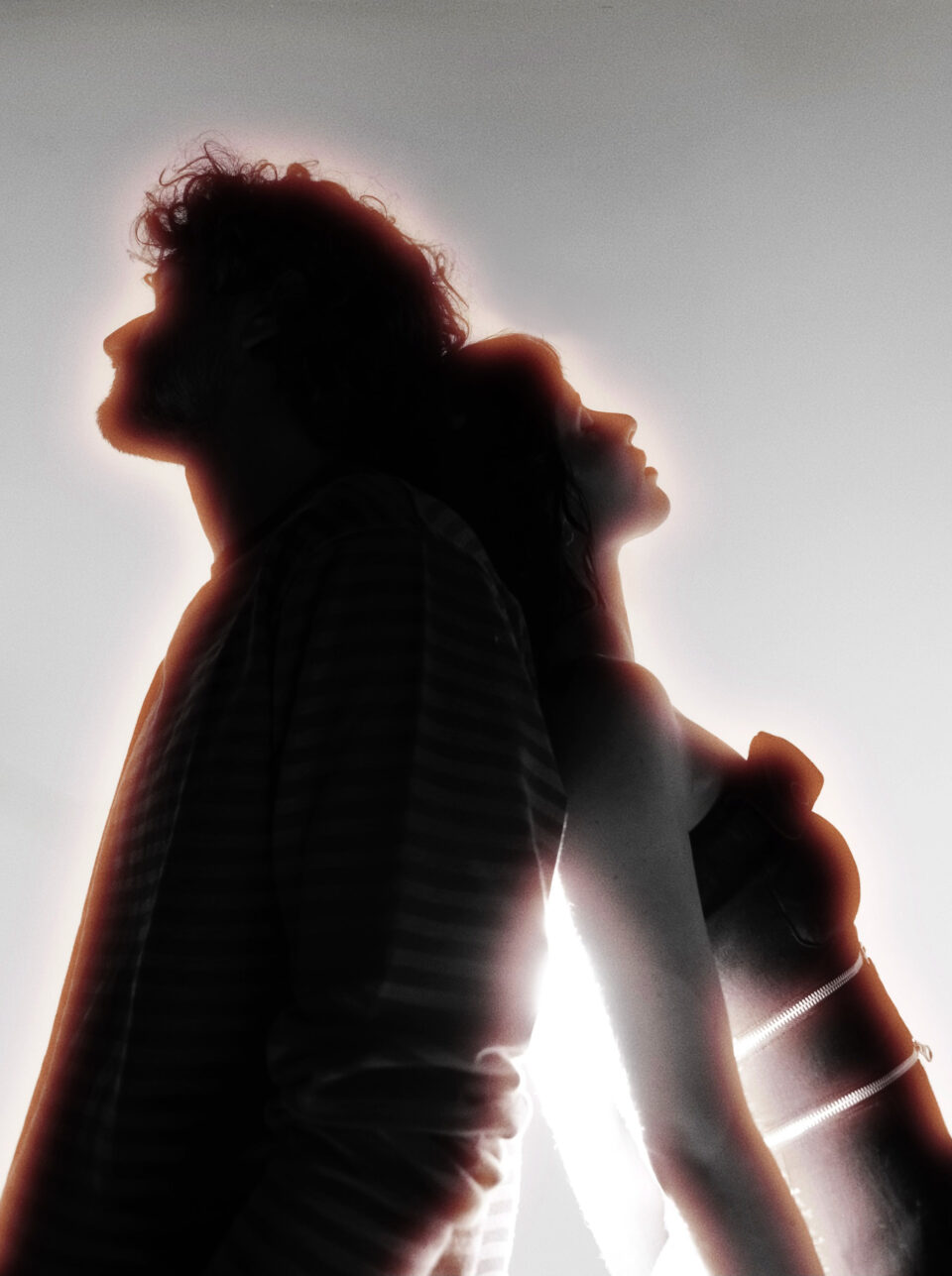
Creative partners as well as life partners, their synergy transcends the typical band dynamic. They’re adept at world-building for themselves and inviting others into their universe. At times, it seems they’re more comfortable navigating these constructed spaces than the real world.
Digital natives born in the mid-’90s, it’s no surprise they’re at ease on a virtual plane. Early Magdalena Bay tracks were crafted remotely while they were in college, Tenenbaum at Penn and Lewin at Northeastern. It’s also how they discovered their audience, especially on TikTok. They excelled on the platform’s short-form, character-driven ecosystem, blending music, late-’90s/early-’00s internet-inspired structures, surreal film references, and skits that reveal enviable acting chops. YouTube and Instagram also proved handy mediums through which they showcased their DIY videos, glimpses behind the scenes, memes, and interactive content. Their friendly, approachable personalities organically built a community that grew alongside them. Fans became participants in their fantastical world.
Beyond social media, Magdalena Bay created engaging GeoCities-style microsites for both their albums: 2024’s Imaginal Disk and 2021’s Mercurial World. Styled with the simple charm of early web design—8-bit aesthetics, pixel fonts, blinking icons, and Easter eggs tucked into hidden corners—the sites evoke nostalgia while inviting exploration. Their music provides the narrative for these immersive worlds, opening portals into their alternate realities. “Formative memories of our lives were being on our parents’ desktop Windows computers, exploring the internet,” says Lewin. “It’s so far gone from what that was, but it’s extremely ingrained into our sensibilities—pointing and clicking, CD-ROM games, or websites that were more interactive.”
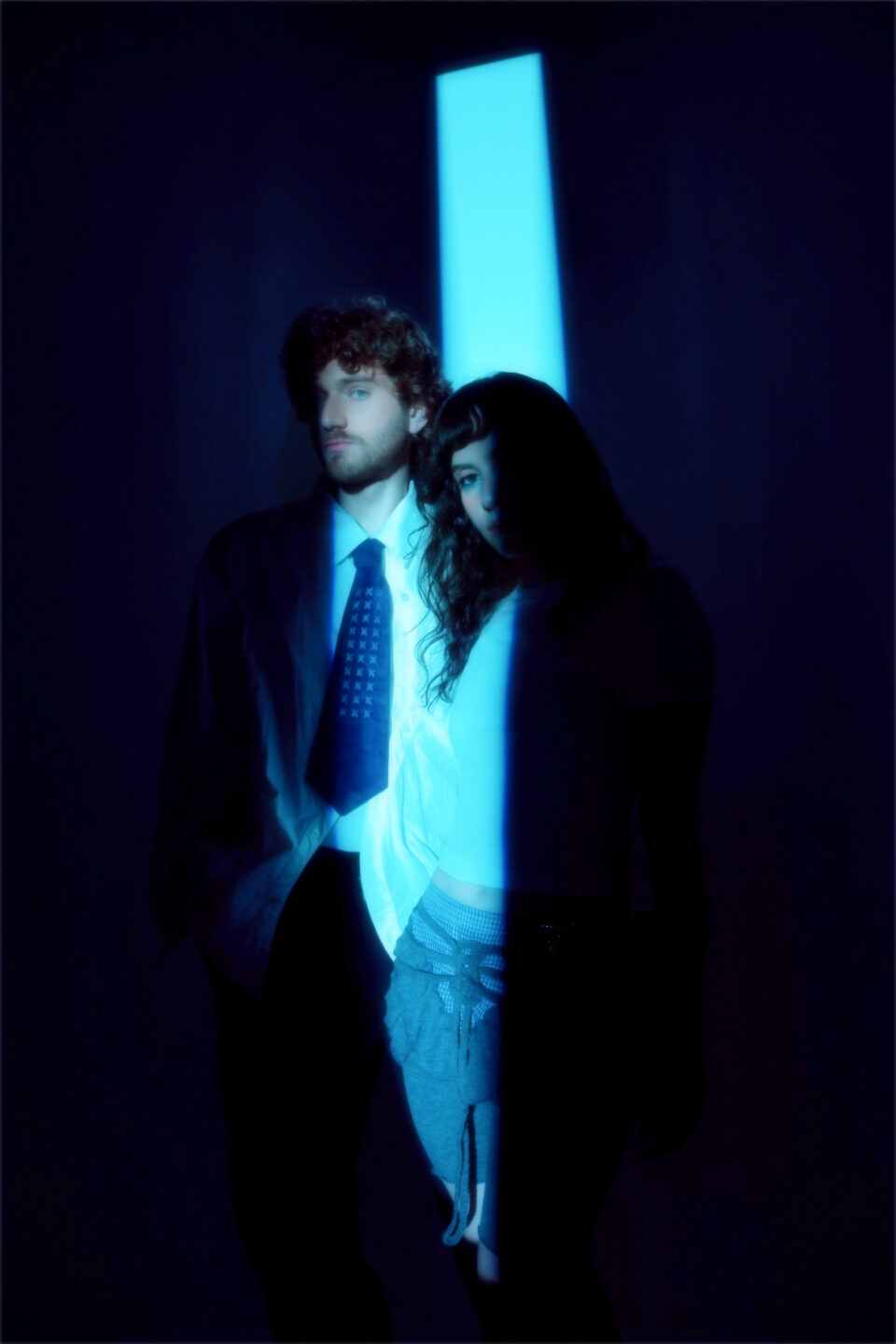
“It felt like a magical place to explore,” concurs Tenenbaum. “Our website for Imaginal Disc was inspired by Neopets, which I rediscovered last year. It’s just text and images, but it’s this huge, expansive world, and it’s just so cool.”
Magdalena Bay’s fans seem to think so. Their participation in the playgrounds and digital toys the duo provides is enthusiastic and prolific. There’s almost as much fan-generated Magdalena Bay content as what’s created by the duo themselves. “A lot of our initial success was due to TikTok, but I think we’ve been able to maintain a core base of fans as we’ve grown,” says Lewin. “Those are the people who are buying tickets to the shows, buying the physical records, and buying the merch. We’re happy that even though we had that viral moment, it hasn’t just come and gone, which is everyone’s fear when something like that happens. How do you hang on to people and keep them interested?”
Tenenbaum adds, “With thousands of streamer personalities, because it’s so heavily monetized, it feels like it’s spoiled in a way because these people are making so much money from developing these parasocial relationships.”
What Magdalena Bay have with their fans is the opposite of parasocial. The crowd at their Hollywood Forever concert is dressed up, reflecting what the duo is projecting. It’s almost like they’re cosplaying and they fit right into the “Imaginal Mystery Tour” world. The queue leading to the merchandise booth runs the length of the cemetery. Along the way, a tent offers face painting, where fans can be transformed into Tenenbaum’s Imaginal Disk character, True. “Our early adopters were LGBTQ, who are early adopters to a lot of things that are happening in music, and it was very cool to see them pick up on us,” says Tenenbaum. “Imaginal Disk reached a wider array of people, but also the music nerd community, which I don’t think we were super tapped into before. We’ve had high schoolers all the way to people in their fifties and sixties at our concerts.”
Magdalena Bay’s music is accessible to a cross-section of music lovers—including one of their heroes, Grimes, who remixed their song “Image,” a full-circle moment for the duo. “Art Angels changed our perspective on what pop music could be,” says Tenenbaum. Lewin adds, “It was probably the most impactful album on us when we were first starting the band.”
Additionally, Magdalena Bay have supported pop acts like Billie Eilish, Charli XCX, Halsey, Caroline Polachek, and Rina Sawayama, and they’ve performed on festival stages from Lollapalooza to Porter Robinson’s Second Sky. “We’ve played to lots of audiences that didn’t like us,” says Tenenbaum. “The kids [at Billie Eilish’s show] were very open-minded. [But] there was a video kind of making fun of me because I’m wearing my sunflowers thing. There’s 20,000 people there. Of course not everyone’s going to like it. But there’s something that happens on TikTok, a phenomenon where the reaction to something will be more magnified than the actual thing. There’s other videos copying that format and a lot of people defending us. It became a whole thing, even though it was really fine from our point of view.”
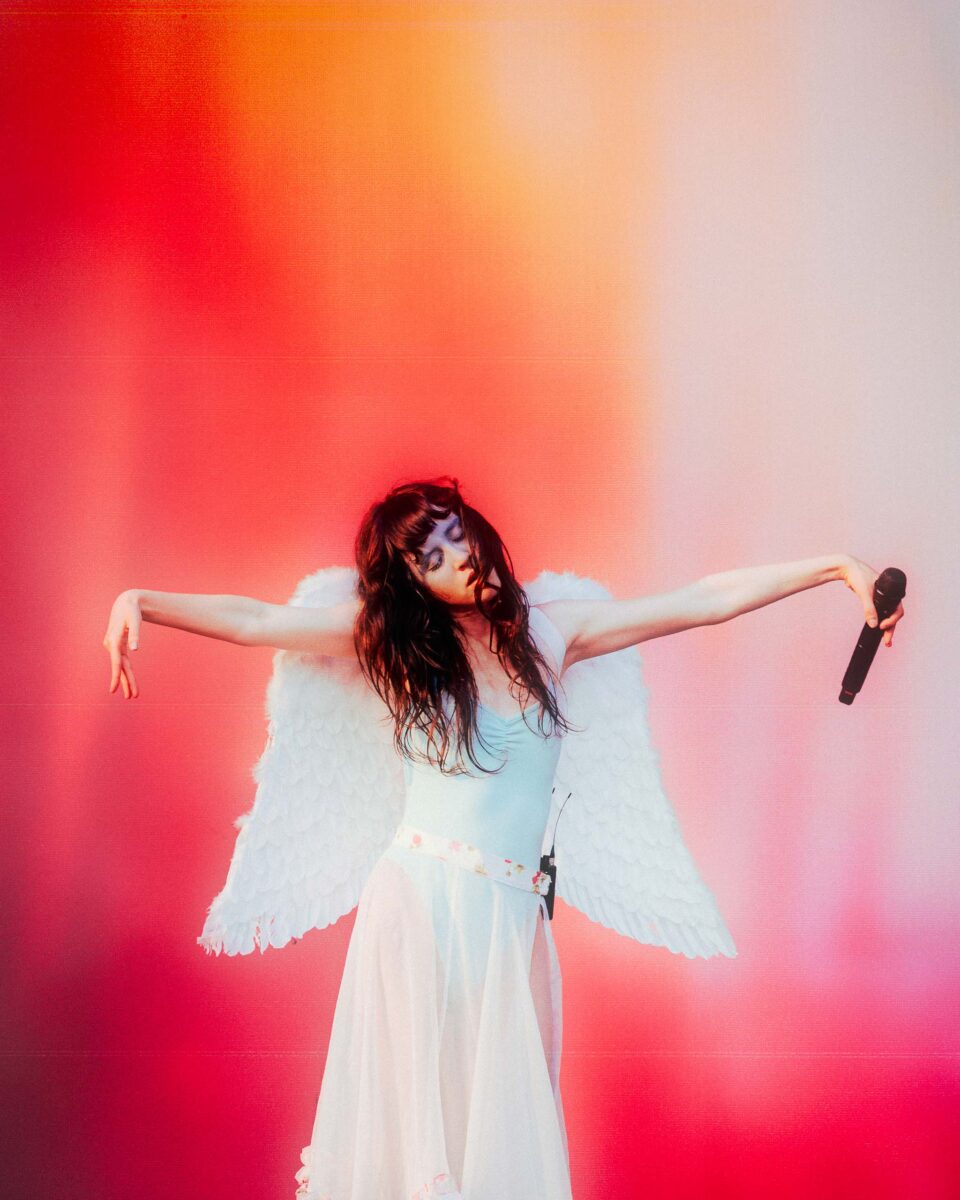
Magdalena Bay at Lollapalooza 2025/ photo by Christian Sarkine
“When we first started getting negative comments on our YouTube, we were like, ‘This is great!’ No one would ever be so mean to a really small band, because it’s just cruel.” — Mica Tenenbaum
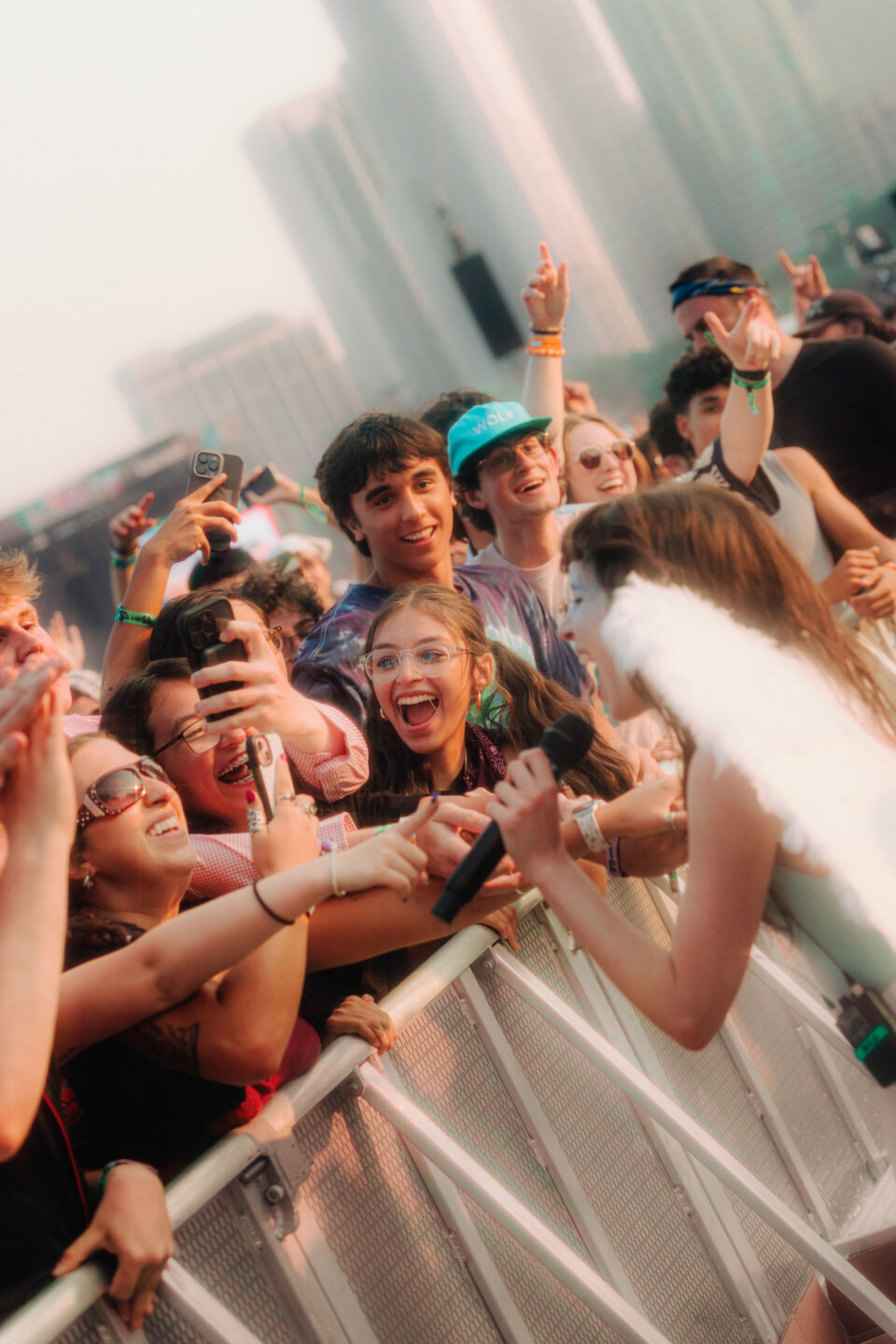
“It’s a consequence of building an audience base of a certain size,” observes Lewin. “There are so many people, and you can’t have all of them like everything.”
“When we first started getting negative comments on our YouTube, we were like, ‘This is great!’ No one would ever be so mean to a really small band, because it’s just cruel. They thought we’re legit enough to write hate comics,” remembers Tenenbaum.
The visual aesthetic Magdalena Bay have cultivated—expanding on their earlier experiments while venturing into new territory—is central to their creative identity. Their low-res computer graphics, apartment green screens, stock assets, and VHS effects evoke ’90s home videos, early internet broadcasts, retro video games, and public access TV. The homemade quality was both intentional and born of necessity when the duo first began creating and world-building at their apartment upon moving to Los Angeles.
Their influences span the internet circa 1998 to 2003, as well as classic science fiction and fantasy films ranging from Star Wars to The NeverEnding Story, which Lewin was introduced to by his sci-fi-loving father. The pandemic, and the cushion of stimulus checks, gave Tenenbaum and Lewin the time to work through their entire science fiction watch list. “We had built out this massive list of must-watch movies,” says Tenenbaum. “It was maybe 50 movies, and there were a lot of sci-fi and horror classics. But now, it’s tough. Where do we go from here?”
“Sci-fi is fun because there are more avenues to explore. You’re not bound to the rules of reality or the present.” — Matthew Lewin
“We’re drawn to things with a strong stylistic visual element to them,” says Lewin. “Sci-fi is great. But if you just have sci-fi, you have a very straightforward look to it, then it’s not as interesting to us. For us, it’s this blend of strong stylization, direction, production design, costumes, and special effects. There are a lot of non-sci-fi movies that appeal to us for those reasons. But in general, sci-fi is fun because there are more avenues to explore. You’re not bound to the rules of reality or the present.”
Those films, along with their early internet references, informed Magdalena Bay’s developing visual world. What began online has since extended to their live production, where the imagery takes on a physical form. “The aesthetic of the album is completely driving the live show in every way,” says Tenenbaum.
“Not only the aesthetic, but also the loose narrative of the album,” adds Lewin. “We’re not doing theater, it’s still within the confines of a pop rock show, but we try to integrate elements within it.”
The “Imaginal Mystery Tour” production has grown with each run, evolving significantly from its early legs to their late 2025 and early 2026 dates. “We’re playing bigger rooms each time we go out on the road,” says Lewin. “We want to grow along with that. We don’t want to be playing big rooms with a small production. It might feel a little disappointing for the audience, but also for us. We’re just trying to keep up.”
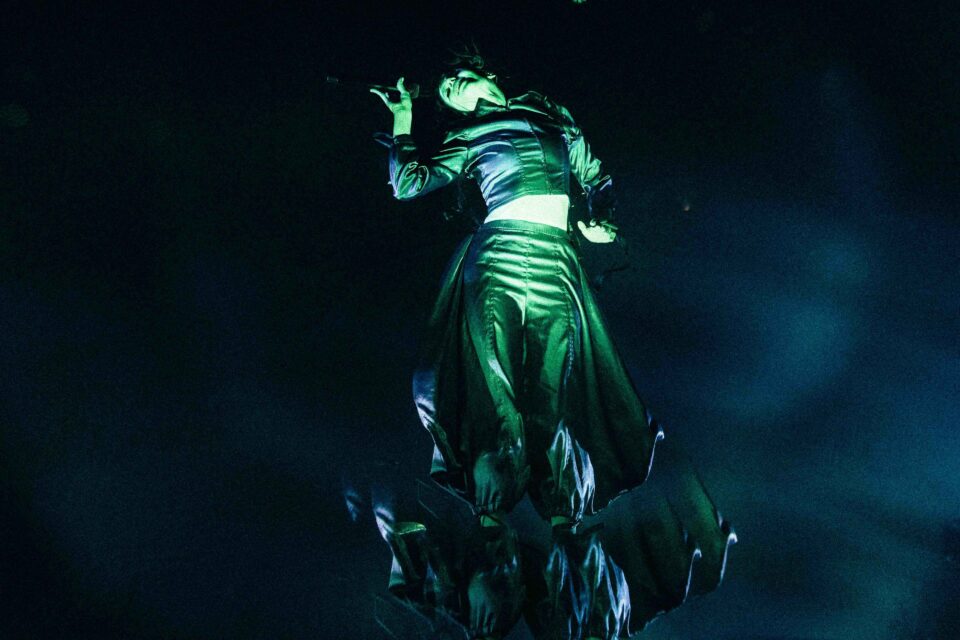
Magdalena Bay at Terminal 5 in New York 2025 / photo by Kimberley Ross
“As we’re writing music, involuntarily we start daydreaming and seeing visual things happening. It’s a complementary part of the process.” — Mica Tenenbaum
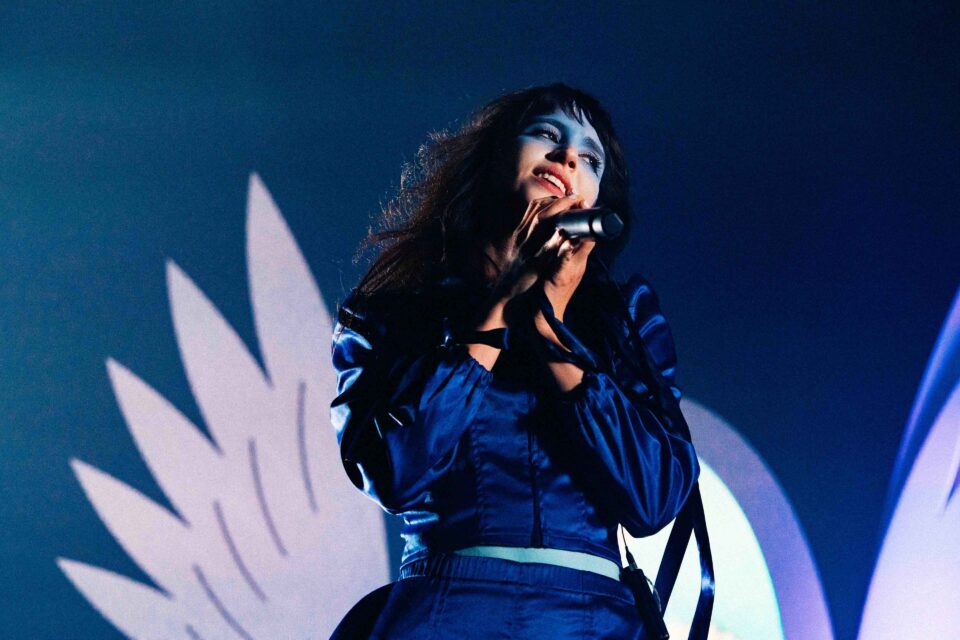
Up until a year ago, Tenenbaum and Lewin were still building nearly everything themselves. Now, they oversee the realization of their ideas rather than single-handedly executing them, though they haven’t forgotten the stress of their 360-degree approach. “I remember pulling all-nighters before every tour trying to finalize everything,” says Tenenbaum. “Maybe on the outside it seems like we’ve grown quickly, but we’ve been very involved with every step and taken everything into very careful consideration. We know a lot about each element that goes into the show, because we’ve been quite hands-on with it historically. It’s cool to see it at this stage where we can hand off a lot of the work. It’s a fun time.”
Despite the visuals being such a defining characteristic of Magdalena Bay, Tenenbaum emphasizes that “The music is definitely leading the charge. But as we’re writing music, involuntarily we start daydreaming and seeing visual things happening. It’s a complementary part of the process.”
“The visuals can feed the music,” elaborates Lewin. “You’ll start writing a song, and very shortly after, you’ll start thinking about how the video is going to work, and you’ll start having ideas about it. When you think of visuals, it almost cements the mood of a song even stronger, or gives it a more specific direction. It’s almost like you’re scoring the video in your head without even realizing it.”
Magdalena Bay are taking their visuals to the next level with a feature-length “album movie” directed by Amanda Kramer (Ladyworld, Please Baby Please, and the upcoming By Design) that expands on the universe created for Imaginal Disk. The narrative and storyboarding were completed by Tenenbaum and Lewin as they were wrapping up the album. They say the film is in the DNA of the album and that Kramer is helping bring the story from PowerPoint slide form to “something more real.” Part of the draw to Kramer was her experience directing stage plays, which they feel comes through in the film.
They’re closed-lipped about revealing much more as the film has only just moved from “post-production purgatory” to actual post-production with a team of VFX producers. The completion date is yet to be determined, but parts of the film are already out in the Magdalena Bay universe in the form of music videos for “Death & Romance,” “Image,” and “That’s My Floor,” as well as being revealed in their live show (including their live performance of “Image” on Jimmy Kimmel Live!). “When the full thing is out, hopefully it should help people make some sense of it,” says Lewin. “But even when it is out, I’m sure plenty of people will be like, ‘What the hell was that? I don’t understand what I just saw.’ If you try to approach it too literally, then you’ll probably end up a little disappointed. A lot of the narrative elements are very loose, but that’s intentional. We definitely want people to impart their own narrative.”
The film is informed by their binge-watching of Star Trek: The Next Generation and David Lynch movies, to which they ascribe the lack of concrete narrative, replacing it instead with “symbolism and emotional forces driving through it rather than plot elements, per se,” according to Lewin. They reference ’70s art-leaning films for the character and set designs, colors, and effects.
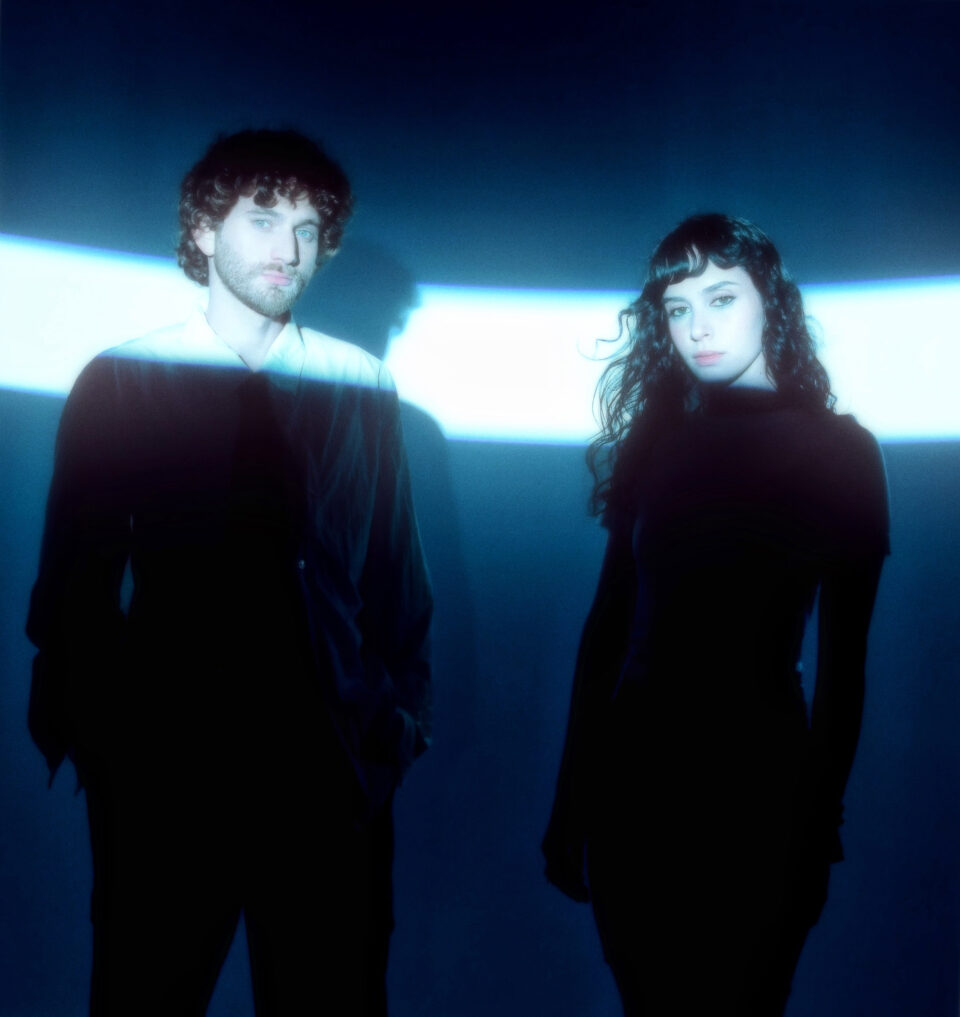
The film, unsurprisingly, had some influence on the music of Imaginal Disk. Says Tenenbaum, “We were writing this movie as we were finishing the music and a little idea, small touch, or a detail for the visual would trickle back into the music. But it’s really the music from which all the visual ideas come.”
Tenenbaum and Lewin are as much musical sponges as they are visual ones. At the time of Mercurial World’s creation, they were steeped in pop music across the ’80s, ’90s, 2000s, and 2010s, discovering gems like Tears for Fears’ “Head Over Heels.” Their cover of that song was one of their early releases; it wasn’t so much that they were drawn to the song as they were stimulated by how they could make it different—’80s indie, if you will. Ahead of Imaginal Disk, they made a U-turn to the rock sounds of their younger years. “We never want to sound exactly like something, because what’s the point?” says Tenenbaum.
“Unless we’re specifically doing pastiche—which we do sometimes—our goal is to take those influences from the ’90s, ’80s, ’70s and interpret them through whatever our unique sensibilities are,” says Lewin. “It’s the Bowie method. He dabbled in all these different things but it would still be unmistakably him, because he had such a strong creative voice behind it. It’s different frames you can play around in.”
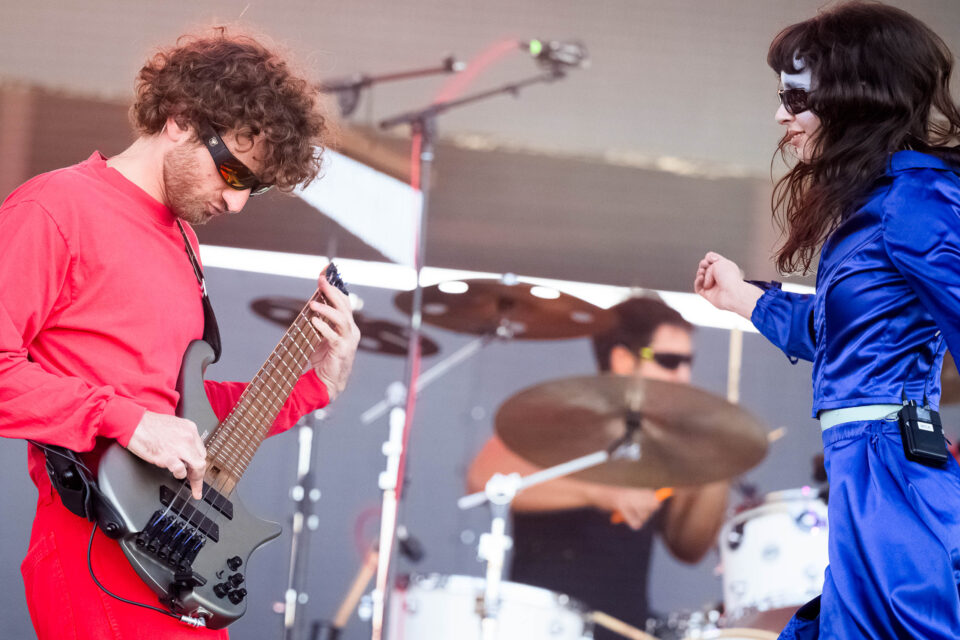
Magdalena Bay at Portola 2025 / photo by Wilson Lee
“We’re playing bigger rooms each time we go out on the road... We don’t want to be playing big rooms with a small production. It might feel a little disappointing for the audience, but also for us.” — Matthew Lewin
Prior to the albums, they released three EPs: Day/Pop and Night/Pop in 2019 and A Little Rhythm and a Wicked Feeling a year later. At the same time, they released a collection of snippet-length songs as Mini Mix Vol. 1 and Mini Mix Vol. 2 in 2019 and 2020, respectively, with the third volume arriving in 2023. Each Mini Mix came with a full visual accompaniment of “cyberdelic” Matrix-like videos. “I like making albums, but it’s hard,” says Tenenbaum. “Mini Mixes are fun. They’re less pressure for us. They’re sort of like genre explorations.”
“They’re short,” says Lewin. “We don’t feel like there needs to be a lyrical, thematic connection. They’re more just bouncing around short ideas in a fun way. The visuals are obviously a lot more lo-fi and goofy. They’re a good way for us to try different things and take it a little bit less seriously.”
Tenenbaum and Lewin are the sole writers and producers of their music; everything is recorded at their home studio, barring some string arrangements. Practically, the creation process of Mercurial World and Imaginal Disk were the same, with the main distinction being that the latter had more live drums. The writing for Mercurial World happened over the pandemic, assisted by the same stimulus checks that provided the space to absorb film influences. Imaginal Disk, on the other hand, was written while touring. By the time of that second album, the duo had moved from a restrictive apartment to where they live now—a place with enough room to set up an upright piano and drum kit. The kit sits behind them now, cocooned in acoustic panels. In this live/work space, they admit the biggest square footage is taken up by the studio, but they love the ease and coziness of creating at home.
Lewin took guitar lessons when he was a child and studied music business at Northeastern as a compromise with his parents. “To their credit, they have no experience in the music industry,” he says. “They only hear stories of musicians signing record deals and then either becoming drug addicts or losing all their money and being homeless by the time they’re 20. For them, the whole idea of being a musician was such a non-viable thing. It didn’t feel real to them because they probably didn’t know a single person who ever was successful in the arts.”
His recording and production skills were attained through watching YouTube videos and Googling questions, listening to music and trying to figure out how certain sounds were created. “When you first listen to a song, it’s this black box of music,” he says. “But when you really dissect it and try to recreate it, it’s very enlightening and teaches you a lot of practical knowledge that you could use in your own way.”
For her part, Tenenbaum was an excellent student who got excellent grades and a high SAT score, landing her at the ivy-covered University of Pennsylvania where she studied communications and completed internships, but all the while missed songwriting. “I never considered being a musician as a real option,” she says. “When I took a break from writing songs between our high school band and Magdalena Bay, I was like, ‘Shit, I really miss writing music’—the part of me that was the most interesting, the part that I liked the most, that was my creative outlet.’ By the time I had my first summer job in corporate America, I was like, ‘I need to go for this music thing.’”
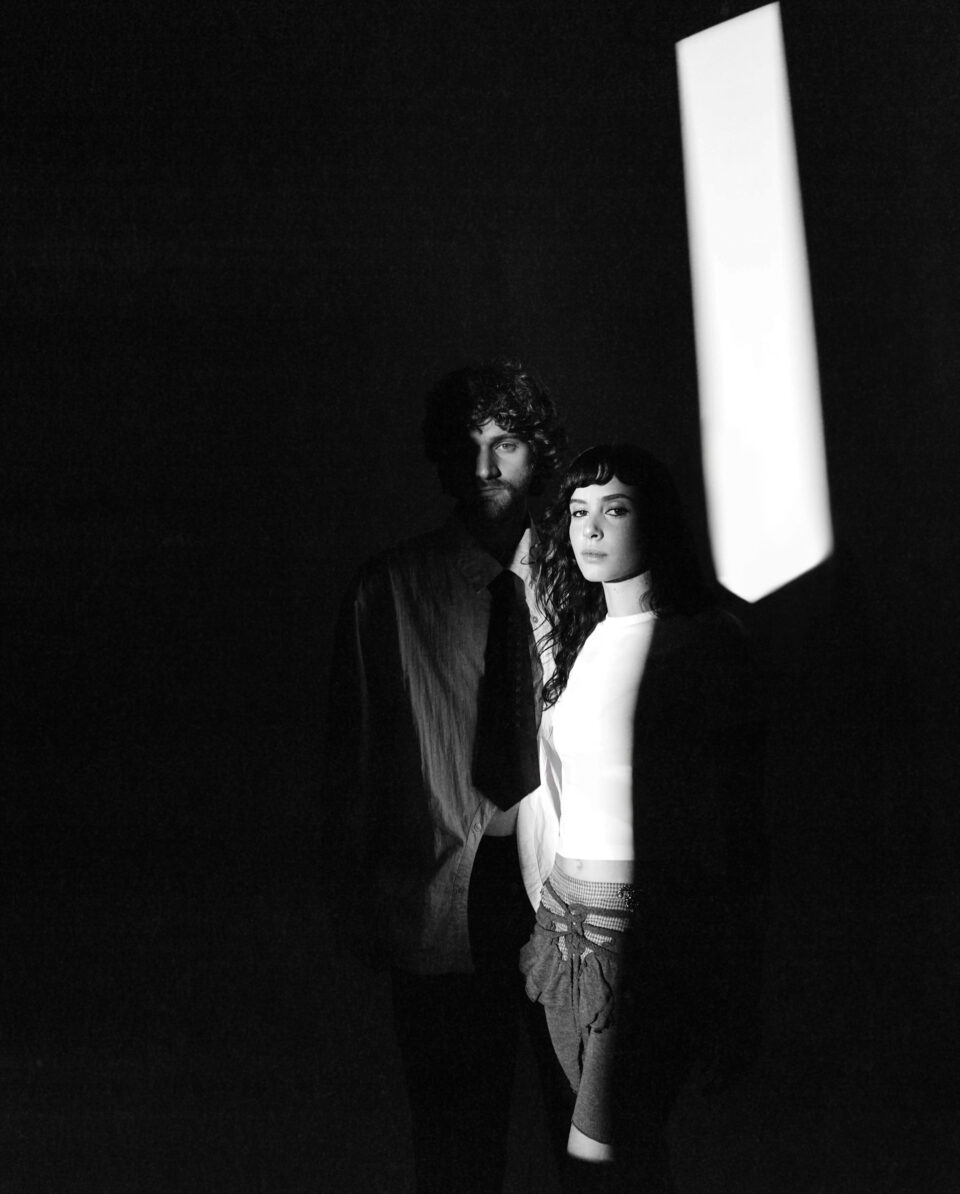
When asked about lyrics, Tenenbaum tenses up, preferring to let the songs do the talking. “Over the years, it’s gotten easier for me,” she concedes. “Some songs are more personal. That’s definitely an aspect of it. But there’s just more openness of lyrics being abstract in a way that makes them easier to write. They feel more integrated with the music. There’s this more subconscious flow between the words and the music where lyrics reflect certain things we’re thinking about or experiencing. It could be deep in the back of our minds, or it could be from a journal, or from something I saw on the street that I put down in a Notes app. It’s always hard to talk about that.”
“In the past, we were more set on writing songs like pop songwriters, where every song needs to have a thing,” expounds Lewin. “Recently we’ve been able to explore not writing like that.”
They tapped Dave Fridmann to mix Imaginal Disk based on his work with some of their referential artists such as MGMT, The Flaming Lips, and Tame Impala. Lewin mixed Mercurial World himself and did rough mixes of Imaginal Disk, but didn’t feel he was able to get the album across the finish line to his satisfaction. Plus, the closeness Magdalena Bay has to every aspect of the music creation makes it difficult to have any objectivity when it comes to mixing, so having a fresh set of ears was helpful. “Even if it’s someone you totally respect and love their work, it doesn’t necessarily mean they will understand your vision for the music, or will be able to hear what you’re hearing in your head and make it happen,” says Lewin. “What made us really excited about working with Dave was we sent him our rough mixes and he was willing to jump off of what we already started and take it from there and make it better, which he did.”
Magdalena Bay released “Second Sleep” and “Star Eyes” at the time of the Hollywood Forever Cemetery shows. A double-sided single, the songs were written at the time of Imaginal Disk, but needed to exist on their own since the duo aren’t quite ready to think about the third album yet. “It always just ends up being what we’re into at the moment,” says Lewin. “Music-wise, we’re into a little bit more…is ‘mellow’ the right word? For example, an album like R.E.M.’s Automatic for the People, not directly in terms of sound, but how it was such a departure for them from electric guitars and high-tempo drums. They came out with this almost fully acoustic album. It has this very specific melancholy to it which I’m super attracted to. It’s way too early to say if that’s how our next music is going to be inspired by, but it’s something we’re interested in right now.”
“A lot of our inspiration will start with something as vague as a mood or an energy we want to tap into,” says Tenenbaum. “As we keep listening to things and as the touring wraps up, we’ll hone in on this mood naturally and create around that.”
“Our goal is to take those influences from the ’90s, ’80s, ’70s and interpret them through whatever our unique sensibilities are. It’s the Bowie method.” — Matthew Lewin
“It’s all going to be subconscious as we create the music,” adds Lewin. “We’ll make choices when we sit down to write music that will stem from whatever we’re listening to, or what mood we’re trying to convey. You don’t want to be too conscious of how you’re making creative decisions, because then you might get in your head about things.”
AI won’t be assisting Magdalena Bay in realizing their creative ideas. Interestingly, when the topic is broached, they immediately assume it’s meant for their visual output, not music. In early 2022, they made a video for “Dreamcatching” for which they used the elementary version of AI to come up with visuals. “It was a super attractive thing because it was this weird dream version of a computer trying to create reality,” says Lewin. “It was so uncanny and weird and so up-our-alley. I miss that awkward stage. As AI has gotten better, it feels less inspiring to us creatively.”
For the next few months, their creative ideas will be realized on stage, where they’ve spent most of the last year, but the finish line is in sight. “We’re definitely slowing down, slowly but surely,” says Lewin. “We need to get back to thinking about what the next record is going to be, and spending time at home with our dog and enjoying some time off for a little bit. The end is nigh.” FL