





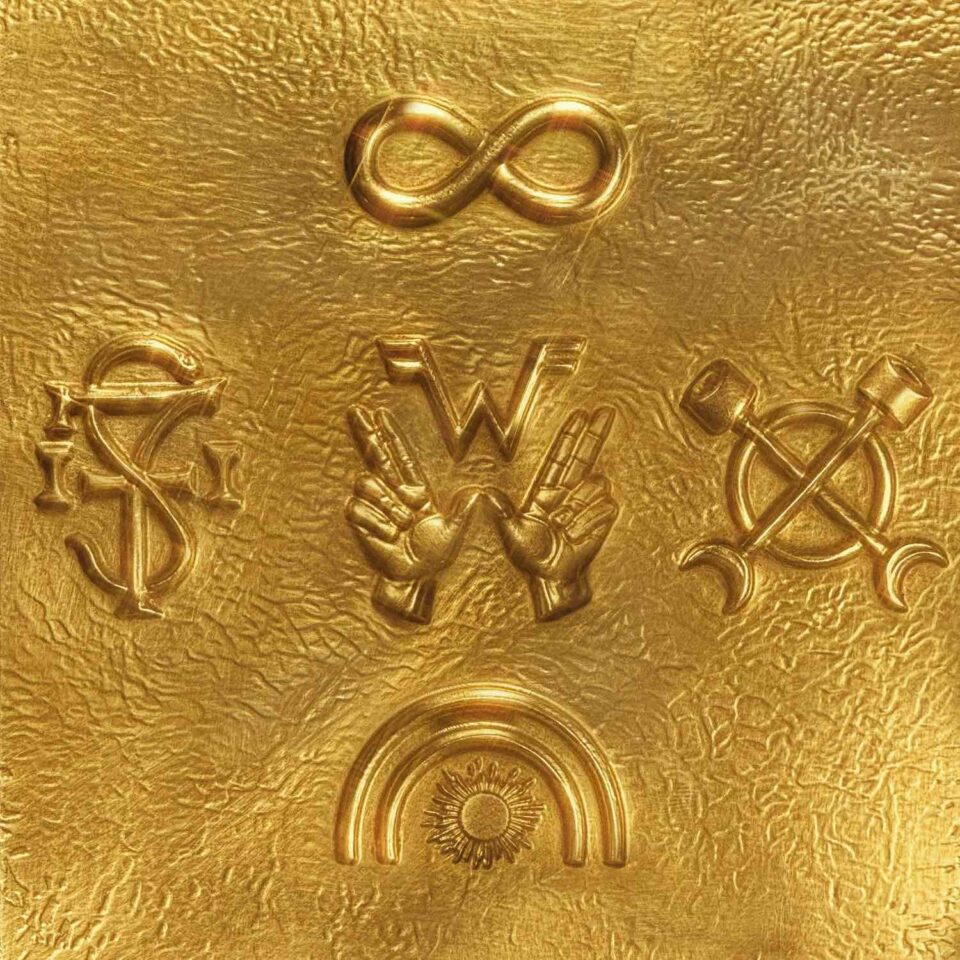
BACKSTORY: The Alaskan songwriter honors his Sitka Tribe—who have lived in this homeland for thousands of years—in both his songwriting and visual art
FROM: Sitka, Alaska
YOU MIGHT KNOW HIM FROM: His Sub Pop debut, 2021’s Indian Yard, which featured appearances from Portugal. The Man, Shabazz Palaces, Nick Hakim, and more
NOW: The songwriter expands his genreless sound in new directions on Stand on My Shoulders, recruiting more guests including Pink Siifu and Meshell Ndegeocello
Though there is a meticulous craft to the arrangements on Ya Tseen’s second LP, Stand on My Shoulders, songwriter Nicholas Galanin didn’t imbue the process with much formality. This low-pressure recording experience lends itself to the album’s sprawling scope, a genreless exploration of each and every idea that Galanin found interesting. Stand on My Shoulders is, as a result, bound to no sound, style, or method. As Galanin tells me, “‘No genre’ is the genre of these projects.”
The Sitka, Alaska-born songwriter began searching for his next muse shortly after releasing Indian Yard in 2021—his first record with the Pacific Northwest label Sub Pop. There was a bit of time in which Galanin allowed the project to exist in its own world, to celebrate the success of turning his ideas into a collection of recorded music. “At a certain point it became, ‘I have other work I need to keep doing.’” Though the songwriter quickly shifted back into the process of recording new music, his freewheeling, laid back approach informed the truly inimitable final product. “There were three years of writing and recording and exploring the studio, looking for collaborations and things like that,” Galanin explains. “We had over 70 song ideas for the album, and it became a process of capturing ideas, refining them, and seeing which ones survive and help make the album a cohesive project.” That’s the trick that Galanin magically weaves here: He makes an album that’s cohesive, but one that also adheres to no established rules.

“The studio in Sitka deeply impacted the sound—not only technology-wise, but it’s a small community of 8,000 people... Environment is such an important part of anything creative that I do.”
Take opener “Ircenrraat,” which features Ashley Young, an artist whose ancestral roots also reside in their shared home state of Alaska. The psych-pop track buzzes along with an infectious bass melody and a drum groove that occasionally launches into double-time. Galanin and Young’s vocals merge and float in harmony before dovetailing in different directions. On the next song, “Twilight,” Ya Tseen is joined by Pink Siifu and Sidibe for a lo-fi dance workout built around warbling synth stabs and a delightful concoction of snares, hi hats, and bass drum rhythms. Later, “Taste on My Lips” reimagines disco within the context of soulful funk grooves with the help of Portugal. The Man and Meshell Ndegeocello. “Katlian’s Hammer” plays with DIY punk and experiential rock, landing somewhere between early TV on the Radio and Beck. Nothing is off limits and every idea exists in its own universe.
The glue, of course, is Ya Tseen, who imbues these songs with a confidence and humility that’s also a central tenet of his character. Galanin’s musical identity was one bestowed upon him by his father, Dei Kee Tla Tin (Dave Galanin), who also made blues music under the name Strummin’ Dog. In 2013, Galanin the younger broke his back and ribs while coming home from a hunting trip. His dad gave him the name Yeil Ya Tseen, which means “Raven be alive.” When Galanin’s father died, he renamed his project Ya Tseen to honor both his musical lineage and his ancestral home as a member of the Sitka Tribe of Alaska, also known as Tlingit.

“‘Stand on my shoulders’ is a recognition of the mentors, ancestors, and elders who have come before and provided the foundation for us to continue the work we do and with the knowledge we have.”
Galanin’s relationship to Alaska played a significant role in the way Stand on My Shoulders unfolded. “The studio in Sitka deeply impacted the sound—not only technology-wise, but it’s a small community of 8,000 people,” he explains. “We’re connected closely to land and sea and harvesting and seasonal access to living. We sustain ourselves. Environment is such an important part of anything creative that I do.”
Even though the album wasn’t entirely recorded in Alaska, with Galanin inviting artists into his world and meeting up in other cities, too, every song is an amalgamation of the singer’s lived experience, which can be traced both in his lifetime and generationally to Sitka. “[The title] ‘stand on my shoulders’ is a reference to continuum in our culture. It’s a recognition of the mentors, the ancestors, and the elders who have come before and provided the foundation for us to continue the work we do and with the knowledge we have,” he explains. It’s also tied into the way his father’s memory works its way into his music. “My father transitioned during the process of starting this record. Not every song was written directly with that in mind, but it’s a recognition of that continuum.”
Stand on My Shoulders, then, is a musical examination of that continuum: where we’ve been, where we are, and where we’re going. FL

