
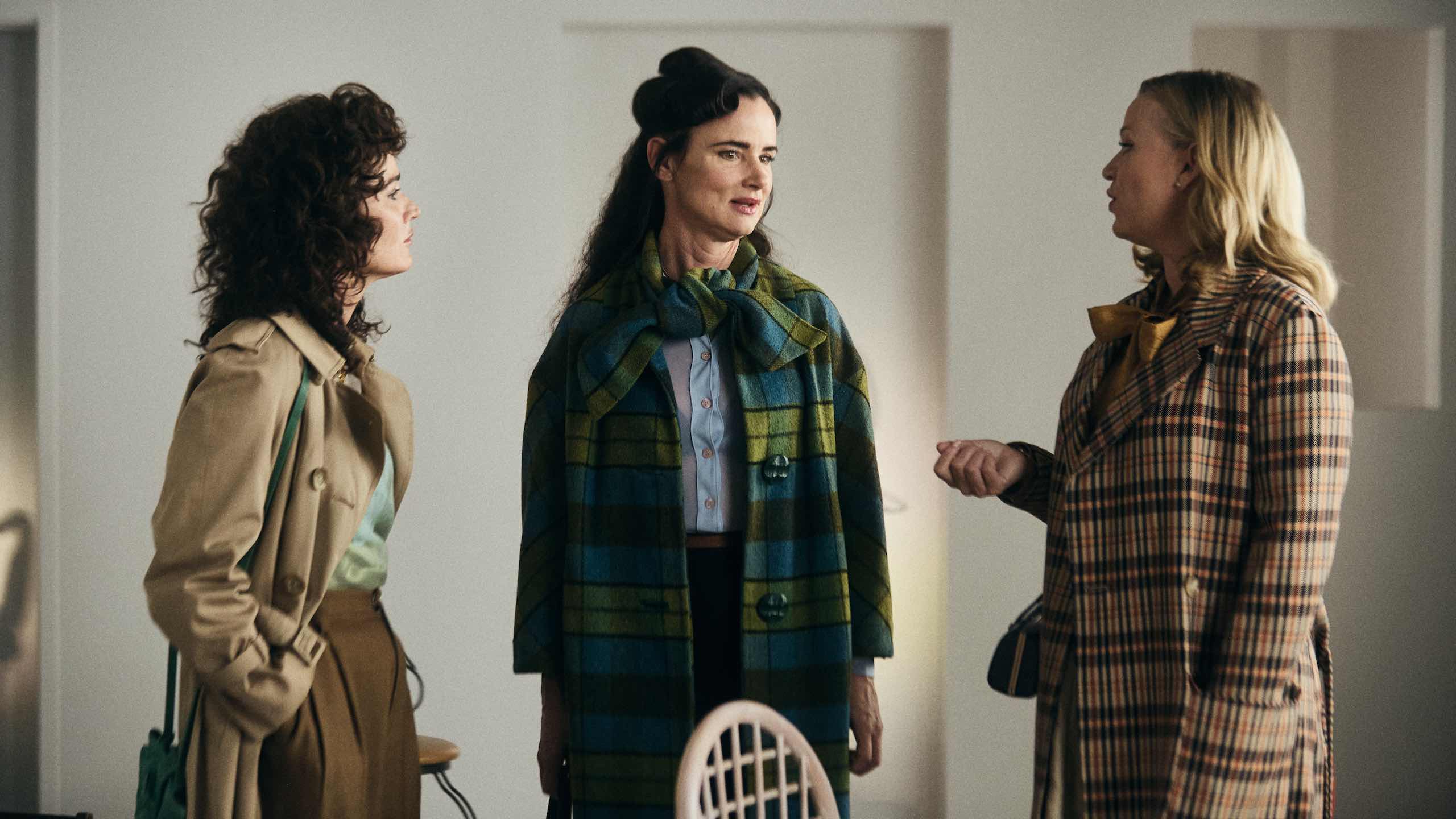


I adore an audacious, obsessive work of art that evades and actively resists categorization, and By Design swings for the fences. The new film is a poetic, satirical, surreal odyssey that stretches the body-swap genre to its absurdist limits. The brainchild of writer/director Amanda Kramer, the film stars Juliette Lewis as Camille, a woman who becomes a wooden, elegantly designed, sinuous chair—a logline that demands attention.
The film’s premise is arresting enough to attract curious viewers, though audience reactions have been varied. Some critics have recoiled at its weirdness, while others have reveled in its Lynchian sensibilities and Waters-esque ethos. Ultimately, if you’re a viewer who’s intrigued by arthouse experimentation, extended metaphors, and/or lyrical framing, By Design is captivating. It’s highly curated and choreographed, but humor and sincerity are also present in the artifice. Conceptual in approach, the movie remains grounded in familiar quotidian concerns: malaise, capitalism, identity, and desire.
That vision is realized by a formidable cast. Samantha Mathis and Robin Tunney—who join Lewis to form the film’s central trio—shine as Lisa and Irene. Mamoudou Athie is wonderful as pianist Olivier, the late Udo Kier makes a cameo in a kind of avant-garde seal of approval, and Melanie Griffith is our sultry narrator. Paired with other recent films like If I Had Legs I’d Kick You, Harvest, and Titane, By Design is another exciting, boundary-pushing film from an intriguing director (who also happens to be a woman) engaged in imaginative storytelling.
With the film hitting streaming this week, we spoke with Kramer, Mathis, and Tunney about the movie, but really just waxed poetic about the value of authenticity, risk-taking, and the state of the film industry. And, of course, I had to talk to Tunney about The Craft.
Voiceover can be a polarizing tool in cinema, but in By Design, it feels necessary. Why was Melanie Griffith the right speaker for the story?
Amanda Kramer: Melanie Griffith’s voice is…
Samantha Mathis: Like silk. It’s like butter.
Kramer: From my childhood in the ’80s, there are only a few actors whose voices are so distinctive. Your eyes could be closed, it could be raining, dogs barking, and you’d still say, “That’s Melanie Griffith!” The softness, the sincerity, the sexuality and sensuality, mixed with a sort of faux…not unintelligence, but a knowing she doesn’t fully reveal. It’s “foxy,” which we don’t really have in voices anymore. She takes work very rarely; she’s very picky, and why not be? But she said yes right away. I spent a day with her, and as she read a line out loud from the script, she turned to me and said, “Oh, that’s so sad.” And I said, “Me? Yeah. Thank you!”
Robin Tunney: We’re so conditioned to mansplaining. Narrators often sound like a telegraph from God. There’s almost an arrogance in the kind of narration we’re used to hearing, and [Griffith] doesn’t sound patronizing. If the narrator’s not in the movie, they’re generally these omniscient know-it-alls, and she’s so vulnerable.
Amanda, in a recent interview, you said that “nothing in Hollywood is cool,” but that you specifically cast actors who possess a certain innate coolness. When you were building this world, what was it about Samantha and Robin that fit By Design?
Kramer: There’s just no denying it; these are two of the coolest people. When they came of age in Hollywood, you could be a rarity, a true one-of-one. These two people are true one-of-ones. No one was trying to be Winona. No one’s trying to be Juliette. They were themselves. When you watch their early performances, you get blasted backward by the intensity and meaning coming off them. Throughout their careers, they just stayed so beautiful, of course, but so cool. There’s nothing inauthentic about these two people, and that is forever.

Mathis: I feel so blessed to have come up when we did in this industry. As young women discovered in our late teens and early twenties, it was such a different landscape. Was there misogyny in the business? Yes. Was there objectification of women? Yes. But when I look back on my young self and the way I was able to present myself—I mean, I wanted to be Meryl Streep—I wasn’t going to sell my body for press, and we weren’t expected or asked to. We were able to be cool in a different way, in an innocent time without cell phones or social media. We could be artists, be weird and quirky, read books, smoke cigarettes, sit in cafés, wear black all the time, and have our hair in our faces.
Tunney: I was just having this conversation with Jena Malone about the pressure on young women today with branding and Instagram. Everyone has a stylist; everywhere they go, they’re fully made up. We didn’t have vanities, so people could express themselves through what they wore and how they presented themselves. Now there are teams, and collaborations, and you really don’t know who somebody is in real life—filters, makeup, and money. It’s a machine. You know, Juliette had cornrows at the Academy Awards and wore a vintage dress, and that’s who she was. More women are writing for themselves and taking agency over their material, and culturally, things have improved, including how men are allowed to speak and behave.
Mathis: Amanda, you inspire me because you don’t ask for permission. You truly make movies on your terms, exactly as you see them. It’s deeply powerful, and you gave me permission to question why I’m still asking for permission. We’re conditioned in this industry to be infantilized, to rely on our representation, to rely on others to make things happen, and fuck that. That’s your ethos: Fuck that.
Tunney: And there’s no AI algorithm that can make an Amanda Kramer movie. Making something that makes you say “I’ve never seen anything like that” needs to be celebrated, because too often people are regurgitating what’s already been made or remaking things that don’t need to be remade. We need to celebrate what is truly unique.
“Making something that makes you say ‘I’ve never seen anything like that’ needs to be celebrated... We need to celebrate what is truly unique.” — Robin Tunney
Kramer: In the era when I was first engaging with Samantha Mathis and Robin Tunney [movies], you looked for the cool character and for the actor portraying them as a soul beacon that speaks to you through the screen. When you’re young, and you see Pump Up the Volume or Empire Records, you love everyone in the movie. I mean, I wanted to die and marry Christian Slater. [Samantha and Robin] played characters who made me feel looked at, thought of, communicated with—that’s a strangely spiritual thing. The two of them have been with me since my own soul mattered, so when it came time to write, there was no greater fortune.
I wasn’t going to say anything, but Robin, I’m clearly a The Craft girlie, and that was a pivotal moment for me seeing weird girls like me on screen.
Tunney: It’s all about the weird girls, which is why I think it permeated. It’s so wonderful to have people comment across generations. So many queer men have said, “You made high school bearable for a gay boy.” There are no gay characters in it, but it was made by a gay man, one of the first openly gay directors, and somehow, that permeated. It was about feeling different, feeling outside of something. In a John Hughes movie, it would have been one person in the corner, but [The Craft] was a movie where everybody was disenfranchised in their own way.

“There’s just no denying it; these are two of the coolest people. When they came of age in Hollywood, you could be a rarity, a true one-of-one. These two people are true one-of-ones.” — Amanda Kramer on Robin Tunney and Samantha Mathis
I was just reading some Letterboxd reviews of the film to see what audiences were saying, and I noticed a similar queer embrace of By Design as you described with The Craft. Is that something you’re noticing?
Kramer: The film is as it exists in my mind. Then I meet my actors, and something exists in their minds after they’ve read the script. The only thing that’s ever going to come out of it is our collaboration. Once that exists, we give it away; it’s no longer ours. If you see yourself in the character, it’s because we’ve done something beyond our earthly being, our mortal selves. We’ve spread ourselves out into the universal, which is difficult to do. We’ve had really amazing male filmmakers since day one, and they think very literally, mostly, and they think very linearly, mostly. Women are not like that. We dream, we are fantasists, and we’re able to skip around narratives. I mean, just talk to a group of women, the way they tell stories. It’s amazing, it’s never a beginning, middle, and end.
Tunney: I know this is going to sound hippie-dippie, but I think that an audience member can feel when the people who made the film love them. It’s in the fabric of the art, and there doesn’t have to be a character that’s exactly like them, but in the storytelling. People can sense if a filmmaker is homophobic, and it’s inexplicable. Cinema speaks to audiences when the people who make it love them.
Camille’s transformation into a chair in this film feels like a radical gesture of stillness. Has the film changed the way you think about stillness or escape?
Kramer: In this film, Juliette has to seem like she still has a self inside [while sitting completely still]. She’s gotta project something. I would tell her, “You have to think of something, you have to go somewhere, you have to be listening. Something will come through your eyes.” It was amazing to watch her do that, but also the way that Sam and Robin had to stand erect and not move very much. That’s such a difficult thing to say to an actor; it goes against their naturalism, against their bodies. They have to kind of pose. And posing in this movie is the part of the artifice that comes across in the subtext. They’re mannequins, too, and they’re thinking about themselves like they’re also beautiful chairs. So they have to stand on the exact sides of the chair, equidistant to the chair—annoying, annoying. I mean, I’m sure Wes Anderson is annoying people every second of the day, but it creates these beautiful images.
“[Amanda] gave me permission to question why I’m still asking for permission. We’re conditioned in this industry to be infantilized, to rely on others to make things happen, and fuck that. That’s [her] ethos: Fuck that.” — Samantha Mathis
How important is experimentation in film?
Kramer: What can you do if not experiment? [An actor’s job] is to receive, to see brilliance, to see the evocation, the provocation. Actors need to be experimenting because pages are not alive; actors make them alive. That’s why actors are so amazing, and their jobs are so important, and we cannot, not, not, not, not get rid of them for non-beings. A page is nothing. An actor gives everything—their eyes, their voice, their body. They need to be experimenting; they need to take the trip.
Mathis: As a filmmaker, you’re always experimenting, too, Amanda. The Pope had a summit recently with filmmakers, major movie stars, directors, and creators, and he said you have a moral obligation to continue to make movies, a responsibility as creators to reflect humanity back to itself. If we just keep making the same shit over and over again, what are we telling human beings about their life experiences? How are we reflecting on the absurdity of living in 2026?
Tunney: There’s become less and less room for experimentation. Everything’s owned by a corporation now. It’s very transactional. As things are getting more expensive, [the studio heads] ask, “How are we going to get our money back?” It really narrows the margin for magic. The only way to change that is to go and see the ones that are different, and celebrate them, and tell your friends, because [the higher-ups] want to make sure there’s no room for movies like this—that everything is regurgitated, and you know exactly what you’re going to get. As an actor, we all started doing this because we’re like carny folk. I want to play in the sandbox and never know what I’m going to get. It could be diabolical, or it could be amazing.
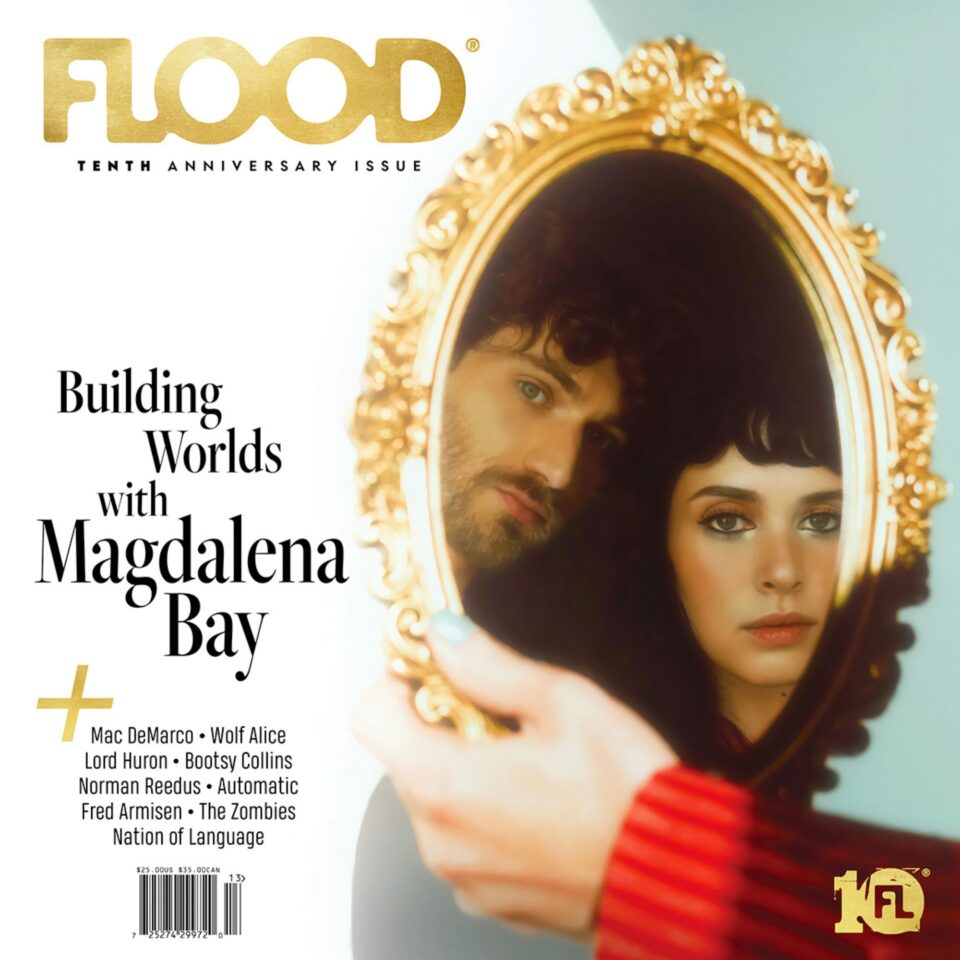
Amanda, you’ve directed several music videos for our recent cover stars, Magdalena Bay. I’ve heard whispers about an upcoming project you’re collaborating on with them—can you tell me more?
Kramer: It’s so important when I work with [artists] that I get to work with them again, because the conversation has to keep going. But yeah, the Mag Bay project is in post and will screen this spring! I [also] wrote an action film. I mean, to me it’s an action film, but god only knows what everyone else thinks it is. FL

