
For nearly four decades, one of New York City’s most unique Lunar New Year celebrations has been the annual Tibet House US Benefit Concert, where an eclectic lineup of artists gathers to collaborate, perform, and celebrate Tibetan culture while raising funds for cultural preservation. The concert is organized by Tibet House US, a nonprofit cultural center founded at the request of Tenzin Gyatso, the 14th Dalai Lama, to help preserve Tibetan culture in exile.
Now in its 39th year, the event returned to Carnegie Hall on Tuesday night. While the evening celebrates art and community, it has also long served as a space to acknowledge the harsh realities of global events and the importance of compassion and activism. Tibetan scholar and Tibet House co-founder Robert Thurman delivered his annual onstage address, reflecting on the tension between celebration and uncertainty. He acknowledged that the world may feel filled with turmoil and anxiety, but reminded the audience that celebrating life’s blessings—family, friendships, and the beauty of the world around us—is essential. “We cannot allow the bad to stop everything in our lives,” he told the crowd. The theme resonated throughout the night, with many artists referencing conflict and unrest at home and abroad through their remarks and song choices.

The evening began with traditional chanting by the Drepung Gomang monks, grounding the concert in Tibetan spiritual tradition. The first guest of the night was a last-minute addition to the bill: Robert De Niro, delivered a powerful reading from Abraham Lincoln’s Lyceum Address, a speech focused on the preservation of democratic institutions. The message felt particularly timely. Earlier this year, the concert’s founder and artistic director Philip Glass withdrew from a planned performance at the Kennedy Center where he was scheduled to premiere his Symphony No. 15 “Lincoln.” De Niro’s reading appeared to echo the concerns that fascism isn’t just a threat to democracy, but to the arts, as well. The Philip Glass Ensemble took the stage to perform “Train / Spaceship” from Glass’ landmark opera Einstein on the Beach. The piece’s urgent, repeating motifs filled the hall in a hypnotic wave. When the performance concluded, the musicians pointed to the balcony where a spotlight revealed Tibet House founder and artistic director Glass himself—present, as always, even if not onstage.


Robert Thurman

Laurie Anderson and James Austin Johnson
Tibet House mainstay, Laurie Anderson then took the stage alongside violinist Martha Mooke and the GRAMMY-winning Scorchio Quartet, backed by the evening’s house band consisting of bassist Tony Shanahan (of the Patti Smith Band), pianist/organist Todd Caldwell, percussionist Brian Griffin, and guitarist Andy York. Anderson performed “Walk on Water,” culminating in an inventive moment where she turned her jacket into a musical instrument using trigger pads to generate beats. Over a bed of ethereal sounds, she spoke about the current political situation: “Meanwhile, our entire government has disappeared, evaporated. Gone almost overnight. What do you do when you lose your country? Where do you go? I’m thinking of the Russian writer Vasily Rozanov, who said: ‘It’s like when the show is over. The audience gets up to leave their seats. Time to collect their coats and go home. They turn around. No more coats and no more home.’”
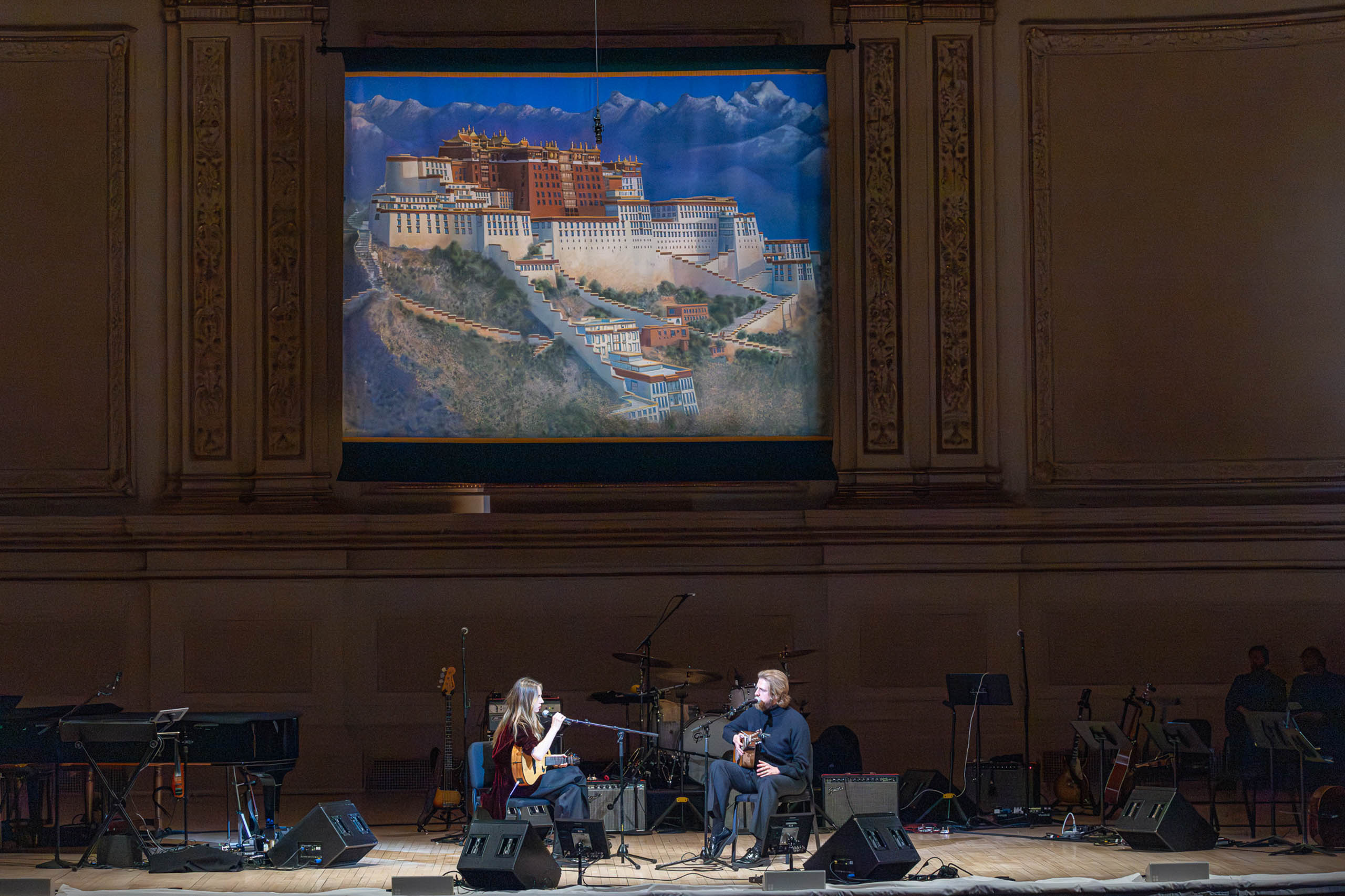
Anderson then welcomed James Austin Johnson, known for his Donald Trump impersonation on Saturday Night Live, for a dramatic reading of Allen Ginsberg’s “Ballad of the Skeletons.” Anderson closed her set with “Lucid Dreaming,” though she’d return to the stage several times throughout the evening. Afterward, Christian Lee Hutson returned following last year’s performance with Maya Hawke. Hutson debuted a new, as-yet-unfinished song before welcoming his now-wife Hawke to the stage for a duet of “Devil You Know,” trading guitar and vocal duties. Robert Thurman returned to the stage to introduce Tibetan exile and musician Tenzin Choegyal. Before that, though, Thurman gushed about his granddaughter and her new husband. Choegyal, known for his haunting vocals, playing both the flute and dranyen, performed a piece inspired by the poem “White Crane,” accompanied by Laurie Anderson and Martha Mooke.

Maya Hawke and Christian Lee Hutson
He was later joined by pianist Alex Gray, the Scorchio Quartet, and New York’s Resistance Revival Chorus, a NY-based collective of women and nonbinary activist singers, for a stunning rendition of “Snowy Mountains (GangRi).” The chorus remained onstage to perform “Woke Up This Morning (With My Mind Stayed on Freedom)” by Reverend Robert Wesby. A member of the chorus took the mic and told the audience about who they are and what their mission is: “We are out in the streets and we hope to see you out there too!’ she proclaimed.
For the second year in a row, Allison Russell appeared on the bill, bringing several collaborators with her including Ganessa James, poet and musician Kara Jackson, and fellow Hadestown cast member Morgan Dudley. Together they delivered a powerful rendition of “Hy-Brasil,” followed by “We Raise Our Cups” from Hadestown. Toro y Moi also joined Russell for a duet of The Rolling Stones’ “Wild Horses” before performing his own set. Highlights from his set included his song “Undercurrent” and a surprising piano-led cover of Paul McCartney’s “Maybe I’m Amazed,” backed by the house band and Scorchio Quartet.

Jesse Malin

Elvis Costello
One of the evening’s most emotional performances came from New York rocker Jesse Malin, who recently suffered a stroke that left him paralyzed from the waist down. Unfazed, he took to the stage in a wheelchair and delivered one of the night’s most electrifying performances. At one point he stood at the microphone on his own to belt out “Meet Me at the End of the World,” drawing a thunderous response from the audience.
The night took an unexpected turn when Debbie Harry of Blondie was forced to cancel due to illness. Enter: Elvis Costello, who explained that he was in Nashville when Laurie Anderson called to ask if he could step in. “When you think of Debbie, you think of who else? Me,” he joked. While fans were disappointed to miss Harry, Costello delivered a fiery set that included a Blondie cover and the blistering “We Are All Cowards Now,” repeatedly asking the crowd, “Which side are you on?” He closed with a rousing “(What’s So Funny ’Bout) Peace, Love and Understanding.”

The evening concluded with the always-luminous Kate Pierson of The B-52’s, who walked out in silver platform boots and her signature red hair shining under the stage lights. She performed The B-52’s classic “Revolution Earth” backed by the Resistance Revival Chorus. Time constraints forced her to cut two songs—including fan favorite “Roam”—prompting a collective groan from the crowd. Instead, the entire evening’s lineup joined Pierson and the chorus for the traditional closing song, Patti Smith’s “People Have the Power.” The audience were on their feet chanting the chorus, a message which seems needed now, more than ever.
Next year marks the 40th anniversary of the Tibet House Benefit Concert, and with the way things are going, we’re going to need it more than ever.
Check out more photo highlights from Tibet House 2026 below.


Laurie Anderson


Elysian Fields

Christian Lee Hutson

Maya Hawke and Christian Lee Hutson

Robert Thurman and Tenzin Choegyal

Laurie Anderson and Tenzin Choegyal

Tenzin Choegyal


Toro Y Moi and Allison Russell

Toro Y Moi

Jesse Malin

Elvis Costello

Elvis Costello

Kate Pierson

Kate Pierson
