


“We’re not so different, you and I,” says perhaps the most handsome and charismatic movie star of his generation to a pile of misshapen rocks deep in the recesses of outer space. The first trick IMAX epic Project Hail Mary pulls off is convincing us that this is, in fact, quite true. The second is that we don’t collectively groan at such a well-worn trope made so plain.
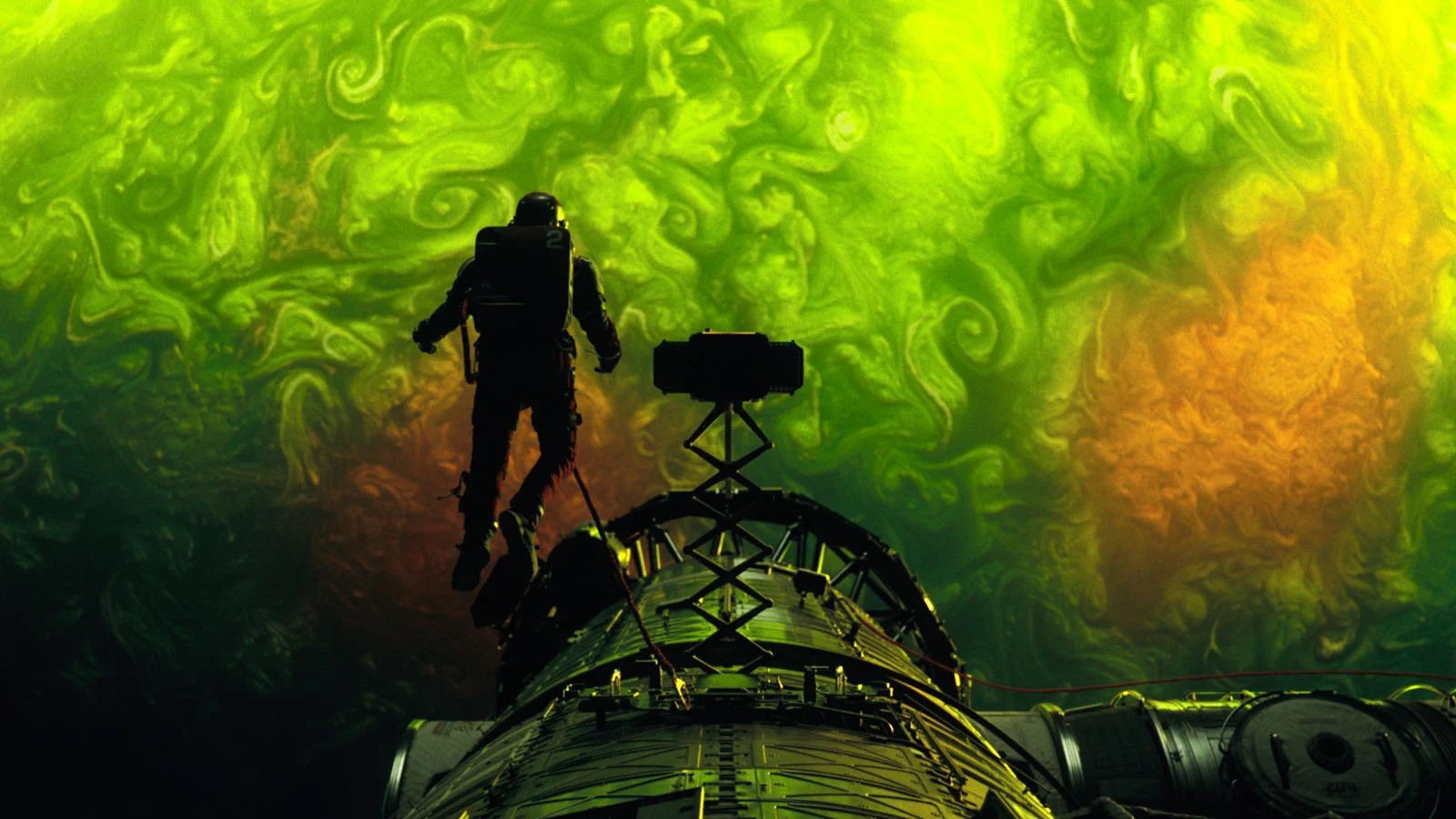
The movie star in question is Ryan Gosling, here playing Dr. Ryland Grace, an unassuming science teacher who, as it turns out, is also a brilliant yet somewhat disgraced molecular biologist. When we meet Grace, though, we don’t know any of that, and neither does he. Instead, we wake up right alongside him, begraggled, confused, and alone aboard a space ship some light years away from home. It’s a move screenwriter Drew Goddard takes directly from writer Andy Weir’s best-selling novel of the same name, and an effective one. While it doesn't take long to get a bigger picture of his mission—one aimed at studying the biology of a sort of alien bacteria currently eating away the life force of our one and only sun—Gosling’s bumbling everyman allows info to be exposition that slowly gets parsed without the tediousness of similar space epics.
It’s also precisely why you get this specific movie star. There’s perhaps no one doing the smart dumb-guy routine better than Gosling, who can fiddle helplessly with knobs and buttons one moment and do complicated calculations the next without ever really losing us along the way. The joy in Weir’s novel (especially in the first half) lies in Grace’s methodical realizations, his memory flashing back to life in bits and pieces as he pastes together the larger mission and his own place within it. This isn’t inherently cinematic stuff, so the fact that Gosling can hold our attention with bits of physical humor and tossed-off asides to some near-sentient computer system gives the film a lot of leeway as it rifles through its first act.
Which brings us to the real heart of Project Hail Mary: the friends we made along the way. Grace is not as alone as he might imagine on his mission. As it turns out, Astrophage, that pesky microorganism hurtling us toward early extinction, is not the bane of humankind alone. Enter Rocky: an adorable little creature from a race of hyper-intelligent rocks. It’s here that co-directors Phil Lord and Christopher Miller face their biggest challenge. As much as Dr. Grace is the engine and audience-surrogate of both the film and the 2021 novel, Rocky is the star. Communicating through the universal language of science, Rocky and Grace manage to triangulate their shared crises, trauma bond over their hatred of Astrophage, and gently rib each other over the absurdities of their disparate cultures. Grace teaches Rocky to be human; Rocky teaches Grace to be Euridian; they teach each other the true value of friendship. And somehow, in about 45 minutes of screen time, you’re ready to give your life for this little rock puppet’s entire species, perhaps even over our own.
For this to work, Lord and Miller—writer/producers whose directorial work all but came to a halt after 21 Jump Street and The Lego Movie—needed to nail pretty much every aspect of the way this relationship plays out on screen, from the stilted communication to the way Rocky careens through Grace’s ship to the form he takes. Having read the book, this was the primary question I had about the whole endeavor, as Rocky could’ve been anything from a CGI blob to a sort of formless voice from the shadows. But their decision to make him a puppet, in all the clunky, tactile glory this suggests, was brilliant and pretty much trumps any other decision they needed to make.
The other challenge, of course, was to turn a 500-page book—one dense with scenes of the scientific method undertaken in minute detail—into a compelling feature-length film. To do this, Lord and Miller needed to stretch and compress space-time itself, and in that, too, they mostly succeed. While the flashbacks at first serve as a way of explaining just how Dr. Grace ended up in that mess, then expand to describe how screwed we are if he fails in his mission, they eventually begin to feel like B plot distancing us from the two friends we’ve grown to love. It’s not that Sandra Hüller as mission leader Eva Stratt isn’t uncompelling, it’s just that she’s no Rocky. Here’s hoping he can land a five-picture deal with Amazon Studios after this breakout.
The plot, too, becomes a bit cumbersome as things progress. Weir is a writer who loves throwing a wrench into the gears of his story, each success only the beginning of the next emergency. But when grafted onto a feature, this can make an epic conclusion hard to muster. There’s yada-ing going throughout the final act, to be sure, but even that doesn’t manage to fully distract from what really matters: two pals strolling down a bioengineered beach, the stars of their solar system shining bright.
