
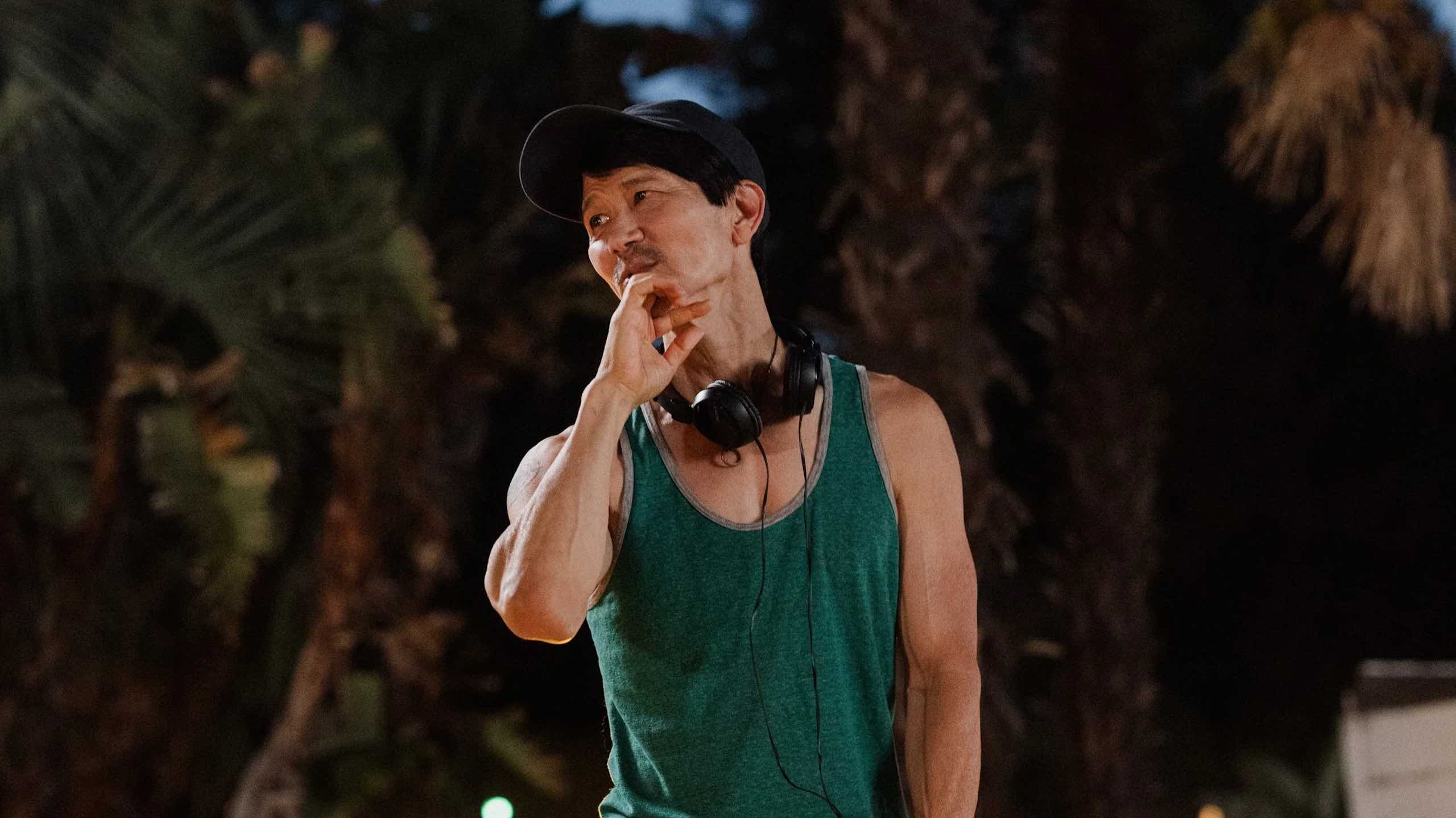
For over three decades, Gregg Araki has thrilled American audiences with his cult-classic films delving deep into the psyche of the nation’s repressed youth. As a pioneer of the New Queer Cinema movement in the 1990s with films such as Totally F***ed Up, The Doom Generation, and Nowhere—a.k.a. his “Teenage Apocalypse Trilogy”—Araki immersed audiences in his erotic and nihilistic world, centering his stories around compelling protagonists trying to find their place in society.
Marking his first feature film in 12 years, and following his 2019 venture into TV with Starz’s Now Apocalypse, Araki’s new project I Want Your Sex revisits these familiar themes, following a protagonist searching for purpose while undergoing a sexual awakening. The film tells the story of a young college graduate (Cooper Hoffman) who’s hired as the assistant to provocative pop artist Erika Tracy (Olivia Wilde), who chooses him to be her sexual muse in a dominant-submissive relationship. What starts as a dream soon spirals into obsession and betrayal.
With the film hitting theaters this weekend, we spoke with Araki about developing the script over the course of 14 years, adapting both lead characters from his own experiences, and more.
The spec script for I Want Your Sex landed on your desk in 2012. How did the movie change and take shape over that time?
It’s changed a lot. The original spec script was pitched to me as a “comic Fifty Shades of Grey.” It was about a female intern and a male boss and it didn’t have any of the film noir elements. But also, after #MeToo, I started to feel uncomfortable with a woman getting dragged around by the hair, so the sex roles got flipped to a male sub and a female dom.
More and more, the story veered in this direction where the distance between me and Erika Tracy got less and less, in the sense that a lot of things Erika says in interviews were actually things I’d said in interviews about sex and art. My work, like Erika’s, is about sex—it’s controversial, it’s provocative and polarizing for some people. I became very invested in Erika’s character and she became, in a way, a mouthpiece for me. A lot of the things she says in the film are my reactions, particularly in the couch scene when she’s talking to Cooper about Gen Z not having sex. It’s like, “What’s with your generation? Why aren’t they having sex?” Sex is such an important part of my work, but also my journey as a person.
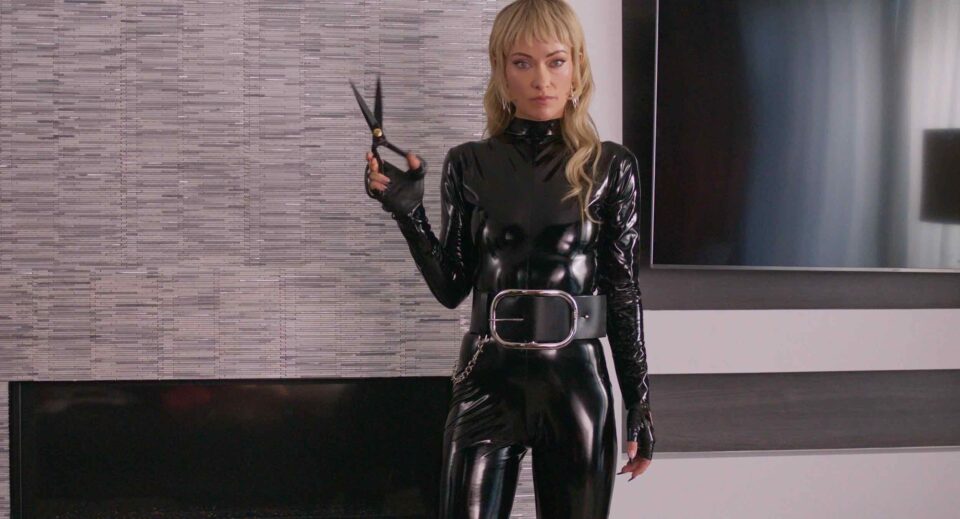
“My work is about sex—it’s controversial, it’s provocative and polarizing for some people. I became very invested in [Olivia Wilde]’s character and she became, in a way, a mouthpiece for me.”
Was it hard to create that distance between yourself and Erika? Or did you just let it flow naturally?
The process of working on the script took years. I wrote 10 or 11 drafts, so it was constantly evolving. There was a point—pretty much after Now Apocalypse, because the interviews I was doing for that project hinged on sex and sexuality—where I started relating myself to that character. Obviously, I don’t do the inappropriate things that Erika does, like sleeping with my employees. But I really related to her passion, her creativity, and her boldness in pursuing her vision.
The cast seemed really engaged and insightful with regard to the themes of the film. How did you create that atmosphere on set, and what’s your process for choosing actors who will dive in head first?
I’m one of those directors who believes directing is 99 percent casting. I have a picture in my head of the characters, and I’m really specific during casting sessions—I’m looking for that spark. This cast is literally one of the most fantastic I’ve ever worked with. They were all incredible and brought so much to their roles, really bringing those characters to life. It was so fun to watch them together. They’re all great actors individually, but then you see the dynamics. Cooper Hoffman, in particular, is such a great actor. He’s so real, authentic, and accessible, as everybody loves him and roots for him. Then, seeing him work with Olivia, Mason [Gooding], Chase [Sui Wonders], and Roxane Mesquida—everyone has a different acting style and energy, and watching those different combinations was always super fun for me.
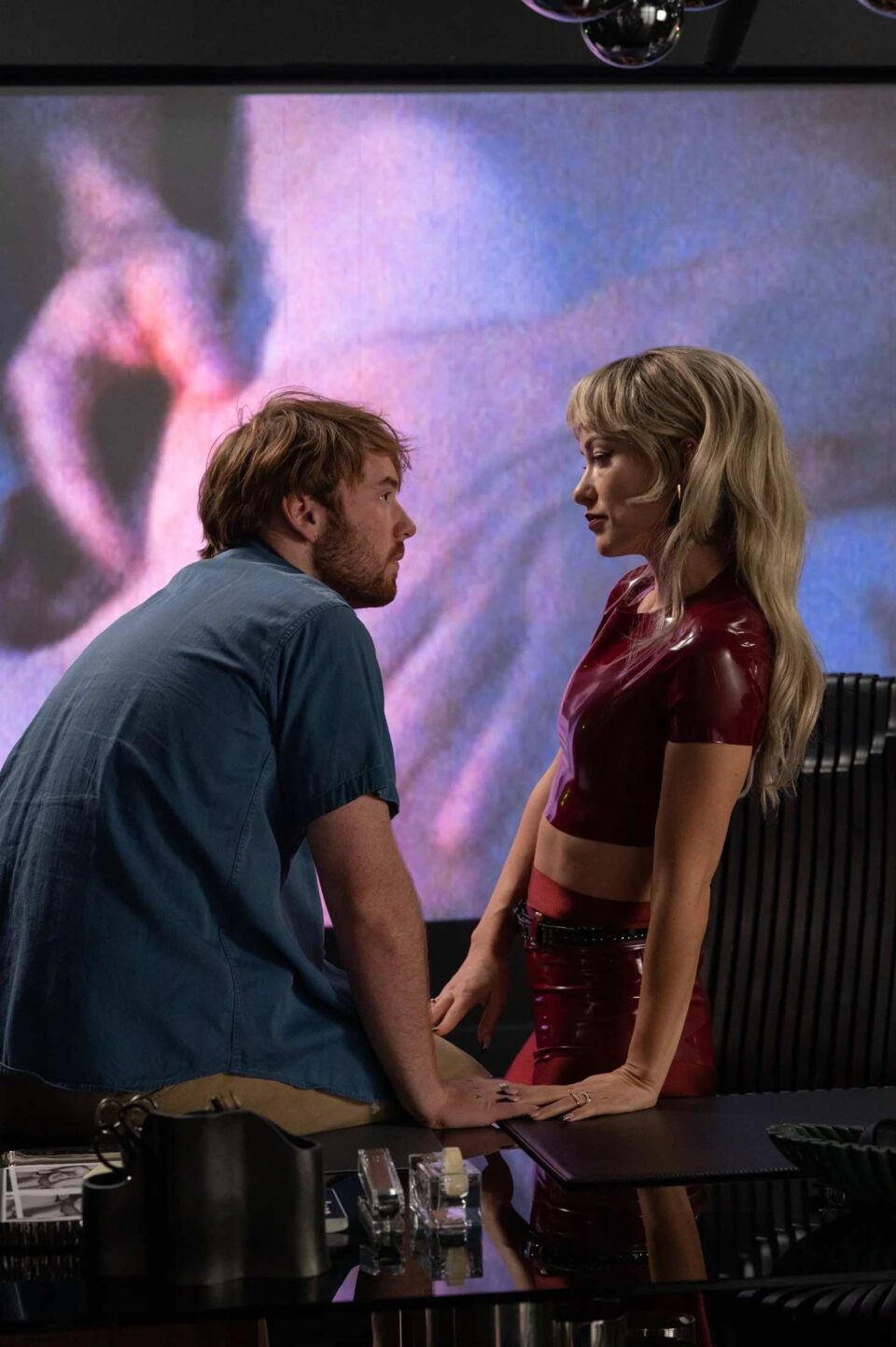
“I like my movies to feel like movies. They’re not documentaries about somebody’s gray world. The worlds in my films have more style, vision, color, design.”
There are so many interesting shots. Do you plan camera placements in advance, or are they more spontaneously feeding off the energy on set?
My movies are all very pre-planned, because they’re indie movies shot on a very tight budget and schedule. It’s not like we go to set and say, “Let’s just be creative.” It’s very much, “This is how we’re shooting this.” I have it all in my head, and it’s really a matter of just actualizing that. For the shot where Cooper falls into the Vertigo well, we planned exactly what it was going to be. He would be laying on a green screen and the camera is moving away from him, so it creates a feeling that he’s falling. It’s all part of the design.
I loved the visuals and set design. What inspired Elliot and Apple’s flat? It almost reminded me of Alex’s house in A Clockwork Orange.
That’s really just part of my style. My movies are not real. They’re not necessarily naturalistic. Almost all of my movies take place in a heightened world where things are accentuated: the colors are brighter, the costumes are crazier, and the set design is a little bit wonky. It’s a level of expression that interests me. I like my movies to feel like movies. They’re not documentaries about somebody’s gray world. The worlds in my films have more style, vision, color, design.
I noticed that Elliot has the same knuckle tattoos as you. Who did it first?
I’ve had those tattoos for a while. It’s another example of how much of myself is in these characters. There’s a lot of me in Olivia’s character, but there’s also so much of me in Cooper’s. I really related to him because I saw myself when I was that age, 21 or 22, and trying to figure out my life, wanting to be an artist, not knowing my place in the world or who I was. I was working through my sexuality. It’s such a tender but cool and fascinating age. It’s a confusing time, but so rich in experience and emotional ups and downs and all the things that happen to you when you’re young. We gave Cooper these tattoos and he actually went out and pierced his ear. I wanted him to have that vibe of how I was when I was an artsy kid back in the day. FL
