
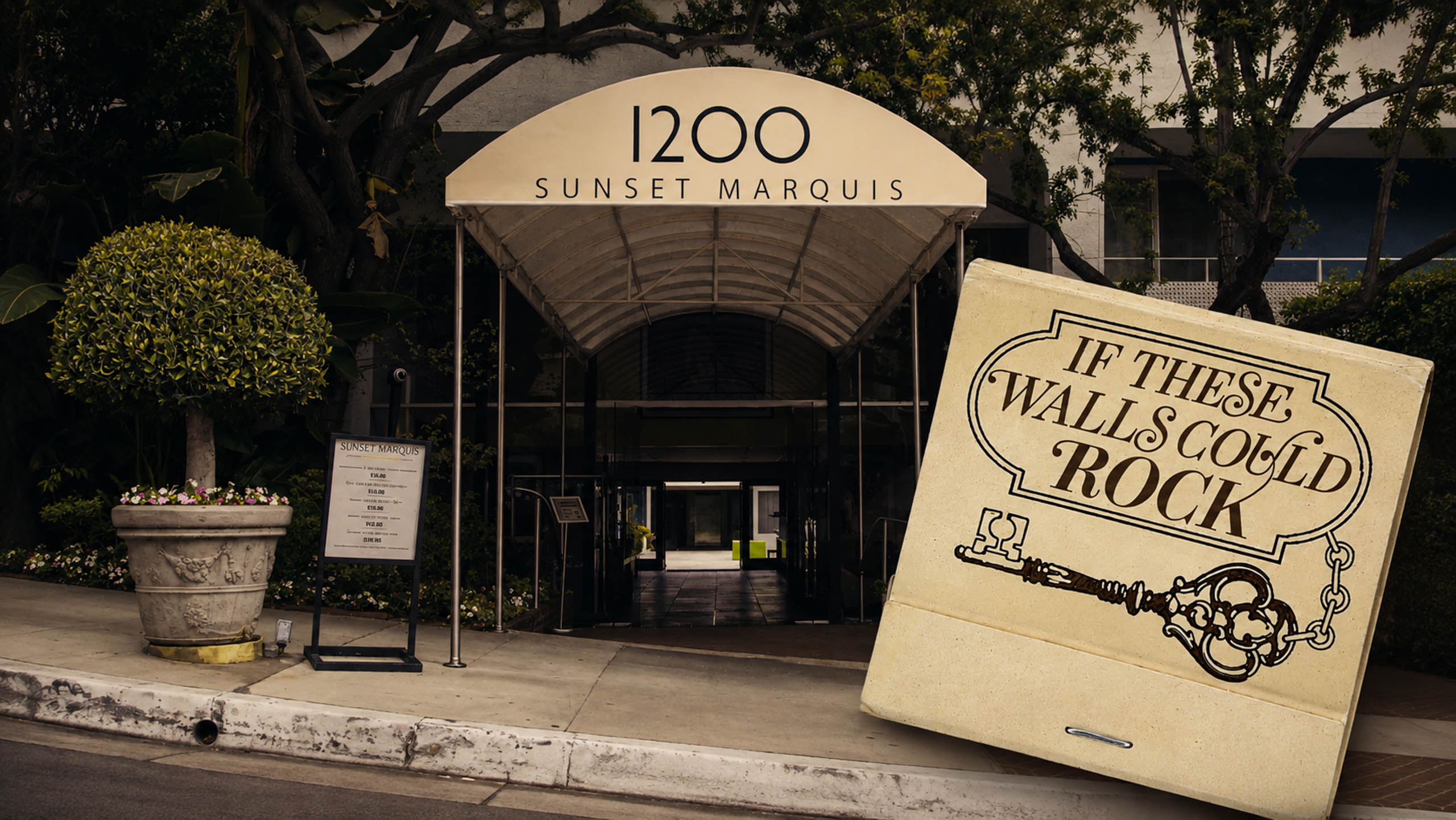



Los Angeles has no shortage of rock ’n’ roll hotels. There’s the Chateau Marmont, where Jim Morrison famously fell two stories; Le Parc at Melrose, immortalized in Blur’s “Trimm Trabb”; the Continental Hyatt House (a.k.a. Riot House, now the Andaz West Hollywood), where Led Zeppelin’s debauchery became legend; and the Sunset Marquis, where Morrissey once set up residence. Much of my professional time has been spent in these establishments interviewing bands. But the first time I arrived at the Sunset Marquis—its stylish lobby, lush grounds littered with oases tucked behind foliage, garden hideouts reached by stone steps and stark white buildings—it made me realize that only artists of a certain level of success stay here. Then I saw Slash standing in the pool in swim trunks, complete with top hat and sunglasses, and knew I was right.
Anyone who’s set foot inside the Sunset Marquis has a story about who they saw there. Even the biggest names in music have stories about other big names they’ve encountered. These are the people who make up the bulk of If These Walls Could Rock, a new documentary about the storied hotel, directed and produced by Tyler Measom and Craig A. Williams. As I enter the lobby to meet the filmmaking duo, Nile Rodgers—one of the talking heads in the film—brushes past me on his way out, natch. In 2019, I interviewed Liam Gallagher in his suite here. Many years before, I interviewed Jason Mraz outside one of the villas—the first time I saw those structures, and the first time I realized there was another pool. I walked past a tribe of Morrissey fans camped outside when I came to interview Peter Hook. I stayed up with Daddy G of Massive Attack as he put together a playlist for the DJ set he was doing the next day on KCRW’s Morning Becomes Eclectic.
Perhaps most memorable was interviewing Happy Mondays’ Shaun Ryder at the time of his Black Grape project while he was on a heroin nod that I mistook for jetlag. Later, his partner, Donovan’s daughter, Oriole, asked me if I took narcotics and did I want to do them with her in the lobby bathroom. I said no, but that I would stand watch while she partook. It’s these kinds of memories that are the throughline of the new film—they’re just a lot more exciting when the people telling them are Bruce Springsteen, Ringo Starr, Dave Grohl, Simon Le Bon, Roger Daltrey, Billy Gibbons, Nancy Wilson, Gene Simmons, Sheryl Crow, Cyndi Lauper, Slash (of course), Richard Marx in a peekaboo hotel robe, and, best of all, Morrissey.
This is Moz like you never thought you’d see him: In blue-and-white-printed pajamas with the top unbuttoned, he’s lounging next to a poster of Poly Styrene on a cloud-like bed with oversized pillows and a downy comforter, everything snow-white against a tufted silver headboard. “The fact that he agreed to do it, we were just like, ’Holy shit! Can’t believe this is happening,’” says Williams of the film’s primary source of comedic relief. “He was the nicest guy I’ve ever met. He loves this place. A movie is being made about it, he has to let everyone know that this is his place, and he has his own story here. There’s certain staff members that he has a really close relationship with. There was a butler here who’d make these vegan pies for him at home and bring them to him here at the hotel. He felt taken care of. He has an affinity and a loyalty to this place. Add some blue skies and some palm trees, and it fulfills this fantasy he grew up with about Hollywood.”

Craig A. Williams and Tyler Measom / photo by Diana Fiel
“We had to find ways to be creative with hitting the moments we thought were important... There’s the rise. There’s the fun part. There’s the crisis, and there’s either death or reinvention. And for the most part, we told the reinvention.” — Craig A. Williams

Kelly Osbourne / photo by ony Johannson
The film’s origins trace back to the Sunset Marquis’ 50th anniversary in 2013. The hotel’s President/CEO Mark Rosenthal—son of its originator, George Rosenthal—commissioned Williams to write a book about its history. A one-time hair-metal band reject, Williams says in the late ’80s he was playing afterparties at the Travelodge on the nearby corner of Highland and Hollywood, aware that Guns n’ Roses and The Black Crowes were partying nearby. He eventually put down his guitar and completed an MFA at USC instead. His memoir caught Rosenthal’s attention. Suddenly, “I was on the inside of this place I had always heard about, but would never dare set foot in, and I’m hanging out with Slash, Steven Tyler, and Chris Robinson,” he says. Meanwhile, Measom was directing the Paramount+ series I Wanna Rock: The ’80s Metal Dream when he brought Williams in as a talking head. Williams, in turn, gave him a copy of his new book If These Walls Could Rock: 50 Years at the Legendary Sunset Marquis Hotel, and the film was underway. It took three years to make, with the hotel’s general manager, Rod Gruendyke, assisting with interview suggestions.
In addition to musicians, photographers Ross Halfin, Bob Gruen, and Timothy White provide plenty of color. Photographs are a hallmark of the Sunset Marquis. Framed images line the walls, many of them shot onsite. The Morrison Hotel Gallery, a small art space in the lobby, has frequent photo exhibitions—another celebrity-spotting destination. The stories are sordid, but delicious. They hit hardest when a familiar musician’s voice narrates a particularly outrageous scene, rendered here in animation. Iggy Pop doing laps in the pool, swimming from a girl on one end to another on the other end, as told by Michael Des Barres in what’s clearly a staged trashed room at the Sunset Marquis. Or Steven Van Zandt talking about Jimmy Iovine arriving poolside with acetates of Born to Run, which Springsteen hated so much he threw them in the pool. Or Robinson describing Keith Richards walking around the pool with a pack of cigarettes and a knife tucked into either side of his Speedo, a piña colada clutched in one hand and a Heineken in the other.

“Documentaries have a tendency to be sad and dour. We wanted the film to match the spirit of the hotel itself: poppy and neon and bright and sunshiny—with a little bit of a dark underbelly.” — Tyler Measom


“One of the great things about the hotel, and the reason a lot of the artists keep coming back, is they don’t allow cameras,” says Measom. “We didn’t have many photos or video, so we knew in order to tell the stories, we wanted to do animation. But we thought it might be fun, in the spirit of this community of having multiple artists come together and create, so we had seven different animators. We said, ‘This is a script, but we don’t care what you do.’” Notes Williams, “In a weird way, it adds authenticity to the stories. They’re not necessarily documentaries of your memory. It’s usually a little crazy, a little off, more colorful.”
The film’s narrator and self-proclaimed mayor of the hotel is a chain-smoking Billy Bob Thornton, who seems like he’s playing the role of an irrepressible degenerate rock star in full cliché costume and vernacular. But like Morrissey, he’s a frequent and long-term resident of the hotel. A separate film could be made of the actors that come to the Sunset Marquis, particularly during the era when Rande Gerber was the proprietor of the lobby bar. The film has ’90s footage of Brad Pitt, Angelina Jolie, Nicolas Cage, Paris Hilton, George Clooney, and Ben Affleck, among others. “They were drinking here, but they weren’t staying here,” Meason notes. “They weren’t sleeping here. I mean, they might have rented a room for a couple of hours.”

Billy Bob Thorton / photo by Tony Johansson
The film is nonlinear as it unpacks the hotel’s origins as a place for Bunnies from the nearby Playboy Club to stay. We see George building up real estate holdings while being a world-class philanderer and the financial struggles of the hotel; we see Mark’s continued hard work to revitalize it and continue to keep it afloat; we see the debauchery of the musician guests—most notably in the ’70s, a bit less in the ’80s, even less in the ’90s, and continuing to dwindle. But if there’s a commonality in different artists’ experiences at the Sunset Marquis, it’s a sense of safety, protection, and feeling at home. “We were trying to tell several parallel stories at the same time, and those don’t always line up the way that you want them to,” says Williams. “We had to find ways to be a little creative with hitting the moments that we thought were important. There’s a similarity between the arc of the history of the hotel and the history of the relationship between Mark and George, and the life of a rock star. There’s the rise. There’s the fun part. There’s the crisis, and there’s either death or reinvention. And for the most part, we told the reinvention.”
“Mark says it in the movie: ‘The hotel was birthed at the same time as rock ’n’ roll,’” says Meason. “It went through the same evolution as rock ’n’ roll: the fun swinging ’60s into the crazy debauched ’70s into the happy, cheerful ’80s, and into the depression of the ’90s. Literally and figuratively, it fell apart, and it had to go for a reinvention. Now it’s more about what’s Instagrammable than throwing a TV out the window. From the onset, our goal was, ‘Let’s make something that’s fun.’ Documentaries have a tendency to be sad and dour. We wanted the film to match the spirit of the hotel itself: poppy and neon and bright and sunshiny—with a little bit of a dark underbelly”

Morrissey / photo by Dan Adelstein)
“What the Sunset Marquis does really well is embrace the past, celebrate it, and they’re aware that it made them what they are, while also evolving into something else.” — Craig A. Williams

Dave Grohl / photo by Tony Johansson
Outrageous stories aside, If These Walls Could Rock is, at its core, a story about a father and son. Neither George nor Mark Rosenthal sugarcoat the negative experiences, their questionable choices, or the effect those choices had on the people around them. Mark doesn’t make excuses for his father’s behavior, and George doesn’t expect to be forgiven. “[George] didn’t come out looking good,” admits Meason. “[Mark] actually said some bad things about his dad in the film and that was kept in, which was important. This is a real person with real foible, real downfalls, but you also understand why he was that way given his upbringing, given the temptations of what he was surrounded by. He’s a flawed human being, but a human being.”
“We were surprised at how open and thoughtful and almost organized Mark’s thoughts were about his childhood and about his relationship with his father,” says Williams. “They’ve clearly gone through a lot of therapy to work through whatever they went through together. When somebody’s that vulnerable with you, you have to protect that, and it became the heart of the movie.”
“We’re watching these people ruin their lives. That’s why we had that element of, ‘Yeah, we partied a lot, but we needed to get sober at some point.’ That’s a reflection of the hotel, as well.” — Tyler Measom
While musically and culturally historic spots in Los Angeles are under constant threat of being torn down to make way for more personality-free blocks of housing, the Rosenthals keep the Sunset Marquis operational—even though it’s clear that there’s no way the place is solvent. Still, sitting in the outdoor area of Cavatina, the hotel’s restaurant, the noise of a $30 million renovation project for the John Barrymore estates on the property threatens to drown us out. But we can hear The Smiths’ “Panic,” which starts as we sit down—a coincidence that has us all laughing. “What the Sunset Marquis does really well is embrace the past, celebrate it, and they’re aware that it made them what they are, while also evolving into something else,” says Williams.
The evolved version of the hotel is the one I’m familiar with: an elevated hotel where misbehavior is far from encouraged. “The stories are funny, but you’re also like, ‘Oh, that’s stupid,’” admits Measom. “It’s stupid to jump from the roof to the pool. Why do we revere people who, like Chris Robinson, tore the shit out of a hotel room? It’s childish and immature—even he acknowledges it was a stupid thing to do. We’re watching these people ruin their lives. That’s why we had that element of, ‘Yeah, we partied a lot, but we needed to get sober at some point.’ That’s a reflection of the hotel, as well. The hotel needed to get sober.
“This is where rock stars now bring their kids and go to the spa and work out, as opposed to throwing TVs out of the window,” concludes Measom. “They ask to have the mini fridge cleared out and have green juices put in. That’s how rock and roll is now.” FL

