


The cover of Cardinals’ debut album Masquerade is an immediately striking image. Titled Fristeren (The Tempter) and painted by Norwegian artist Oda Sønderland, the top half features a frostbitten woodland claimed by swathes of snow. What sits at its heart is a tree, its branches exposed as if containing a ribcage, or even a nervous system. It serves as an adequate metaphor for what Cardinals aimed to achieve with their first album. “It was something that Darragh [Manning], our drummer, came across first,” vocalist/guitarist Euan Manning says. “It was pretty early in terms of the writing stage when we found it, so in some ways it helped to influence the direction of the record.”
Formed by brothers Euan and Finn Manning, their cousin Darragh, and friends Oskar Gudinovic and Aaron Hurley, Cardinals are based in the Irish city of Cork. Since forming a few years ago, they’ve undergone various changes already: Their self-titled 2024 EP is the product of a band finding their feet, the songs straddling the line between swooning pop euphoria and more rollicking rock choruses. You can hear the foundations of the balladry that would form the basis of Masquerade on that release, but the new record has a greater grasp on specificity in its aesthetic—engrossingly dark at times and with arrangements that feel much denser, more capable of taking you on emotional journeys. The band haven’t just changed sonically, they’ve had a perspective shift about the type of writing that feels important to them. “Pretty early on in the writing stage, as we were finding our feet after the EP, we discovered that vulnerability was the only worthwhile thing pursuing,” Manning says.

When taking in the fragility of the album artwork—which also features on its bottom half a passionate scene involving forbidden fruits depicted in sensual reds—it’s easy to come to the conclusion that openness is the foundation of Masquerade. Realizing the importance of these themes wasn’t so much an epiphany as it was a natural factor of the band growing up and Euan honing his lyricism. In the months it took to write the album, it felt like the most natural form of expression. “[Throughout] the period between the EP and the album, it felt best when we played together, and [we realized] that it feels best when you finish writing something with honesty. We didn’t just use that [honesty] in the writing, but in the studio, too—the photos and the artwork.”
“Pretty early on in the writing stage, as we were finding our feet after the EP, we discovered that vulnerability was the only worthwhile thing pursuing.”
Manning isn’t interested in discussing the specific meanings behind the songs on Masquerade, and the band has stated that a lot of the narratives are fictional. They’d much rather have their listeners interpret the music on their own terms. “We’re pretty hesitant to say ‘yes’ or ‘no’ if someone interprets something a certain way, because it could make or break the record for them. I hope people can pull things from it, because I think it’s probably providing something for them in a way that it couldn’t if we just described it plainly.” But there’s a potential contradiction in their approach to the album: How can it be vulnerable, but also draw largely from fictional narratives? It’s about the subtext. Some of these songs lay upon the ragged shores of bygone romances. Although anything so dramatic may not have happened to Manning, the very real emotional throes of the record are akin to the unpredictability of life that we all experience. That’s where the vulnerability lies: in the actual experiences that Manning has had, which definitely bleed through in the emotional journey the album takes.

This isn’t just traced lyrically—you can feel it in the instrumentation, too. For example, Finn Manning’s usage of the accordion brings buoyancy to tracks such as “St. Agnes” before becoming a much more somber presence on the second half of the record, skulking in the background on “Barbed Wire.” “The Burning of Cork” is one of Masquerade’s most affecting and haunting tracks. While the record isn’t overtly political, the song has anticolonial overtones as it’s in reference to the razing of the titular city by British forces. The song has also been cited as being a reference to the current crisis in Gaza, where at least 70,000 Palestinians have lost their lives. “People will say that I’m comparing Cork to Gaza,” Manning clarifies. “Which I’m not doing, because Gaza is a genocide and no one died in the burning of Cork. They’re two very separate things. But there is a connection, as the soldiers—the Black and Tans unit that burned down Cork—were sent to Palestine after the War of Independence ended.”
Writing about the conflict within Cork was something that came “subconsciously” to Manning. The band never set out to write a song about such a violent chapter in history, but he believes that it’s a byproduct of the setting he was raised in. “You’re in a part of the country that was anarchy at times—there was a lot of fighting and reprisals,” he explains. “Violence is inherited and it bleeds down from parents, institutions, and governments. Witnessing beatings on Oliver Plunkett Street in Cork is a microcosm, but a window into bigger things.” It was this experience that influenced “Anhedonia,” with its cutting line of “I know I’m not the only one who suffers when suffering is done.” Acts of cruelty leave a variety of echoes, and trauma risks the threat of further violence in vicious cycles. And cycles of suffering can be traced from smaller incidents to wide-ranging conflicts. Either way, they’re likely to lead to further pain.

“Even though Cork is small, we’re enamored by its presence and character. It can get its hands on you, and I think it’s had an effect on every aspect of our characters.”
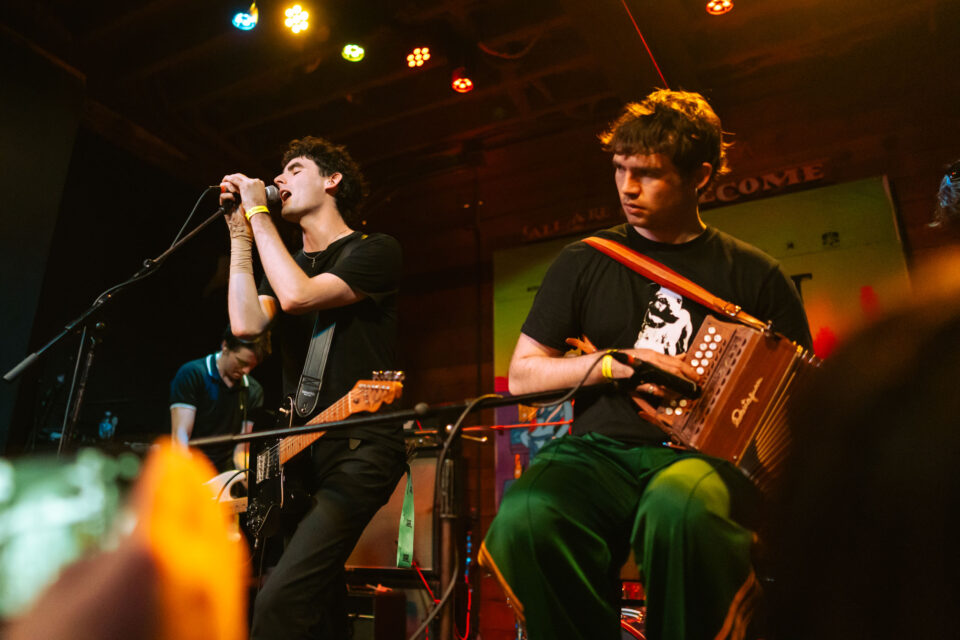
Cardinals at FLOODfest at SXSW 2025 / photo by Kenn Box
It’s when Masquerade leans into the band's roots in Cork that their songs feel most personal. The streets there are well tread by the band, and it’s made a strong mark on them, as heard throughout the album’s lyrics. “We’re all sort of transplants,” Manning says. “We came here as we were becoming adults. Even though Cork is small, we’re enamored by its presence and character. It can get its hands on you, and I think it’s had an effect on every aspect of our characters. We were on the road for half of [2025], which took us out of the place at the right time. Because the album is so linked to the city, it was almost suffocating to be close to the source.”
Masquerade may not be the most personal album, as its stories are embellished with Manning’s imagination. But dig a little deeper and you’ll find that it’s a record pulsating with lived experiences, ripples of generations gone by, and the life-altering experiences of growing up in a new city. Cardinals don’t want to be defined as a “Cork band,” but their hometown has certainly left an undeniable mark on their debut. FL

Cardinals at FLOODfest at SXSW 2025 / photo by Daniel Cavazos
