
Being a Bad Bunny fan since the time of his Oasis collab with J Balvin and 2020’s back-to-back riposte of YHLQMDLG and El último tour del mundo has been a fascinating experience so far, one not unlike attempting to explain David Bowie, Ziggy Stardust, and the whole of glam rock to your high school jock buddies. Here, reveling in the rare, inventive Puerto Rican electronica turned platinum-plated-populist manifesto with Un verano sin ti is the upside; explaining what a “bad bunny” might actually look like to the willingly woefully uninformed, and how it could dare to be justifiable that someone sing in their native tongue could work during the halftime of America’s greatest game, has been the downside. In America, you’re supposed to speak American. You’ve read the signs, I’m sure.
But something happened last night that had nothing to do with politics, with MAGA, with Kid Rock, with language differences, with borders, and with music whose lyrics you might not immediately understand. Bad Bunny radiated joy, plain and simple: exultation as an aesthetic with bliss as his bass line, and radiance as his driving, propellent rhythm. With elaborate yet homey staging indigenous to his homeland of Puerto Rico, Bunny & co. played to the cameras and his community through 14 songs in 13 minutes—the finest and most positive 13 minutes of televised live music this reporter has ever witnessed or danced through.
Prancing through tall-bladed sugarcane fields, plowing through rows of plantain trees and their warm, extended neighborhood of barber shops and liquor stores, Bunny brought the wide-wide world of Super Bowl–watching millions (135-plus) cozily onto his block—a showy but comfortable place where couples were at ease saying vows and getting married (for real), where telephone poles became lecterns, and where Lady Gaga could stop by in her light blue dress and floral brooch for a swift, sweet song and dance (her take on Mister Rogers’ “Won’t You Be My Neighbor” would have been the perfect follow-up after the halftime show’s break).
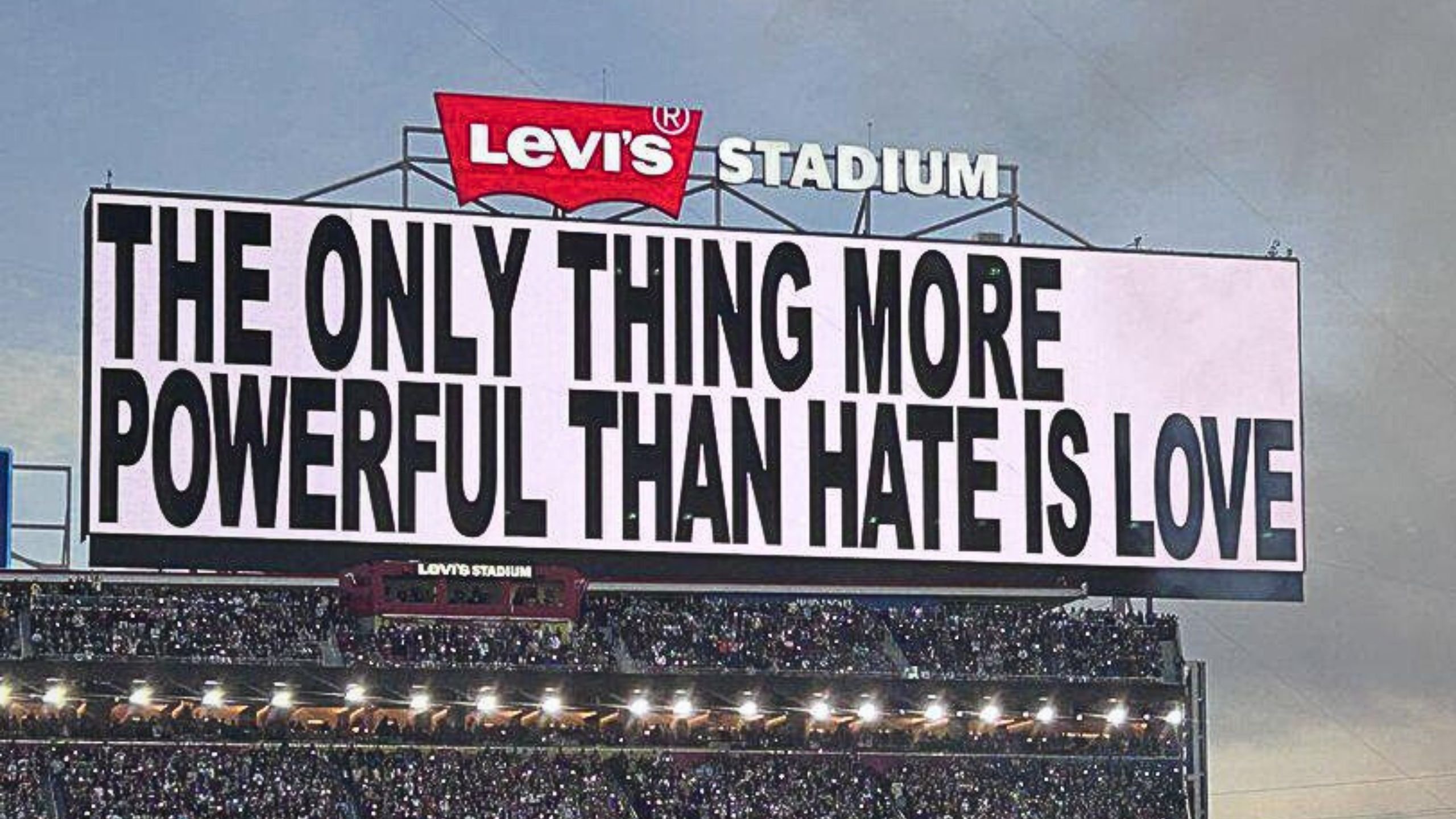
For those who expected snide rhetoric, mean-spiritedness, or politicizing on the part of Bad Bunny—to be frank, I thought he might say something, anything, even if for the sake of humor—the mistake was ours, and so be it. Because BB wasn’t there to admonish the non-believers or smote anti-immigrationists. A genuinely charming, even rakish Bad Bunny brought us all into the land of the good groove, whether you wanted to be there when you turned on the screen or not—to a place where unity reigns and divisiveness is ignored. Where all of the Americas, Canada, and the “Motherland” are one. Where sing-speaking “God Bless America,” as Bad Bunny did at the finale of his performance, meant something poetic and all-inclusive: “The only thing more powerful than hate is love.”
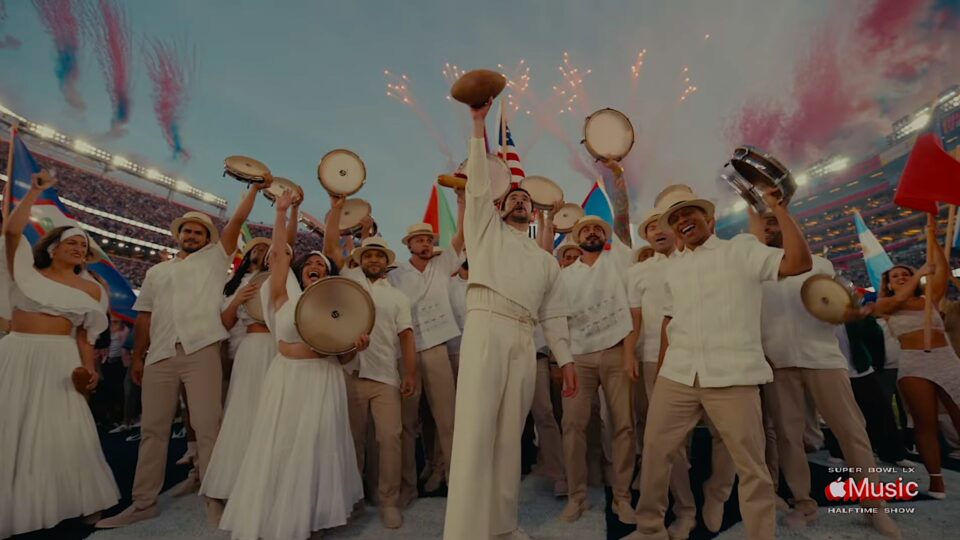
If you’ve never heard this phrase, which Bunny flashed throughout the Santa Clara stadium, it suddenly means more now than it ever has, not unlike watching the Grinch’s small heart grow 10 times its tiny size once he realized how Whovilleians found glee beyond losing their presents. It’s as if everyone inside and outside Super Bowl LX realized that hate and prejudice is this tedious thing gnawing at us all, wearing us down on a daily basis. The energy of hate, of finding fault, is debilitating and grating. Why couldn’t we find a center? Why couldn’t we deal in positives rather than the negative? Would it kill you to smile every once in a while? Heck, even ESPN sportscasters were moved to eye-welling tearful emotion during Bunny’s jubilant showcase. Do you know what it takes to make a sportscaster cry after having to endure hour upon hour of blood-filled extreme wrestling?
I can say in good standing that a feeling of positivity and unity ruling the day was real because come morning, the feelings haven’t gone away. Everyone you’ve spoken with—even those who side-eyed Bunny while viewing Kid Rock’s Turning Point USA alternative halftime—had to confess to good cheer. People who might not feel proud at this time were moved to feeling a new sense of dignity, of pride that may have been displaced as of late. Like Kacey Musgraves or Bunny’s Happy Gilmore 2 co-star Adam Sandler—even the usually gruff John Mellencamp jumped on X to write, “I don’t know what Bad Bunny is saying, however, I do know he is standing up for Puerto Rico and I am standing up for him. His half time show was great.”
Being possessed of joy doesn’t mean that Bad Bunny would eschew all opportunities in which to prove resilient in the face of bigotry and display resistance in the name of all immigrant cultures living in strife. How better to explain Easter eggs such as a child quickly receiving Bunny’s GRAMMY, which was misread as the kid in Minnesota who faced deportation courtesy of the storm troopers of ICE? And having the man behind the rump-shaking crowd favorite “Livin’ La Vida Loca” operatically croon “Lo que le pasó a Hawái”? In a week where Springsteen sang in opposition of ICE’s cruelty, having Ricky Martin intone an ageless protest song was as vitriolic as it was vital.
And still, Bad Bunny’s show radiated all that was inclusive, honorable, and joyful about the melting pot that is the Americas. “The only thing more powerful than hate is love.” Maybe it really is just time to let the hate go, and let the ICE melt.
