
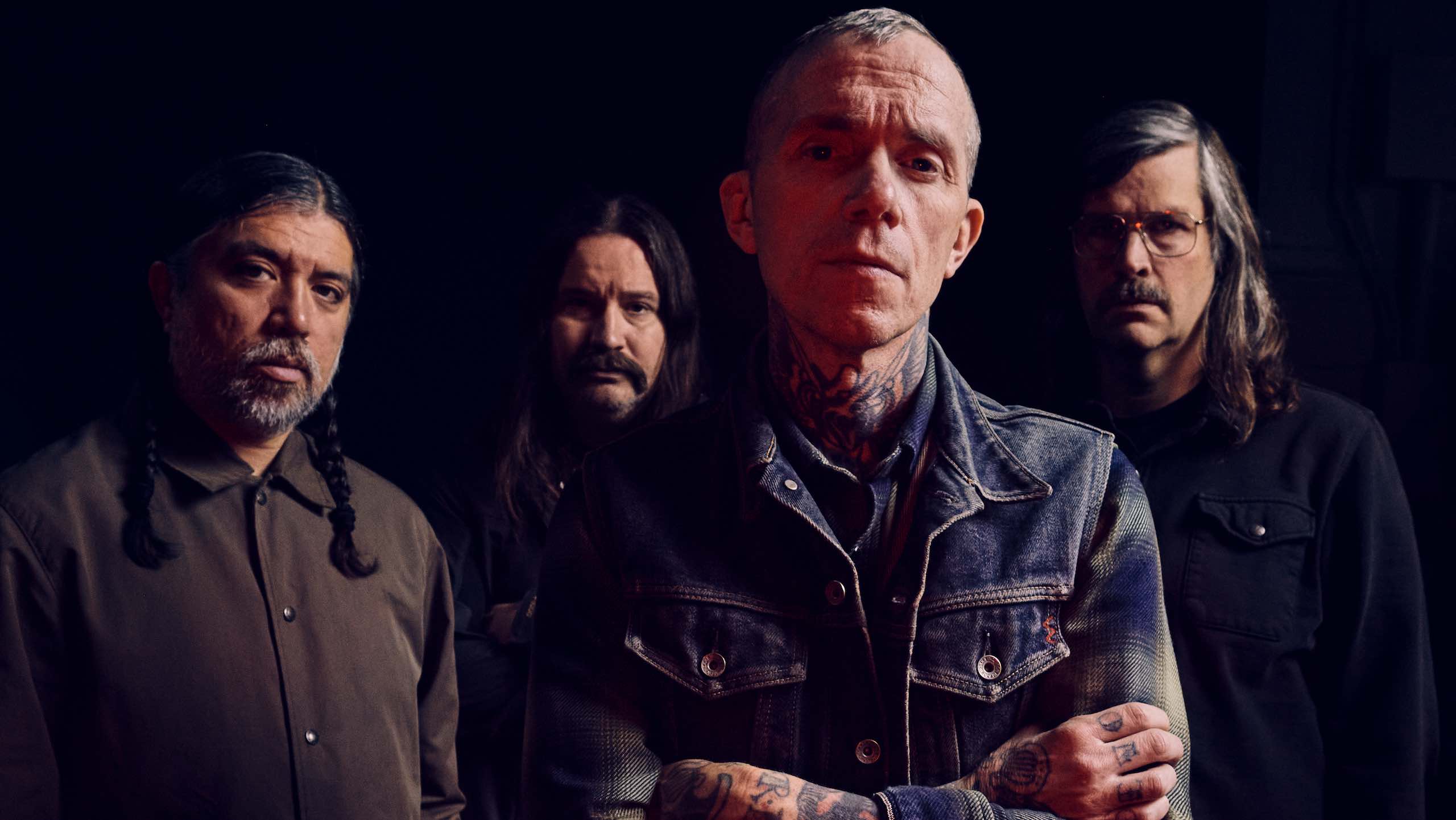

Of the many aesthetic choices that have made Converge the revered gods of heavy music they are today, one of the most commendably humanist is their continued assumption of their listenership’s intelligence. The Massachusetts-based band’s singular blend of extremity (often termed “metalcore,” though the four-piece transcend genre boundaries) pulls no punches. It assumes from the get go that you both understand Converge’s fertile creative imagination and possess a similarly rich and complex inner life.
The title of their eleventh album Love Is Not Enough is the embodiment of this creative philosophy. It’s a proper thinker of a title, rife with interpretation while also hitting some potent emotional buttons. At this stage of their career, Converge have nothing left to prove. We know that Jacob Bannon’s devastating lyrics can bring tears to your eyes, as long as you can decipher them. We know that guitarist and producer Kurt Ballou’s riffs can shred your eardrums, and that the rhythm section of drummer Ben Koller and bassist Nate Newton can switch between lockstep grooves and thunderous momentum like an approaching army.
On their mesmerizing new album, Converge have pared these ingredients down to their ruthless essentials. Love Is Not Enough progresses from shorter, heavier tracks toward a back half featuring some of their most stunning, expansive compositions to date. We spoke to Bannon about the new album’s intriguing ambiguities, Converge’s democratic writing process, his increasingly socially conscious lyrics, and more ahead of the record’s release this Friday.
I love the structure of this album. It starts with these heavier moments, then moves toward more expansive, emotionally charged tracks. What was the idea with giving the album this shape and structure?
We all have our different interpretations. For me it doesn’t quite do that. The album builds. It comes out quite aggressive and continues down that path. But I understand what you mean about those songs having the ability to breathe and not being quite as fast and abrasive. Emotionally, we pay attention to the ebb and flow of how the songs interact with one another. The album does have a natural ebb and flow, but I think there’s overarching tumult and darkness in all the material.
I’m sure you’ve always put a lot of thought into the sequencing of your albums, but this is the first one where I feel like you end up somewhere different from where you started.
The album is rooted in my modern life and experiences of the world around me, so I don’t see much difference or resolve from beginning to end. I think it’s all super self-reflective. It doesn’t offer answers, it’s a mirror.
How does the finished creation differ when compared to the thing you imagined when you were writing and recording the album?
I don’t really go into it thinking too much about the moving parts, but I do wear a variety of hats in the process. I try to communicate my artistic ideas to the best of my ability, but I try not to shape a narrative. It’s a tough place to be, because I want to clearly communicate, but also not lead people. One of the big things about making music—particularly the collaborative element—is that you don’t know what you’re going to get at the end of it. Records aren’t always cohesive—sometimes by design, but sometimes it’s because of a lack of organization. My job is to take everything we’ve created and, with my particular skill set, try to unify the basic ideas and not look much further past that.
“Our band is about personal exploration and trying to improve our own lives. That’s the most rewarding and important aspect of making art.”
I’ve always wondered about the working dynamics of being produced by a member of your own band.
In our band, the music is produced by all of us—at least in the songwriting process. All of our ideas are thrown into one big pot, then we start refining those ideas. Say I’m caught up on an idea, then I’ll double down on it or guide the process. All of us will do the same, and we value all of the input. The hardest part for us is going through the process and seeing what’s best for a song. Sometimes this takes a lot of effort. Actually, it always takes a lot of effort. It’s the most daunting part of the process. On this record there was a particular song I brought to the table, but it just wasn’t hitting for the other guys. They didn’t understand the musical logic, so they were approaching it from that perspective. There was a lot of pushback, but in the end it came together—although it was something drastically different to what I thought it would be.
There’s a saying about making art that I’ve always liked: “They can’t all be bangers.”
They are all bangers, but sometimes you just need to learn their language.
I really like this quote in the press release where you explained how you think that “realism is missing from a lot of modern music.”
There’s a lot of music out there and a lot of approaches to punk, hardcore, or however you want to define this world of music. For me, this music is defined not by sound but by vulnerability and honesty. I think it’s missing from a lot of music, particularly from punk rock. There’s a lot of posturing and role playing. For me, it’s never been about that. It’s about getting to the raw nerve of the reasons why I’m compelled to make music in the first place. I can speak on behalf of the entire band when I say that we just want to make honest and raw music that has the qualities that brought us to [punk and hardcore] in the first place. It was something that was missing from popular music, that’s what defined it. So we chase that direction and avoid writing about subjects of the day or pandering in any way. Our band is about personal exploration and trying to improve our own lives. That’s the most rewarding and important aspect of making art.


That honesty is definitely what gives Converge its edge. I’ve got a friend who’s the frontman of a beatdown band and he’s told me that the version of him on stage is a character.
I have friends in bands who’ve confided in me just the same. It’s not necessarily a bad thing, just a different thing to what we’re trying to do. And it doesn’t mean that that part of that person you’re speaking about isn’t a part of him, it’s just not all of him. Everything I present isn’t all of me, either. But we try to present as much of ourselves as possible within the confines of our music.
The track that really got me on this one is “Make Me Forget You.” I cried the first time I heard it, it’s a really powerful song.
It does it for me, too, so much so that I haven’t really listened back to it. Emotionally, it’s hard for me to listen back to [that track]. It’s not easy to come back to and play, either, and it won’t be if it becomes a part of our live canon. There’s definitely Converge songs that are uncomfortable. I think about it a lot, about being that raw and soul-searching. I unwillingly embrace it, but it doesn’t get easier. However, these are the things I cherish as a listener, it’s what I personally want from an artist I care about.

“Everything I present isn’t all of me. But we try to present as much of ourselves as possible within the confines of our music.”
That track in particular made me think of Touché Amoré.
Yeah Jeremy [Bolm, Touché Amoré’s vocalist] has always had a similar approach to writing about his life. Since they started, there’s been some parallels with us; things that run congruently but without aping one another. I can see it, for sure.
My reading of your lyrics is that, since The Dusk in Us, you’ve become interested in fusing personal and political themes. Is that something you’ve been more consciously aiming for?
Yes, although we’ve never been a political band. We write about personal experiences, but that doesn't mean you can’t approach those subjects. With this record, it’s such a mirror that it’d be impossible not to have some residual influence from the chaos of the outside world. I’d like to keep those things compartmentalized, but that’s not how the world works. I’d say these ideas I’m exploring are social ideas, human ideas. This record, for sure, has that more than any other record we’ve done.
I’ve been in a bubble all of my life; I’m a punk-rock person. If I wanted to, I could stay in this lane and not interact with anyone who has a different mentality to me. But the reality is that I interact, every day, with people who don’t share my belief systems and I appreciate those differences and try to learn from them. I just try to be an empathetic human being. FL
