

A taxi unhurriedly navigates the curves of a faded backroad under a pale wash of sky. The camera follows, pacific and easy. One guy drives; another sits, foot perched on the front seat, in the back. The scene feels innocuous, yet just a little off. The threat quickly becomes apparent as this second man, dressed like a priest, produces a gun. Through parched landscape they drive, dirt and sun-scorched grass and mountains standing far off in the distance, pulling up to a modest little house removed from anything resembling a town and with no discernible neighbors. A man is in the backyard laying brick, and our driver and fake priest shoot him dead. Instead of seeing the man riddled with bullets, squibs bursting, like you might expect from the era, we see a dog barking, horses trotting, the muted guns going on and on and then quiet. These killers don’t realize that they really messed up: the dead man’s brother is Robert Duvall. Robert Duvall top-billed in a neo-noir crime film in the wake of The Godfather. Revenge is a potent catalyst for violence; when the wrong man is wronged, there will be blood.
The Outfit is a perfect encapsulation of John Flynn’s austere yet poetic style—Phil Karlson meets William Friedkin—and the only film he both wrote and directed. A professional takes something done for business personal, a man with a cryptic past that we can safely assume involves expert violence, a man taking on a conglomerate of crooks who refuse to make amends. It’s also one of Duvall’s best films. His vengeful ex-con Earl Macklin expresses himself calmly, pensively, composed in a way that makes clear his competence without flaunting any unsavory skill, committing acts of violence not for sadistic pleasure but with stark, honorable purpose. He doesn’t enjoy his work, but he is compelled. He has to do this, is justified. And he’s very good at it. The Outfit has a tried-and-true B-movie plot, at once no frills yet elegant, beautiful and ugly, raw, controlled. The visuals, as photographed by Bruce Surtees (a regular collaborator of Clint Eastwood), have lovely layers, frames within frames, limited colors save for red, with bright, pale light contrasted with shadows as dark as an avenging soul.
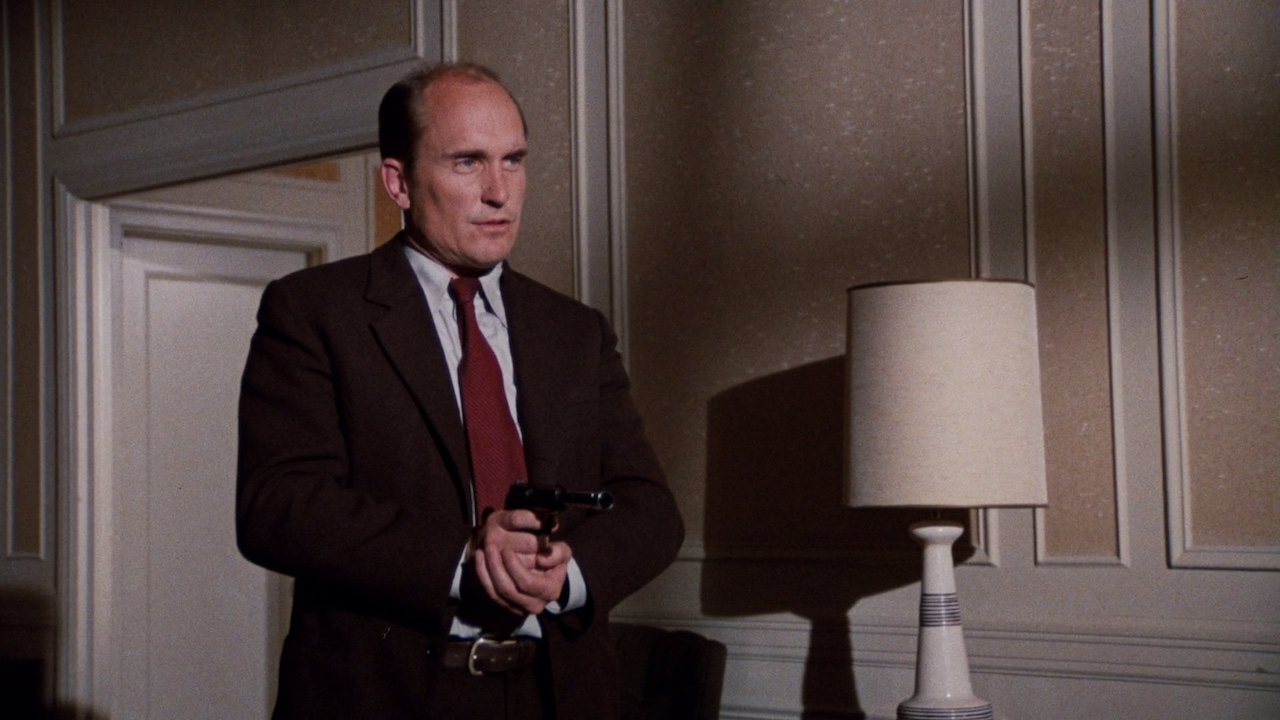
Macklin’s dame is Bett Harlow (Karen Black). She’s tortured by the outfit until she agrees to rat Macklin out. A hitman comes for him, but he gets the better of the shooter. As he has the bloodied, beat-up would-be assassin at his mercy, slumped defeated in a chair while he nonchalantly and confidently points a gun at him, Macklin demands to know who “fingered” him. The man says the typical “If I tell you, I’m dead.” Macklin should retort, as tough guys always do, that he will be dead if he doesn’t tell; instead, Duvall calmly repeats, “Who fingered me?” He doesn’t need a quip. Duvall’s every utterance is strong with determination, sincerity, betraying no fear even if he is, deep inside, in that place we don’t reveal, afraid. That’s The Outfit: seemingly simple, sparse, even spartan, but between the lines, it’s deep with existential ennui, anger, violence always threatening, always eventual. It isn’t shocking or strange, but it undermines expectations.
What one may call strange is Duvall’s quietude, the utter lack of ego in his performance which eludes entirely any loud display of morals or evil, any hint of imperviousness. He’s a real guy, made of flesh and blood, capable of thwarting his adversaries and capable of losing. When Macklin is driving and talking to Bett, Duvall keeps quickly eyeing the road, a slight but important decision, a grounded, realistic detail when so often in films the actor doesn’t seem to really be driving at all. Duvall always feels real, his eyes always scanning as a real man’s eyes scan, looking, thinking, figuring things out, from a quick glimpse down a hallway at the end of which waits a man with a gun to his sweeping scan of a room so everyone knows he’s in charge—or so he can convince them he’s in charge when the odds are against him—and we know he knows what he’s doing.
Duvall gives one of New Hollywood’s least flashy great lead performances. He delivers lines like he isn’t delivering lines, sustaining a diffident rhythm. Consider when he meets the main bad guy, Mailer, played by Robert Ryan, veteran of hardened crooks and cops; he’s well-groomed and menacing as he threatens Macklin’s wife, glares at his goons, walks with unperturbed strides, talking business with and trying to placate Macklin. “You know what I mean?” he asks. “I know what you mean,” Macklin placidly confirms. Mailer lies; he wants Macklin dead. Bad. And Macklin believed him. Now Macklin has another problem to deal with, from which he does not run.
He doesn’t need a quip. Duvall’s every utterance is strong with determination, sincerity, betraying no fear even if he is, deep inside, in that place we don’t reveal, afraid.
Early on, after Macklin robs a poker game of gangsters and puts a bullet in the hand of the man who put the contract on his brother and him, he offers one small brief smile and departs with, “See you guys around.” He’s drawn first blood. Much of the film’s poignancy comes from Macklin’s badinage with old friend Jack Cody (the great Joe Don Baker, who has perfect chemistry with Duvall), and, after a close call during a robbery, a few shots fired and a few men dead, Duvall and Baker share some uncontrolled chuckles, as if reveling in the excitement, revisiting halcyon days of mischief now revived in a new adventure, two buddies just hanging out. These are atypical badasses. How can they possibly defeat a syndicate?
Duvall is perpetually cool, yet seems perpetually on the verge of combustion, a dangerous man but not the kind of untouchable cool Lee Marvin brings to Point Blank, which was, like The Outfit, also loosely adapted from one of Donald Westlake’s (writing as Richard Stark) Parker novels. Macklin hurts people, but he can be hurt himself. Even when he escapes alive, he seems glad, like he’s totally aware that one of these times, he may not. He is, like Marvin, after money as an excuse for vengeance, but doesn’t inhabit John Boorman’s realm of artful vibrancy, borderline-surreal colors bursting like blood from a bullet hole; the world of The Outfit is a believably nasty reality in which everyone is out to get you, and Macklin may, you fear, fail. There is no bombast here, no hyperbole, no grand theatrics.
Lee Marvin is an unstoppable cipher, an inevitability personified as an angry man dressed in stylish attire; Robert Duvall is human. When shots start flying, Duvall looks worried, still smart and collected but aware that he’s the underdog, whereas Marvin always knows that he will win. And when he does, he simply evanesces into the shadows. When Macklin and Cody emerge triumphant at the end, to their own surprise, all they can do is laugh. FL
