
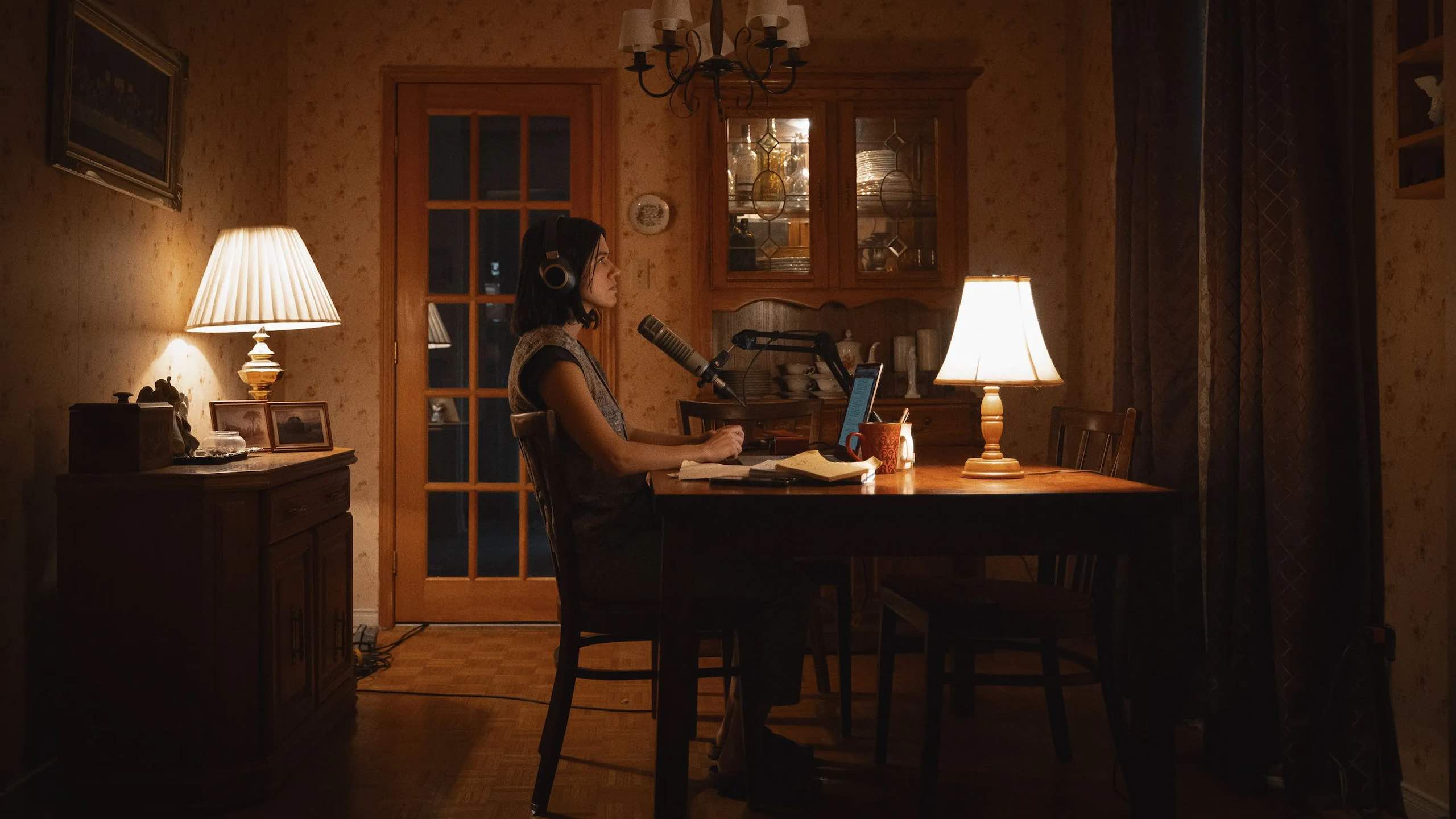


“Let’s get into character,” repeats central protagonist Evy (Nina Kiri from Handmaid’s Tale) to her best friend and podcast co-host Justin (the voice of Adam DiMarco) as they shake off the creepies and try to finish an episode before their imaginations—and some very real terrors—get the best of them. On the podcast, Evy plays the skeptic Dana Scully role, while Justin is the true-believer Fox Mulder.
Undertone is an experimental horror film that at first glance is shackled to a gimmick: the entire movie takes place between two floors of Evy’s house, where she’s camped out taking care of her comatose and dying mother, who sleeps upstairs. When not caretaking, she records that podcast about creepy happenings with Justin downstairs. The topic of the latest podcast episode is a mysterious email Justin received from a cryptic address, with an equally cryptic subject line, body, and attached series of MP3 files about what may or may not be a real possession case involving another couple, Mike and Jessa.
As they play each audio file live on the podcast, experiment with audio backmasking, and Google keywords associated with what they hear, Evy and Justin begin to piece together that a female demon from folklore named Abyzou may be involved. This demon causes miscarriages and stillbirths and seems to be coming for Jessa, giving the film strong themes of worry: about death of loved ones, and about being a new mother.
As the audience is drawn into the story told mostly through podcast audio and creepy sounds coming from the house, it’s apparent that the gimmick is not a detriment to the movie at all. By allowing us to hear the danger in surround sound instead of showing it, director and writer Ian Tuason and cinematographer Graham Beasley amp up the creepiness to an extreme degree, turning the film into an auditory hallucination of a nightmare. As the hosts slowly make their way through the audio files, taking breaks as the creepiness gets to be too much, lights begin to flicker and lightbulbs shatter. Evy’s comatose mom seems to move out of the corner of her eye. An unsettling tiny statue of the Virgin Mary won’t stay in a drawer.
This leads to an extremely unsettling and effective climax that doesn’t really resolve anything or answer any questions, but that works in and of itself because the unanswered questions only add to the off-kilter, nightmarish feel of the movie. I also especially liked that Evy seemed to be metaphorically moving between two worlds when putting on or taking off noise-cancelling headphones; she could only listen to one world at a time, while the scariness moved freely between them.
Up until now, I considered It Follows to be the creepiest movie I’d ever seen; Undertone beats it by a mile, and is the best horror movie of the year so far. See it in a theater with good sound, or if you get the disc later, treat yourself to Atmos and try not to have bad dreams that night.
