
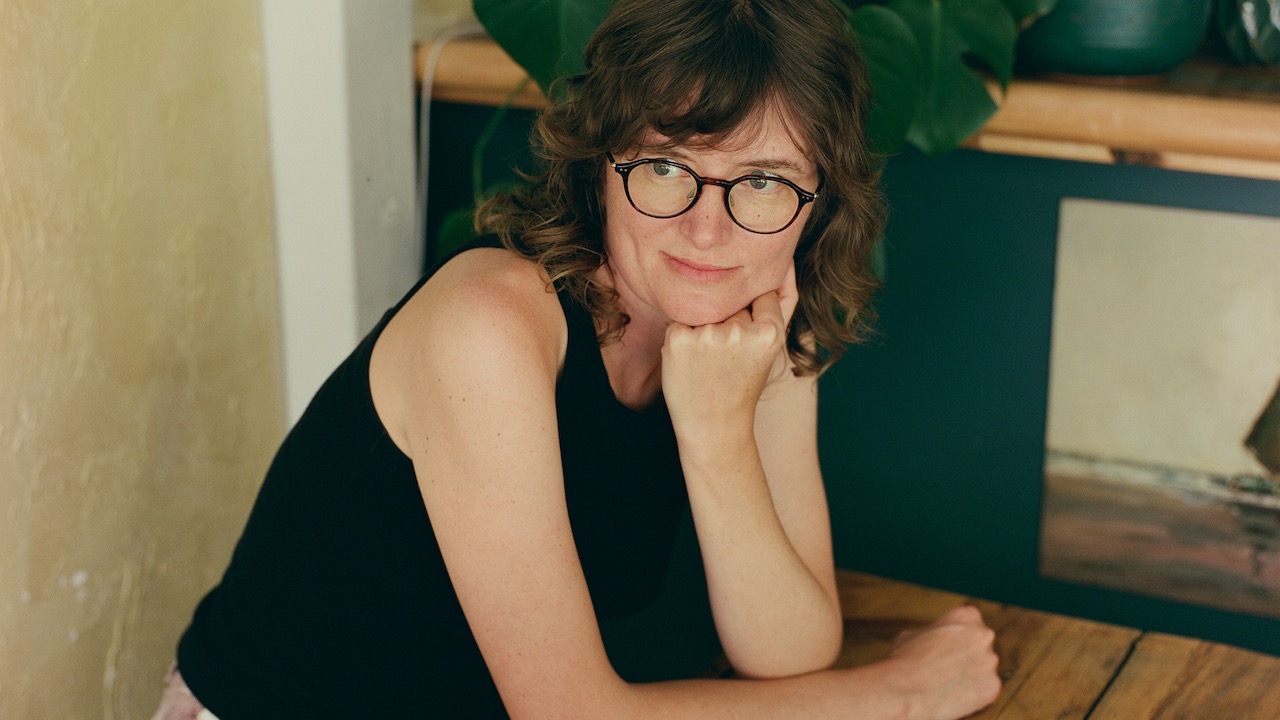

Six albums into her music career, Charlotte Cornfield’s latest project, Hurts Like Hell, feels like a collection of new beginnings. Marking the Canadian alt-folk artist’s debut for Merge Records, this latest set of songs is also the first to be released since the birth of her daughter—a development in her personal life that seemingly afforded her the ability to widen her focus as a songwriter. The 10 tracks included here weave barely fictional stories out of Cornfield’s lived experience growing weary with the music industry as her star began to rise, with plenty of recollections of the awkwardness of youth and other growing pains sprinkled throughout.
Hurts Like Hell is also the most collaborative project Cornfield has released thus far, with her studio players including Palehound’s El Kempner, Dirty Projectors’ Maia Friedman, Lake Street Dive’s Bridget Kearney, and the trained ear of producer Phil Weinrobe. Beyond that, Feist, Buck Meek, and Christian Lee Hutson all make appearances, while The Weather Station’s Tamara Lindeman even gets a shout for lending Cornfield a writing shed behind her home. The number of creative voices involved surely contributed to the broader range of sounds present across the LP, with Cornfield citing Lucinda Williams’ “Drunken Angel” and Jonathan Richman’s I, Jonathan as reference points—either before or after the songs were recorded.
With the record out today, check out Cornfield’s full track-by-track breakdown of Hurts Like Hell below. You can purchase the album here, and revisit our review of Cornfield’s last album Could Have Done Anything here.
1. “Before”
I had the line “Before you came swinging through that door” and I wanted to do something with it. The night before I went into the studio, I sat down at the Wurtlizer at my friend Marianne’s apartment where I was staying. These images started coming up from the beginning of my relationship, and I just started listing them and changing the order around. When I got to “real love, no fantasy” I just wanted to repeat it.
2. “Hurts Like Hell”
This song is about someone getting over deep insecurities and inhibitions and putting themselves out there. These two characters in the song have clearly experienced a lot of pain and are pushing themselves to move past it and connect with one another. It’s a shy-people love story. The pedal-steel/full-band/country-tinged approach felt fitting for this one, and Buck’s backing vocals really sent it.
3. “Lost Leader”
I realized it after the fact, but this song owes a lot to “Drunken Angel” by Lucinda Williams. I wrote it very quickly in my friend Tamara Lindeman from The Weather Station’s writing shed behind her house. I started with “You are a lost leader,” and then this story rolled out from there. After being in this world for a while my perception of fame/success has changed and a lot of the sheen has worn off. I remember when I started touring I was always so wide-eyed when I met someone whose music I loved. And now I’ve met enough characters like the one in this song who are struggling. I got pulled into the story of this night, this party, the inner monologue of this person. And the final verse is from the fan perspective, that “don’t meet your heroes” comedown. Though it could be interpreted as a critique, I really wanted the song to convey empathy for this character, and for their fan. I also like that this song is kind of funny, which keeps it somewhat lighthearted.
4. “Lucky”
This was a verse/chorus that I had in my voice memos for a while and wanted to do something with. It’s the power-pop track on this record. I was thinking about second chances and luck and embracing a moment of joy in a dark time. El from Palehound really helped us bring it to life in the studio—it was really in their wheelhouse, and I love their guitar playing and BGs. Phil was like, “Let’s make it sound like The Rolling Stones.” And Adam Brisbin played a little guitar solo in the middle that ruled.
5. “Living with It”
With this song I wanted to capture the tangle of emotion between these two characters. It went through several versions and verses and choruses, and initially I had nixed the chorus. But when I sent the song to Phil he underlined the chorus as something that was hitting with him, so we brought it back. And Adam Brisbin played that kind of haunting guitar part, and I love how it really opens up into the chorus. When Feist said she was down to sing on the record she asked me to send her a few song options, and this was the one I was hoping she would gravitate toward because I’m sure it is on some level inspired by her music. And she connected to it and added her Feist magic, which is undeniable.
6. “Number”
I really liked the opening line of this song as an image, that snowed-in winter feeling. And then I started thinking about friendships, how they evolve over seasons and sometimes fizzle, and there can be misunderstandings and unspoken feelings, or just a gap in space and time. And then I thought about that feeling of looking for someone’s number and realizing I don’t have it anymore.
7. “Squiddd”
This song is a story that is very much true to me (with a fictionalized band name) about meeting an ex who is now a dear friend. I found myself revisiting these memories in vivid detail and digging in as much as I could. There’s a video from the session of Phil directing us to go full I, Jonathan on this song, and that culminates in the group vocals on “I wanna share files with you.” I backed off the mic and then just kind of yell-sung them at the end.
8. “Kitchen”
This is a straight-up love song. Meeting my partner Nelson was a major turning point in my life. Everything changed for the better after that. I wanted to try to capture that feeling, and some of the awkwardness and tenderness and real shit that is all part of the big picture of love. When we recorded this, Phil had us all switch instruments a few times and then Bridget ended up on piano, and there’s no bass, which gives this song a floaty kind of lift. El and I were playing acoustic guitars really, really quietly, just the high strings. And then Maia Friedman came in and sang that beautiful backing vocal.
9. “Long Game”
I had a lot of fun with this one. I was reminiscing on my late teens/early twenties coming of age in Montreal, falling in love for the first time, all of that stuff. I had this amazing apartment that I shared with two people that was so cheap and majestic, but we had no idea how to really take care of it or take care of ourselves at that age. But when I think about the intensity of what went down there and these core memories that took place while living there, it just led me on a trail of memory. And then the end verses are about looking at it from now, how I’ve lived and learned (and am still learning) and how that’s taken longer than I thought it would at times. Phil and I were both really excited about recording this song when we went in. And we did it and thought we had it, but then Phil listened the next day and remarked that it felt too low and slow. So we bumped it up several keys, made it faster, added piano and saxophone, and the kind of call-and-response backing vocals, and that’s the version we used.
10. “Bloody and Alive”
This was a little fragment that I sang into a phone while holding my baby, and I kept coming back to it. I like this juxtaposition of bloody and alive because it’s like, if bloody alludes to any state it’s probably death, but to be bloody and alive is truly to be in this transitional state of being. And it’s one tiny image, but a very profound moment. This was two takes in the studio. We had the full band in there, plus saxophone and piano. I played the song alone for everyone and then Phil suggested the band improvise a drone, so we did a take like that. Then I asked everyone to play a bit more quietly and we did a second take and that was it.
