

This feature appears in FLOOD 13: The Tenth Anniversary Issue. You can purchase this deluxe, 252-page commemorative edition—a collectible, coffee-table-style volume in a 12" x 12" format—featuring Gorillaz, Magdalena Bay, Mac DeMarco, Lord Huron, Bootsy Collins, Wolf Alice, and much more here or at Barnes & Noble stores across the US.
The Zombies’ remastered mono editions of their groundbreaking opus Odessey and Oracle and their formative debut album Begin Here are available now.
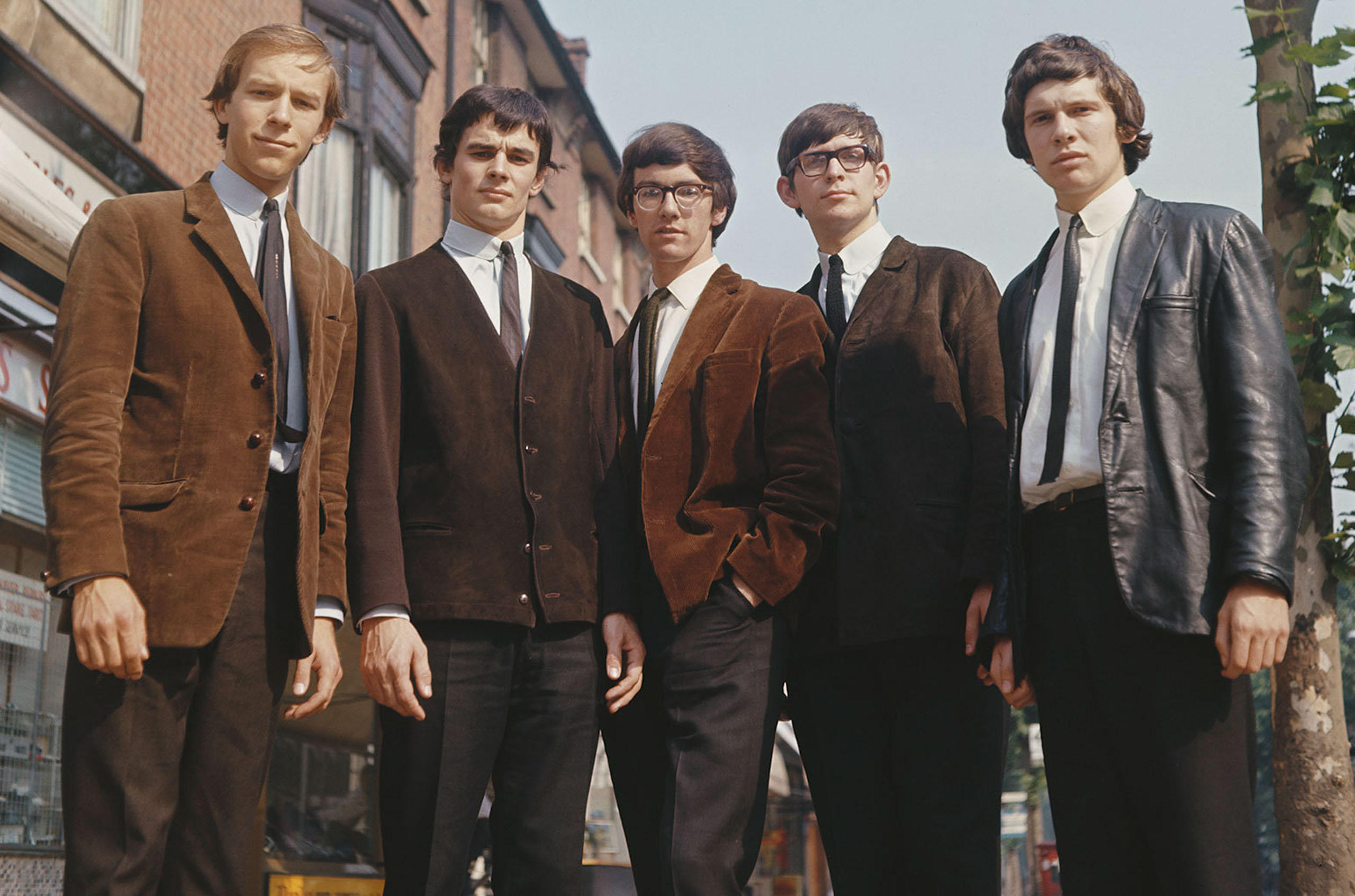
“I almost think the album had a life of its own,” says Zombies lead vocalist Colin Blunstone, reflecting on his band’s 1968 psychedelic pop masterpiece Odessey and Oracle. “It kind of had to be a word-of-mouth thing, because there was no promotion, there was no marketing—there was no band.”
Indeed, as recounted in Hung Up on a Dream, Robert Schwartzman’s recent biographical documentary about The Zombies, Odessey and Oracle was written and recorded at Abbey Road (then known as EMI Studios) in the summer and fall of 1967 as a farewell statement by the tremendously talented British outfit, who were on the verge of breaking up after several years of struggling to follow up their early hits “She’s Not There” and “Tell Her No.”
Recorded on a shoestring budget, Odessey and Oracle was released almost as an afterthought by CBS in the band’s homeland, and was only issued in the US on the label’s tiny Date subsidiary after musician/producer/A&R man Al Kooper personally pleaded the album’s case to Clive Davis at CBS. And while Odessey and Oracle only made it to #95 on the US charts (and missed the UK charts entirely), it still managed to produce a massive hit with “Time of the Season,” an atmospheric groover penned by keyboardist and bandleader Rod Argent, which sold over a million copies in the US and went on to be covered and sampled by artists ranging from Scott Weiland and Dave Matthews Band to Eminem and Insane Clown Posse.
From there, The Zombies’ legend steadily grew (Odessey and Oracle now regularly pops up in the higher reaches of “Greatest Albums of All Time” lists), eventually leading to the band’s reformation in the early 2000s, numerous tours, a 2019 induction into the Rock and Roll Hall of Fame, and the recording of several albums of new material, including 2023’s excellent Different Game. Still, Odessey and Oracle remains the band’s landmark achievement; and with the recent reissue of the album’s original mono mix on CD and vinyl (it hasn’t been available on vinyl since 1968), we thought it might be fun to have Blunstone walk us track-by-track through this wonderful record. “I think we all remember this album differently, but I’ll give you my version,” he laughs. “Which is, of course, the truth!”
“Care of Cell 44” is such a perverse opening track—it has such a jaunty, upbeat feel, but then you realize the song is about a person who’s about to be released from prison.
It’s actually quite a sad lyric, but presented in a very jaunty way. And you can imagine that could be a recipe for disaster, but I really think it works. It’s one of Rod’s absolute best lyrics; how he came up with things like that, I have no idea. I know there was a huge smile on my face when I heard him play it for the first time. That great bass line was already part of the song—he wrote it into the song, just like he did with the bass lines in “She’s Not There” and “Time of the Season.” I thought it was the most commercial track on the album, but it didn’t work as a single, perhaps because the title of the track isn’t in the actual lyric. But it’s one of my all-time favorite Zombie tracks, and all-time favorite Rod Argent songs.
And we go from there to “A Rose for Emily,” which is this lovely, intimate portrait.
It’s such a staggeringly beautiful song, and it’s always a great favorite when we play it live. Rod got the title from the book [a short story of the same name by William Faulkner]. He told me, “I woke up and I said to myself, ‘I’m going to write a song today.’” And he went downstairs and saw this book title, and he sat down and he wrote this song. The song’s got nothing to do with the short story, but he did take the title. I just think it’s stunning that he could wake up and say, “I’m going to write a song today”—and, quite quickly, he did! The recording is basically just Rod on piano and my voice; sometimes the very special songs have to be done in a tender and acoustic way like this.
“Maybe After He’s Gone” begins a run of three straight songs from your bassist, Chris White.
I love all the songs that Chris wrote for this album, but this one has just got such a great chorus. It’s so haunting and so memorable—quite commercial in its own way, I think. I can remember when we first performed the entire album [in 2008], I struggled a little bit with the ending on this, because there’s a little jump in the choruses right at the end; it doesn’t go quite to the end of the phrase. And we weren’t sure if we could make this work live, because there are quite a few vocal overdubs on there. The harmonies on this song, and on most of the album, are just Rod, Chris, and myself. Not only is Rod a great keyboard player, but he was in the St Albans Cathedral Choir for about 10 years, so he really understood harmonies and how to arrange them.
“Beechwood Park,” the next track, is incredibly evocative—you almost feel like you’re there.
Chris White lived in a little village called Markyate, and just up the road there was actually a Beechwood Park. Chris told me that the people who owned Beechwood Park were very unsettled, if not unhappy, that he’d used the name, and I think they approached him for probably some kind of recognition and possibly some kind of financial remuneration [laughs]. But what a great song! Just before Rod had his stroke [in 2024], we did a big concert in London, and Paul Weller asked if he could sing “Beechwood Park” with us. And he did it really, really good; it was a bit different to what I do, but it was a fabulous performance. But yes, this is Chris writing at his very best, I think. It’s breathtaking stuff—it’s simple but ecstatically beautiful.

“Brief Candles” is another Chris song—that’s you and Rod trading lead vocals, correct?
All three of us do; we all take a verse. And of course, famously, that’s John Lennon’s Mellotron on this track—it had been left in the far corner of EMI’s Studio Three after The Beatles had finished making Sgt. Pepper’s, and Rod jumped on that. He’d never played the Mellotron before, but if you listen to Odessey and Oracle, it’s Mellotron all the way through. If John hadn’t left that behind, it would have been a much different album!
And that song transitions quite wonderfully into “Hung Up on a Dream,” which closes the first side of the album.
I think this is one of the best songs on the album. It really captures a time, doesn’t it? It encapsulates what was happening, particularly in San Francisco and the West Coast. Of course there were similar things happening in London, but British musicians have always been incredibly impressed by American musicians—and if we are talking about flower power, I suppose, we would have been looking to America for leadership and inspiration. I’m probably going to get into a lot of trouble saying that [laughs]. Rod sang it on the album, and always sang it when The Zombies performed it live; but just recently, I’ve been playing it with my solo band, and we do it just piano and voice—it sounds wonderful.
The album’s second side opens with “Changes,” which has quite the stunning choral arrangement.
That’s another great Chris White song; that’s the only time all five of us [including drummer Hugh Grundy and guitarist Paul Atkinson] ever sang on a Zombies track. I’ll always remember this song, because EMI Studios were very strict about the sessions: You started at 10 and you finished at one. You had to finish at one. Because we were all singing harmonies, we set the mic up by the piano so that people could get their note, just to remind them where they’re supposed to be. So we’re singing, and it comes up to one o’clock, and we haven’t quite got it. These two guys walk in in these long brown coats; they’re the studio’s removal men, and they’ve obviously been told that the piano has to go somewhere else. We’re recording, standing right there, and they take the piano away from under our noses while we’re recording. And we kept recording! And I’ve always hoped that the tape that they kept was the one we recorded while they were moving the piano away. I’m always listening to see if I can hear them moving the piano [laughs].
“I Want Her, She Wants Me” is another one with Rod on lead, right?
It is. Rod sings the verses and I sing the choruses, and that was kind of presented to me in that form. And that’s fine, you know; I think it’s a good idea for Rod to sing some of the songs. And I remember that this band over here [in the UK], The Mindbenders, got an early listen to this song, and they put out a single of this track. And I remember at the time sort of hoping they had success with it, but equally wondering how I would feel if they had success with it, and we hadn’t had that success [laughs]. But it wasn’t a big hit.

With its descending piano and little horn flourishes, “This Will Be Our Year” reminds me a bit of “Penny Lane.” Was that a conscious thing on your part?
I don’t remember any conversation along those lines, but to me it’s wonderful if you think there’s any kind of relationship between “This Would Be Our Year” and “Penny Lane.” The Beatles were the best band in the world, so I’ll take it! It’s a beautiful song, and I think it’s become an all-time classic; so many people have played it at their weddings. My daughter even had this as her first dance at her wedding, and she had Rod Argent playing piano and me singing, which was very funny. She was absolutely determined to have it. When she said, “I’d like to have ‘This Will Be Our Year’ as the first song,” I said, “That’s wonderful, that’s great.” And then she said, “And I want you and Rod to play it.” “Oh no, you don’t want that!” “I do!” And that was it [laughs].
I’ve heard that you were initially less than thrilled about including “Butcher’s Tale (Western Front 1914)” on the album.
I remember Rod and Chris playing this song to me just once—and, after absorbing the lyric, saying to them, “Are you sure this lyric can fit onto this album?” I just thought, “Great song, but such an intense, heavy subject matter.” Although I think a lot of people associated this song with the Vietnam War, this was really written about the First World War and the Battle of the Somme, where soldiers were often told to march into machine gun fire, and they were just mowed down in great long lines. So I did share a little reservation about this song, but there was no in-depth conversation; from my memory it was, “Oh, OK, Chris will sing it” [laughs]. But it’s such a unique performance that Chris gives. I think it really fits this song, and you can’t imagine anyone else singing it.
Which is followed by the far more upbeat “Friends of Mine.”
It’s a Chris White song, just taking inspiration from his great friendships at the time. The names that are chanted in the background, they’re people that we knew; it sort of gives it a bit of realism, and I think it works really well. If you listen, one of the couples we mention is Jim and Jean—that’s Jim Rodford and his wife. Jim was Rod’s cousin, and he would go on to be a founding member of Argent, and then he was in The Kinks for 20 years, and then years later in the reformed Zombies. Jim was at the very first rehearsal The Zombies ever had; he was in the big local band called The Bluetones, and he very kindly organized our first rehearsal at a place called The Pioneer Club in St Albans. We used all of The Bluetones’ equipment, and I thought we sounded quite good. Some 50 years later, Jim confided in us that when he was watching us play, he was thinking, “No chance” [laughs].
And then the album closes with the great “Time of the Season.”
That was the last song that was written for the album, and it was the last song that was recorded for the album. And because it was written just before we went into the studio, I wasn’t so sure about it. I like to really get inside all the nuances of the melody of a song, and this was a case where I hadn’t had a chance to do that. Rod was in the control room coaching me through the melody as we’re recording; I had a big clock and a bright red “recording in progress” light in front of me, and I can see the money running out by the second. We’d just used our thousand-pound recording budget up to the penny, and I started to panic. Rod was saying, “Can you sing that more on the beat?” or something like that, and it got to the point where I said to him, “Look, if you’re so effing good, you come in here and you effing sing it!” And he said to me, “You’re the effing lead singer, you stand there ’til you effing well get it right!” And I did, and I’m so glad I did, because “Time of the Season” was by far the biggest track we ever had. But it always struck me as amusing that there was all this very aggressive language in the studio, while at the same time I’m singing, “It’s the time of the season for loving!” That always made me laugh! FL

