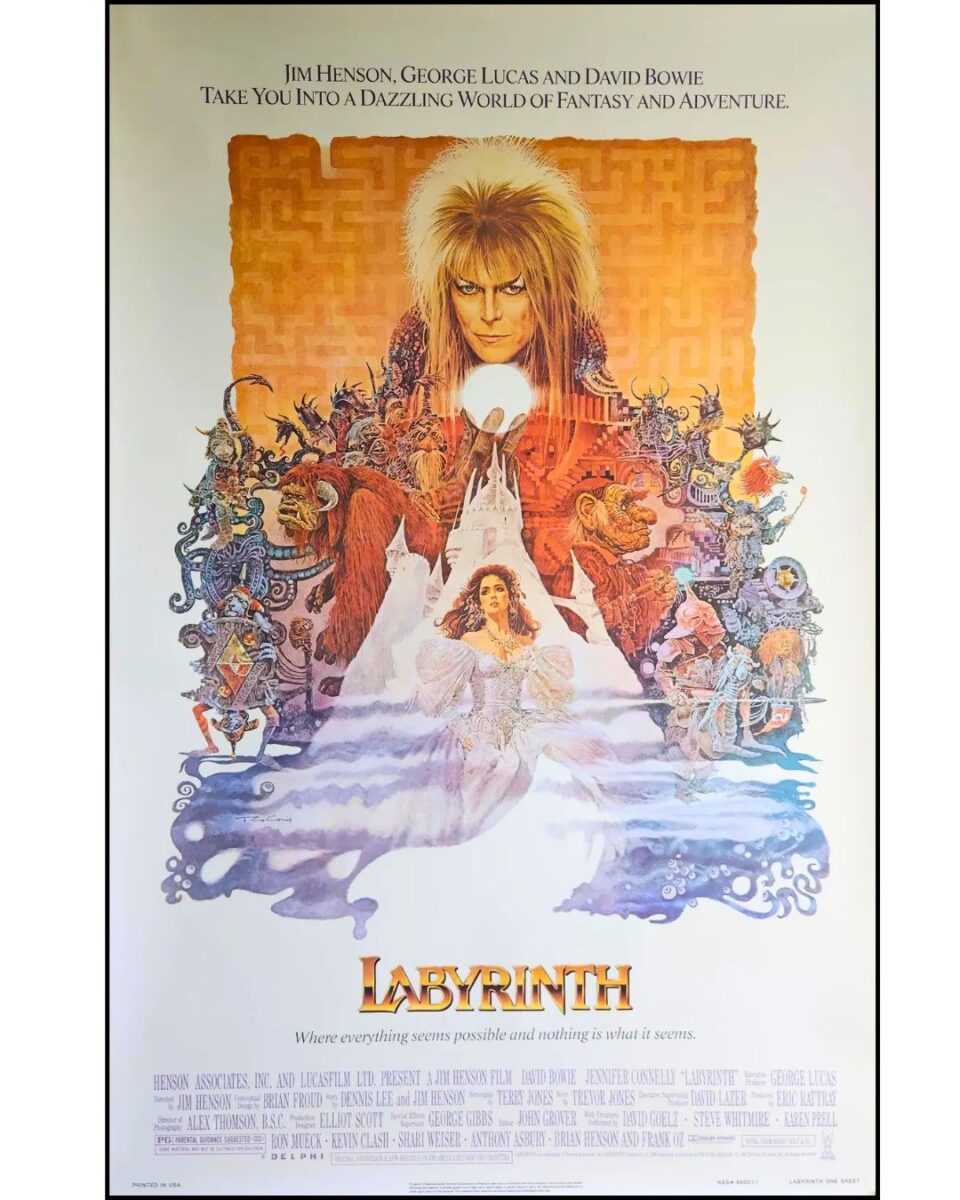



1986 was a landmark year for genre pictures that have stood the test of time. In a single calendar year, moviegoers were treated to Highlander, Short Circuit, Top Gun, Ferris Bueller’s Day Off, Big Trouble in Little China, Aliens, The Fly, Stand by Me, Star Trek IV: The Voyage Home, Three Amigos, and Little Shop of Horrors. Amid all that, a very strange and dreamlike puppet-and-live-action musical fantasy dropped from the minds of Jim Henson, poet Dennis Lee, and Monty Python’s Terry Jones.
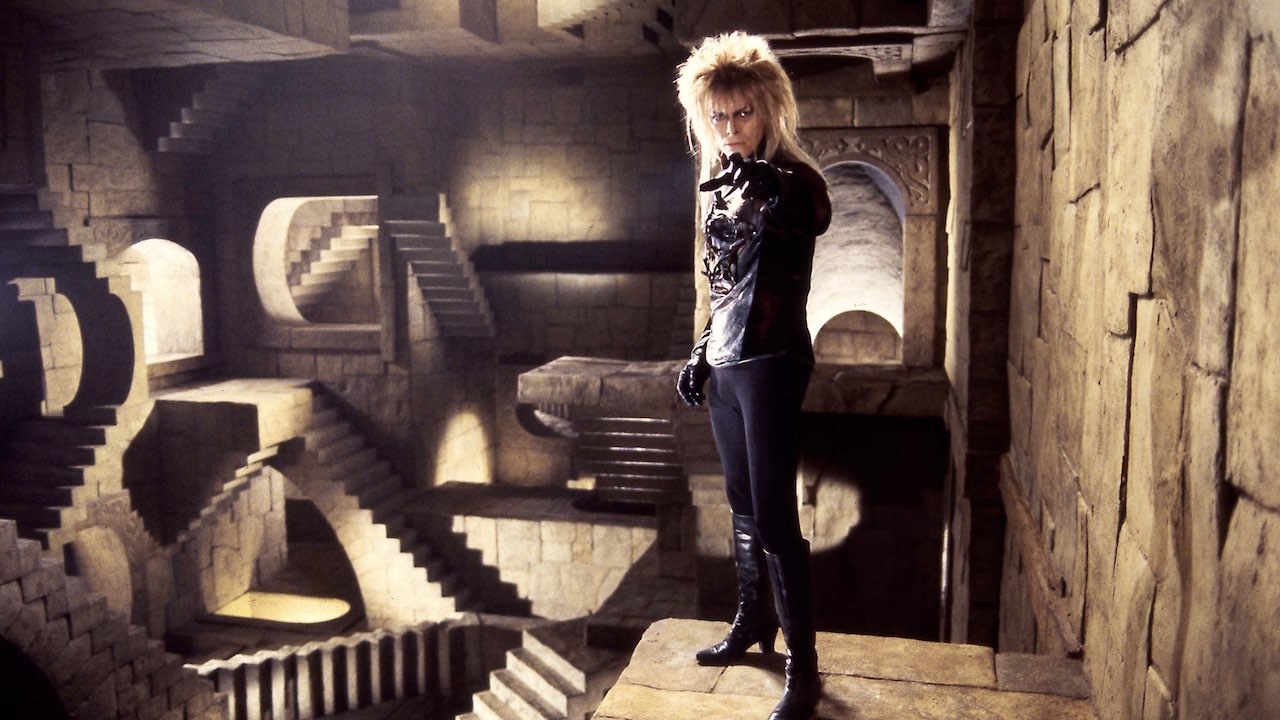
Labyrinth starred Jennifer Connelly—then only 14 and on her fourth film role—as the lost Sarah. Her foil: David Bowie, heavily made up as the Goblin King Jareth, three years removed from Let’s Dance and struggling to stay relevant in a music industry that was changing rapidly around him. It was the only movie on this list not to make back its budget—at least upon its release. Labyrinth would gain significant traction on home video for successive generations and is now rightfully considered a cult classic.
To celebrate its 40th anniversary, we connected with several of the film’s cast and crew members who look back on its unique genius. Read our mini oral history of the film below, and catch a screening of the film with a live score near you later this year at the dates listed here.
GENIUS THE FIRST: JIM HENSON
While in this dark period of filmmaking following 1982’s Dark Crystal, Henson was so disheartened by the lack of contemporary critical acclaim and box office success for Labyrinth that he never directed another feature film, sticking to television for the rest of his career. While making the film, however, spirits were high, and Henson was patient and fair behind the camera.
Dave Goelz (puppeteer): Labyrinth means more and more to me as years go by. For me, it’s a deeply moving statement that you don’t have to put childhood behind you to become an adult. It’s something you’ll always have with you.
Toby Philpott (puppeteer): Jim Henson always created a wonderful work environment (I had worked on The Dark Crystal).
Nigel Plaskitt (puppeteer): This was my first job working for The Jim Henson Company. I’d watched them making The Muppet Show on the next stage to us in the 1970s.
Michael Moschen (juggler): There are many things about the experience that have affected me both in the short and long term. The ridiculous happenstance of my work with the crystal balls becoming known to Jim Henson. Soon thereafter, performing for Jim’s birthday bash at the Waldorf Astoria ballroom. Then, being whisked upstairs to meet Jim and the executive producer of Labyrinth. Soon thereafter, being flown to London to meet with Jim and David Bowie—ostensibly to see if I could teach David any of the physical skills with the balls. Knowing that the movie would celebrate the crystal ball technique that I had invented, with Bowie as the person doing it. Making sure the credit for the crystal ball work was in the credits at the end of the film. Being on set with every person there—being the absolute best at what they do. On set, having Jim summon me and ask if I could make a crystal ball “appear” in David’s character’s hands out of nowhere. Working at it for a couple of hours, coming up with a solution, showing it to Jim and David, and having it end up in the movie! Spending the off day afternoon with Jim at his residence, just talking—and going to Hyde Park with him to fly kites. Then there’s what it did for my cache as a performing artist…
Francis Wright (puppeteer): Jennifer Connelly was always 100 percent professional, good-humored, very hard-working, and seemed to enjoy the whole thing enormously. She never once complained about anything—not even the scene where the bridge across the Bog of Stench collapses underneath her as she’s crossing it. We were sworn to secrecy on set for the scene, because Jennifer had no idea that the bridge was rigged up on hydraulics and would give way on cue. She had a harness and Kirby wire for safety, but she thought that was just the normal thing to do under such circumstances in case she fell off the bridge by accident. Her reactions as the bridge wobbles and gives way are 100 percent spontaneous—and exactly what Jim wanted, of course. After the one take (I think they had two cameras covering it), Jennifer’s response as she recovered from the slight shock was a good-humored “You bastards”—the worst language we ever heard from her lips.
Shelley Thompson (actress: Irene Williams): The set of Labyrinth was one of the first—if not the first—feature sets I stepped onto as a young actor. What remains with me of that experience was the kindness shown to me, and the acceptance of my status at that early stage of my career as a professional who could deliver on a dime what was required, over and over again. It seems a small thing, that treatment, but after a lifetime in this industry where day players are certainly not given that consideration as a matter of course, it taught me a lot. I’ve reflected on it a lot as I’ve moved from in front of the camera to behind it as a director myself. Jim was endlessly creative, kind, grateful for our time and contribution, and it was the only time in my life when I’ve been directed by a frog. Kermit was channeled many times during that day—intentionally or not—and as a young actor, I was grateful for my nerves to be eased with laughter.
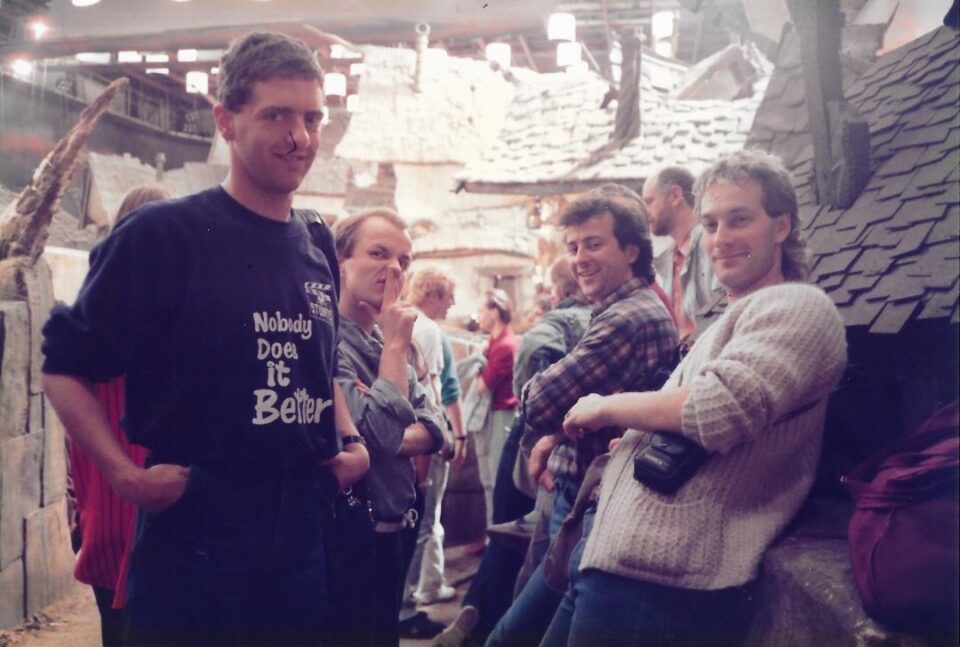
THE LOGISTICS OF DOZENS OF PUPPETS
They tell you that the three hardest things to work with in film are puppets, animals, and babies, and Labyrinth had all three—sometimes in the same scene. These puppets were furry, sometimes oversized, sometimes astride real animals, and controlled by dozens of puppeteers (and, in the studio, brought to life by voice actors).
Ronnie Le Drew (puppeteer): I was engaged as an additional puppeteer for the film, working goblins in the background while the main action was with the American puppeteers. It was my first experience working with Jim on such an epic movie—which, at times, was very overwhelming with such spectacular puppets, large and small.
Plaskitt: Probably the most memorable for me was shooting the “Magic Dance” sequence which, I think, took us about a week. Notably how relaxed everyone was about doing extra takes. When you have so many puppets on a film set, and wide shots, there are many opportunities for heads that should be hidden to come into shot. No easy electronic fixes in 1985. As I remember, Bowie was the only human in the scene—except for Toby Froud as the baby. Bowie certainly appreciated the need to take more takes than usual—as did Michael Caine later in The Muppet Christmas Carol. I also recall the spectacular set of the goblin city built on the George Lucas Star Wars stage at Elstree. It was so big that when we held the wrap party there at the end of the shoot, two bands were playing at either end of the village, and you couldn’t hear one from the other.
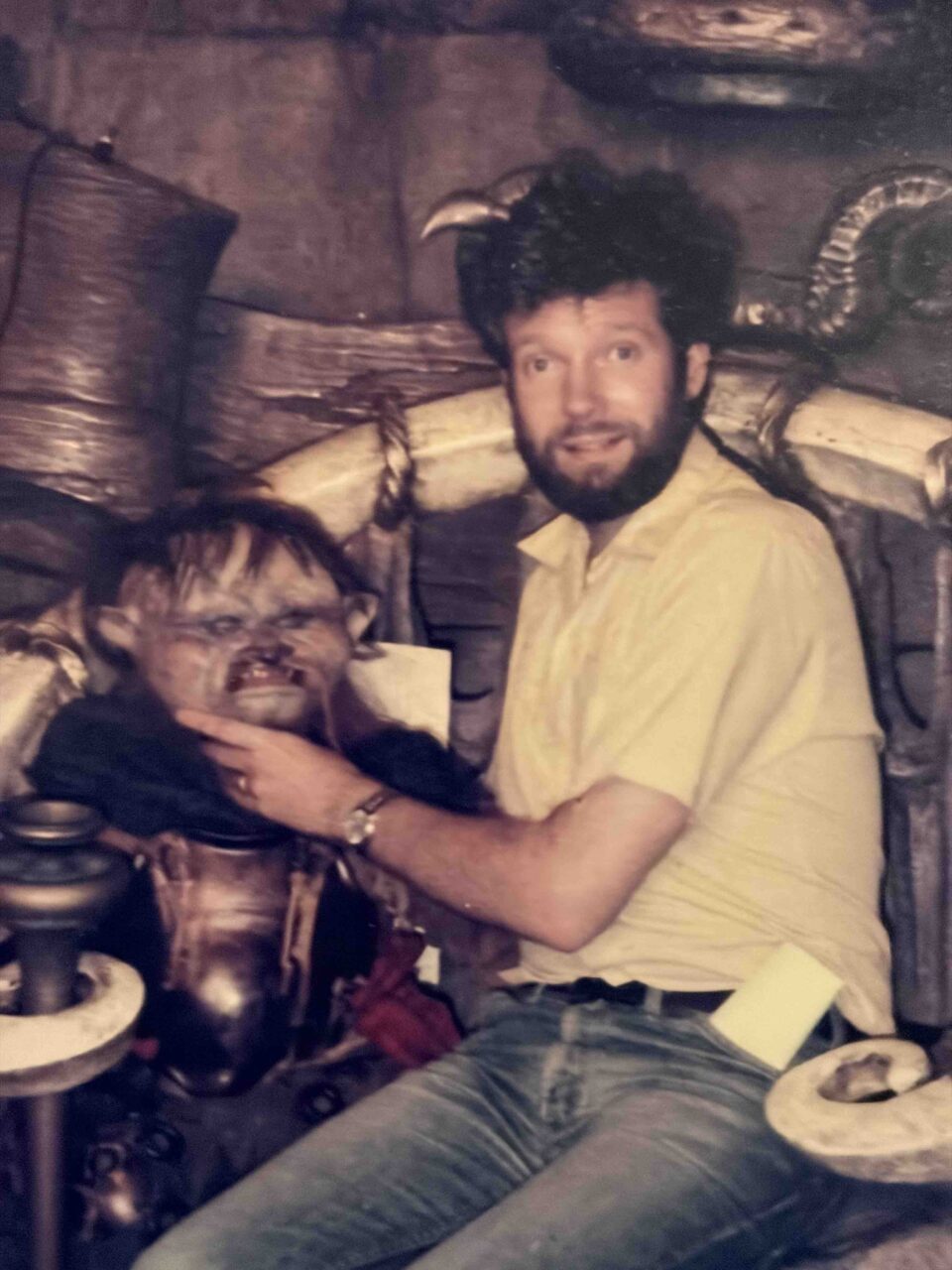
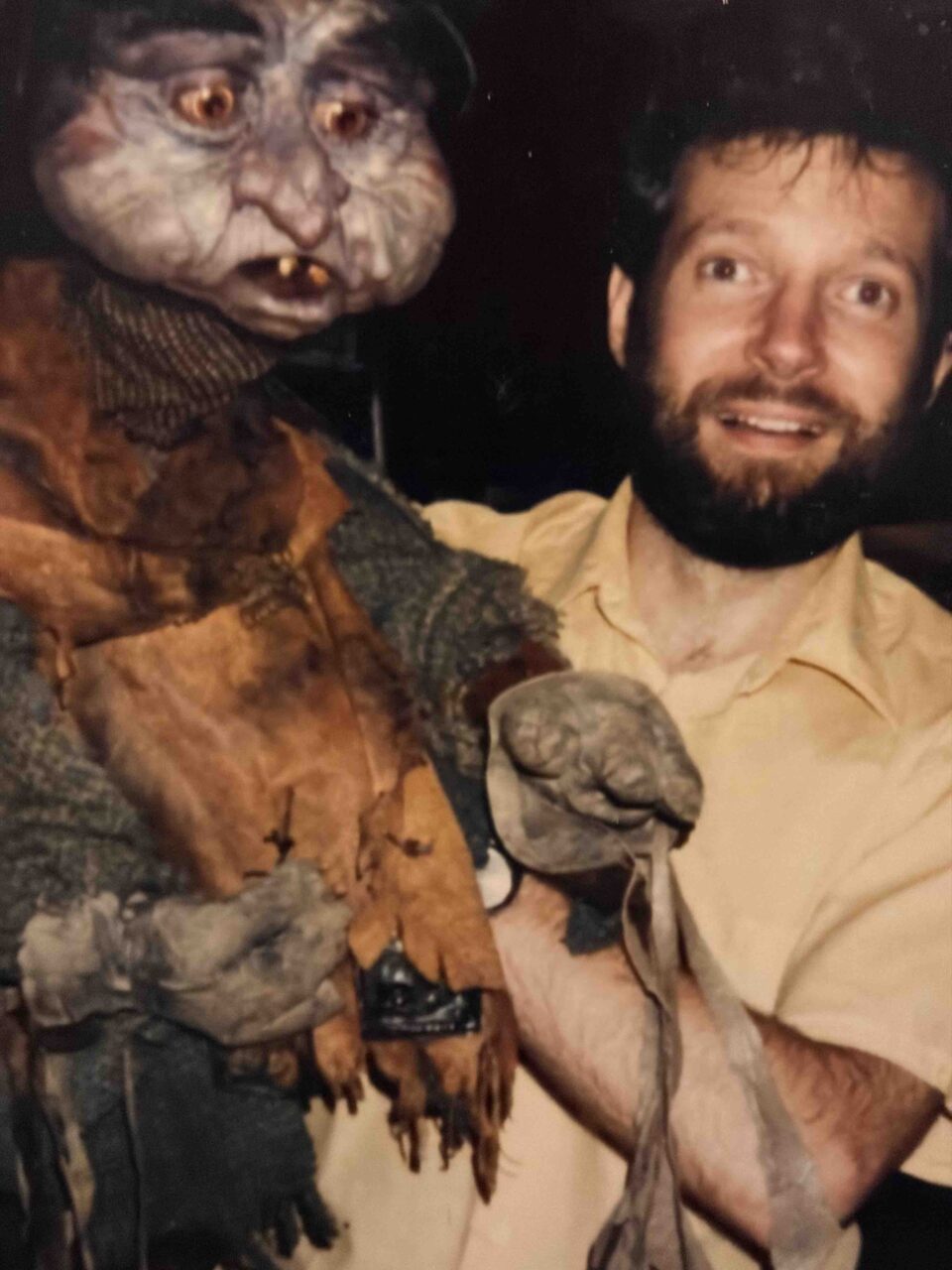
Wright: My first day was as a very small fairy flying up against the wall of the Labyrinth until it was shot down by Hoggle’s Flit gun. The battery-operated wings created a buzzing noise which annoyed the sound recordist, who came around to the back of the set to search for the culprit. All of Ludo’s facial features were radio-controlled, and as the whole system and idea of animatronics was fairly new to the world, there were often problems. Ludo picked up transmissions from local minicab firms in Elstree, and these played havoc with his face—his eyebrows, especially. They’d suddenly leap uncontrollably up and down his forehead, as his lips and eyeballs performed strange moves of their own. This frequently led Jim to sigh and say, “Switch him off,” and we’d have to wait until specific closeups before we could do anything as a team.
GENIUS THE SECOND: DAVID BOWIE
Of course, Labyrinth wouldn’t be Labyrinth without its villain, the enigmatic, romantic, and mysterious Goblin King, played by legendary musician David Bowie. Following roles in other films that were misunderstood at the time of release such as The Man Who Fell to Earth and The Hunger, he had been picking up acting roles in the late ’80s and early ’90s as he was increasingly disenchanted with the music industry, also appearing in Absolute Beginners, The Last Temptation of Christ, and the Twin Peaks movie prequel Fire Walk with Me. Bowie was fond of interacting with the cast and crew on breaks, much to the surprise of the puppeteers.
Philpott: Bowie was very down-to-earth and enjoying himself playing a comedy villain. The longest I spoke to him for was during a coffee break. I was handing cigarettes around to some of the gang of puppeteers when I felt a tap on my shoulder. I looked around to find Jareth—hair, bulge, and all—politely asking if he could have one. I lit it, and we chatted for the length of a cigarette. He didn’t go hide in his caravan, he just wanted to hang out with the crew. A lovely man, still sadly missed.
Le Drew: One lunch time a group of us had an unexpected meeting with David; he was very complimentary about all the puppetry we were doing. Jennifer was lovely, too. The whole experience led me to have other work in future Henson films, which I am eternally grateful for.
Wright: After Jareth has stolen Sarah’s baby brother, Toby, he’s sitting on his throne in his castle with Toby perched on his knee. Jareth is telling Toby that Sarah’s attempts to win him back are doomed and that the child will become a goblin like the hideous specimens to be seen all around the castle. The scene is quiet, and the child has an almost hypnotic stare on its face. On the day, Toby wouldn’t stop screaming. He appeared to be deeply upset by the alien nature of the characters and the set, and as soon as he came anywhere near it, his vocal cords gave full vent. Nothing—not dad or mum or star or puppeteers or anyone—could calm him down. But Bowie had noticed that one of the goblin puppeteers had been playing with a toy hand puppet of Sooty [from The Sooty Show]. Bowie said, “Can I borrow that for a minute?” Sooty was duly handed over. David put Sooty on his right hand and made the puppet wave at baby Toby. The scene was shot faultlessly and quickly with a now-silent Toby mesmerized by Sooty on David’s hand, bobbing up and down just out of shot during the speech. Pure magic. Little human touches like that make filming fun.
PUTTING THE “MUSIC” IN MUSICAL
Along with his acting talent, Bowie also contributed multiple songs to the soundtrack—some sung by him during elaborate musical sequences, some diegetic during the ballroom dance scene, and some sung by other antagonists, such as “Chilly Down” by the Firey creatures. Bowie’s music on Labyrinth was some of his best work from what’s generally considered a low point in his musical career. The quality of these tracks is helped considerably by the fact that, ducking into the studio on days off, he recorded with the likes of Chaka Khan, Luther Vandross, Buddy Guy, and Heartbreakers drummer Steve Ferrone.
Daphne Rubin-Vega (backup singer on “Underground”): Working on the soundtrack was a pivotal, life-changing moment for me. It was the moment I watched my idols sing and asked for permission to join them, and remarkably, beyond my wildest dreams, I was welcomed in. The producer of that album [Trevor Jones] was the same man who produced the Rent album 10 years later. If it weren’t for him—and David Bowie and Chaka Khan and her brother, who was a bestie of mine back then—things would’ve been so, so different. I will never forget David looking me in the eye with his two-colored eyes and saying, “Don’t fuck up.”
Goelz: David’s music for Labyrinth is timeless. I love the YouTube video of David recording “Underground” with those incredible singers. You can see that he knew exactly what he was doing. A master at work.
Nicky Moroch (guitarist on “As the World Falls Down”): I’ve been a Bowie fan since his first self-titled album was released in 1967, so I was absolutely thrilled to get the call to work on Labyrinth. I learned about his love of the blues—Buddy Guy also plays guitar on “Underground”—and, of course, he’s responsible for bringing Stevie Ray Vaughn to the masses via “Let’s Dance.” He loved the Middle Eastern sounding guitar in the outro of “As the World Falls Down,” thanked me for being available to record, and invited me to come hang out with him and Nile Rodgers at the China Club later that evening. The quintessential English gentleman, gone way too soon and sorely missed.
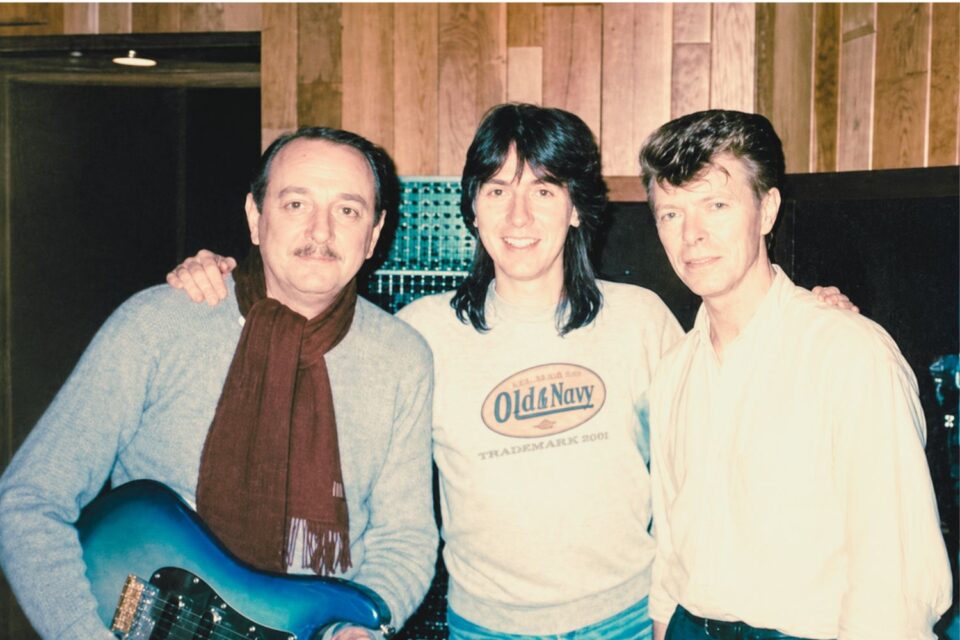
Producer Arif Mardin, Nicky Moroch, and David Bowie / photo by Eddie Garcia
Dann Huff (guitarist on “Magic Dance”): I was in Germany. My parents were celebrating. It would’ve been their 40th anniversary. They took me, my two brothers, and my wife; I was 23 or 24 years old. Sherry and I had just moved to Los Angeles a couple years earlier, and they paid for all of us to come over with them for two weeks. I was over there a week when I got a call from I believe it was Arif Mardin: “Dan, can you come to New York? I’m working with David Bowie on the Labyrinth soundtrack.” So my old self now is embarrassed of the fact that I said “yes,” that I left my wife who is pregnant with my family—good hands, albeit—for the rest of the vacation. I flew from Germany to New York to play with David and with the blessings of everybody; they all thought it was too big of an opportunity to pass up on.
Anyway, I got there and whatever the first song, David wanted an atonal type of guitar solo. Well, to this 23-year-old, 24-year-old whatever I was, I really was the wrong person to call for that. I understood the concept, but I didn’t have real-world experience. Usually, what would happen in a case like this, people would just say, “Well, thanks so much, we’ll pay you for your time, but we need to get somebody who’s more qualified.” My experience with David was just the opposite; he figured out a way to make me relevant to what he was doing and simply what he did was he said, “Tell the engineer, ‘Turn off all of the instruments except the drums,’” and he said, “I’m gonna pick a key and you just play this riff on it, play the blues, play whatever you want. Pick a random key, G, G minor, drums played on it, we’ll just jam. You know what, eight, 16 bars.” Then he would roll the tape back and he said, “OK, I’m gonna pick another random key,” and he would pick something, maybe B major, which against G minor would be really weird harmonies. He did that I don’t remember exactly how many times, but it was enough. To have this discontinuity between everything I played, and he said, “You go take a coffee break and I’m gonna put this together in a comp,” and that’s what he did.
So my memory of David was that he didn’t have to save face for me, and he did, and I’ll never forget that. It’s affected me ever since—how I work with people. If a superstar could do that with a very unknown young guitar player, I can do it with other people, and I’m forever grateful to that man. I never saw him again in my life, but he was so absolutely gracious, kind, everything that you’d want out of a hero. FL