

The Human League were four and a half songs into their set at the 2023 edition of Pasadena’s Cruel World Festival when—after only two flashes of lightning streaked the sky, seven miles away—promoters pulled the plug and evacuated the Rose Bowl grounds. It was a decision that baffled the group, who since forming in the drizzly Northern English hub of Sheffield have “played in rainstorms, blizzards, all sorts of things,” as frontman Philip Oakey chucklingly points out. But this summer, they’ll get a do-over of sorts when they embark on the “Generations Tour” with support from peers Soft Cell and Alison Moyet, which includes a show at an even more iconic LA-area Bowl: the Hollywood Bowl.
The 21-date tour is a full-circle development in a more profound way, in that both The Human League and Soft Cell effectively kickstarted music’s “Second British Invasion” when their respective synthpop singles “Don’t You Want Me” and “Tainted Love” dominated US radio during the summer of ’82. “It’s terrifying, isn’t it? It doesn’t make any sense!” Oakey marvels when asked about The Human League headlining their biggest American tour yet, this many decades into their career. “But I can’t be too terrified of anything now, because I’m 70. Whatever happens, everything is just a bonus and a chance to enjoy experiences that I never thought I would have in my whole life.”
The sole original member in the current Human League lineup after multiple personnel changes, Oakey is self-deprecating throughout our interview. He insists that he’s “about 150th the singer of [Soft Cell’s] Marc Almond or Alison Moyet” and was considered “tone-deaf” when The Human League started; he repeatedly credits Gary Numan, Ultravox, and The Flying Lizards with laying the groundwork for his success; he even claims that The Human League’s revolutionary debut single “Being Boiled”—a song that David Bowie declared “the future of music” in 1978—gave them an “authenticity that maybe we don’t deserve.” Such modesty is entirely unexpected from this bold new-wave superstar, whose asymmetrical and angular Sassoon bob, kohl-ringed stare, and booming baritone once made such an indelible impression in the early MTV era that Michael Jackson hired Steve Barron to direct “Billie Jean” after seeing Barron’s cinematic video for “Don’t You Want Me.”

“I can’t be too terrified of anything now, because I’m 70. Whatever happens, everything is just a bonus and a chance to enjoy experiences that I never thought I would have in my whole life.”
“I think that sort of [humility] is pretty much what UK bands do; most have imposter syndrome,” Oakey shrugs. “But also, we didn’t really work toward it. So many musicians start learning guitar at eight or nine years old, and they’ve got a plan and really put the hours and study in—we didn’t do that. We were lucky to coincide with the technology that supported us, without learning our chords and scales. The great breakthrough for us was when Japan started making [affordable] synthesizers that ‘normal’ people could buy; if we really got all our finances together, we could buy a KORG. Up until that point, the only people buying that stuff were Keith Emerson and Pink Floyd. So maybe that makes us feel like we didn’t work as hard as other musicians.”
The Human League formed in 1977 when co-founders Ian Craig Marsh and Martyn Ware were looking for a new singer. Ware reached out to his school chum Oakey, whose only previous singing experience had been performing Bach’s Christmas Oratorio in choir class. “Martyn came around, and under his arm he had Kraftwerk’s Trans-Europe Express and I Feel Love by Donna Summer,” Oakey recalls. “But I think it was actually Ian who thought I might be a useful character to have around. It was a positive that I wasn’t particularly musical, because he and Martyn had that covered. Making synthesizer records was a bit intricate and laborious, and they didn’t need a third person coming in and changing the settings while they weren’t looking! So that made the division of labor more sensible. I could just be the haircut at the front.”
By 1980, creative differences between Oakey and Ware caused Ware and Marsh to quit. Not content to just be a pretty face (or haircut), Oakey wanted to take control, and take the band in a poppier direction. They’ve since made amends, but Oakey admits, “I do regret the bad feeling that happened for a few years between myself and Martyn and Ian. It didn’t make any sense. I’ve always liked them, and it was crazy to not be able to negotiate our way through that. I think it was sort of the power-politics within the group. Or it wasn’t so much about power as it was thinking, ‘Am I good enough for this? Am I better than them? Am I getting paid more than them? Am I getting more attention than them?’ Suddenly everyone tells you you’re important when really, of course, we weren’t—it’s only pop music. I still regret, at that stage, falling out with people that I thought would be my best friends for the rest of my life.”
At the time of the fallout, Oakey and The Human League’s other remaining member, Adrian Wright, decided to carry on—and to everyone’s shock, especially Oakey’s, they pulled off one of the greatest reinventions of the 1980s. “We really suffered a crisis of confidence at that point,” says Oakey. He explains that the only reason why Ware and Marsh let them keep the band name was because a tour had already been booked, and if Oakey and Wright fulfilled those obligations, they “wouldn’t be sued by the promoters for not turning up.” At the time, Oakey’s only concern was getting through those shows, and he “assumed we wouldn’t do all that well, because we didn’t have the same technical talent as Martyn and Ian.”

But that’s when Oakey and Wright impulsively hired the striking Joanne Catherall and Susanne Sulley after Oakey met them at Sheffield’s Crazy Daisy nightclub. Just as Oakey had been recruited for The Human League largely because he “already looked like a pop star,” Catherall and Sulley had even less musical experience, but they, too, looked the part. “They synthesized the style of the time,” Oakey explains, recalling the fateful night that he spotted them on the dance floor—Sulley with her glamorous, sculptural swoop of peroxide-blonde fringe, the brunette Catherall looking like a new-wave Louise Brooks with her Cleopatra eyeliner and scarlet pout. “They really loved a band called Japan, and they’d created this look that was a little bit David Sylvian, a little bit Gary Numan—and a load of themselves that they got from nowhere.”
And less than a year later, Oakey’s risks paid off more than he could have ever imagined. The revamped Human League that Britain’s music press initially dismissed as “Oakey and his dancing girls” released the Martin Rushent–produced Dare, and the rest was synthpop history. “Don’t You Want Me”—a Star Is Born–inspired, he-said/she-said dialogue between an obsessive svengali (authoritatively played by Oakey) and the ingénue girlfriend who’s outgrown him (portrayed with impeccably icy detachment by the sullen Sulley)—became an instant classic and the top-selling UK single of 1981. It also cracked the Top 10 in 16 other countries, and spent a whopping 21 weeks in the US Top 40, seismically shifting American culture in the process.
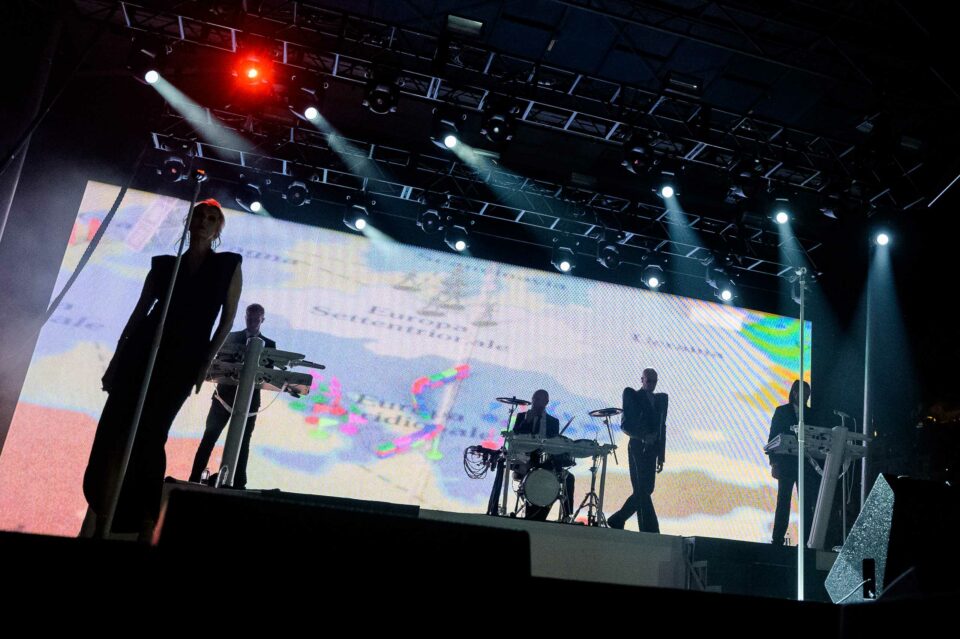
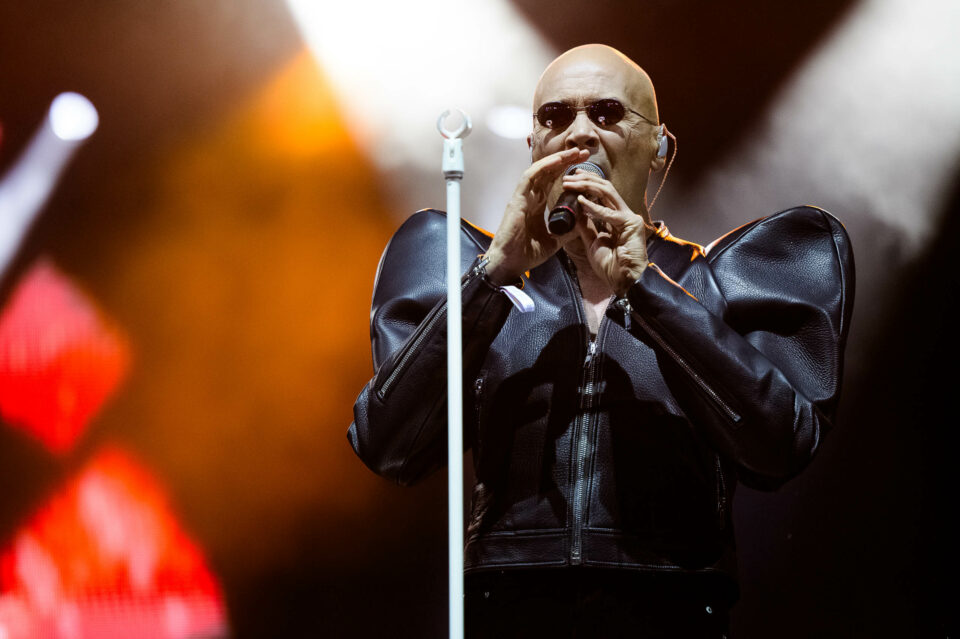
The Human League at Darker Waves 2023 / photo by Wilson Lee
“So many musicians start learning guitar at eight or nine years old...we didn’t do that. We were lucky to coincide with the technology that supported us, without learning our chords and scales.”
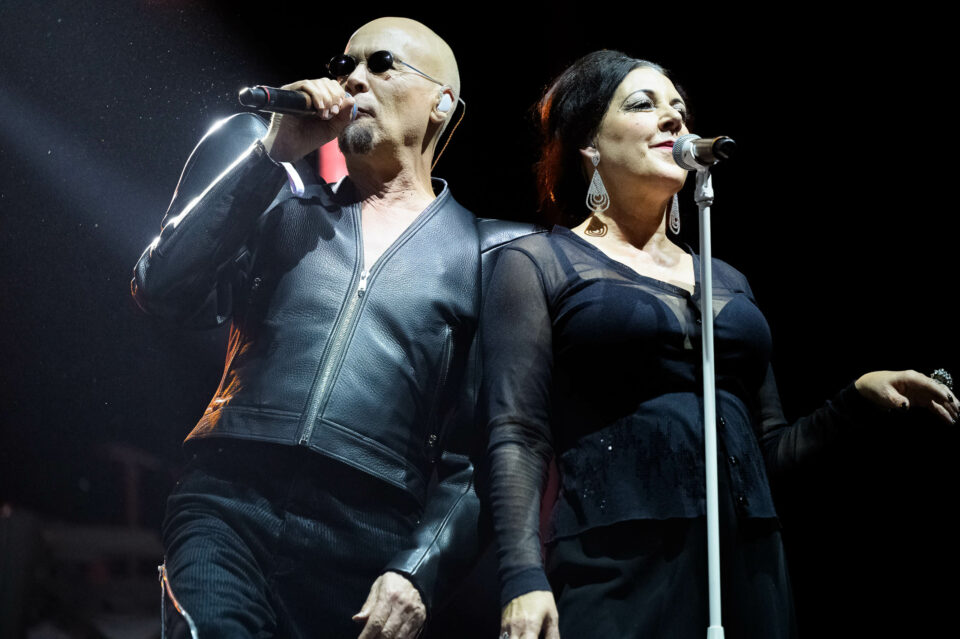
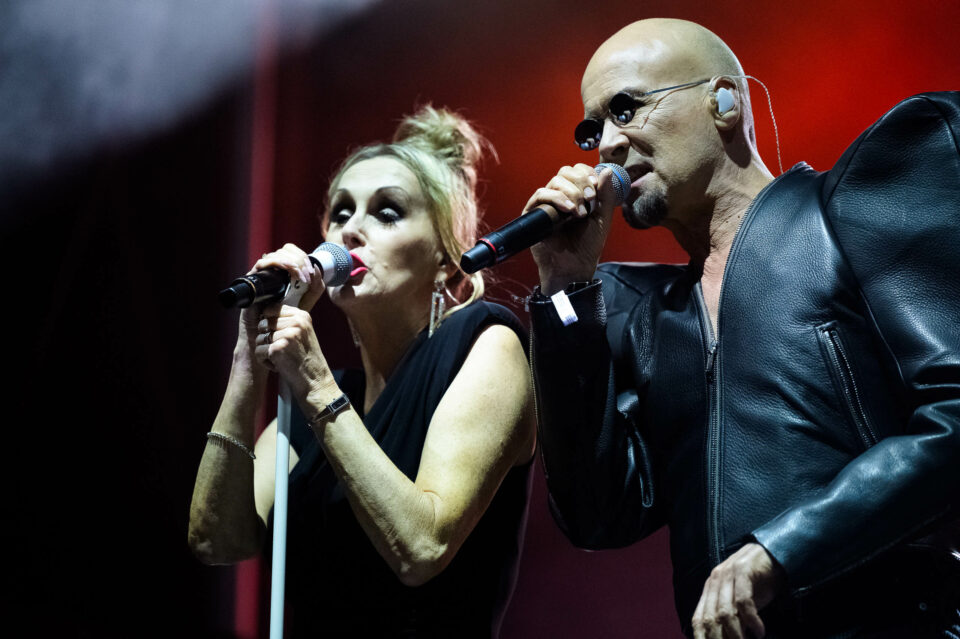
The Human League at Darker Waves 2023 / photos by Wilson Lee
The Human League
Despite his pop aspirations that had driven a wedge between him and his former League-mates, Oakey felt uneasy with the massive success of “Don’t You Want Me,” which he’d once bizarrely thought was Dare’s weakest track. Deep down, Oakey also wasn’t sure if he and his new bandmates were truly ready for the big-time. “We had come off quite a bleak circuit of live shows in Britain, doing shows with Joy Division and early Scritti Politi, so I think we felt we were now lurching too far in that [pop] direction,” he explains. “And we were very defensive. We were scared about everything at that stage, and it was hard for us to accept it. It was scary for us to think, ‘Oh my God, we’re going into this professional area that we might not be able to cope in.’”
So, how did they cope with it? “Badly,” Oakey answers bluntly. “I don’t know if anyone is ever prepared for it, but I’d sort of hoped we would drift along at the bottom of the Top 20 and maybe do OK for a few years. I didn’t really think that we could have #1 hits—especially not international #1 hits! I think we resented the loss of control. We’d had this lovely little cottage industry of our own, where we’d bumble about in our little studio and get stuff done, and now, suddenly, after being ignored by our record label, we were worth manipulating. And we didn’t feel strong enough to fight back. We felt we weren’t good enough for the task.”
The band rebelled on their next album, 1984’s Hysteria, by releasing “The Lebanon,” a grim political single about the Lebanese Civil War. Subject-wise, its serious statement wasn’t that off-brand for the group (“Being Boiled” was an animal-rights protest against the textile industry’s abuse of silkworms, after all), but its slashing guitar riffage was a drastic, almost unrecognizable departure from the sleek Eurodisco of “Don’t You Want Me.” It all seemed like an act of career suicide, although Oakey insists that wasn’t their intention. “We’d always told [guitarist Jo Callis], ‘We’re a synth band, we don’t do guitars.’ But then he walked in one day with this riff and we thought, ‘Do we actually tell this guy, who’s been so good for us, that we won’t use his prime skill?’ And so the decision was simple. We just couldn’t deny the power and the relentlessness of that song.

The Human League at Darker Waves 2023 / photo by Wilson Lee
“We’d had this lovely little cottage industry of our own, where we’d bumble about in our little studio, and now, suddenly, after being ignored by our record label, we were worth manipulating.”
“Once again, we weren’t making a plan; we just sort of found ourselves on a track being dragged along,” he continues. “But I certainly think we confused people. The guitar fans didn’t like ‘The Lebanon’ because we were The Human League, and they knew us as a synth band. The synth people didn’t like it because we weren’t being ‘synth’ anymore. There was a big difference in Britain back then between synthesizer music fans and guitar fans, and we confused them all.”
Two years later, the band creatively veered in another potentially confusing manner by recording their fifth album Crash with the Prince-associated Minneapolitan production team of Jimmy Jam and Terry Lewis, best known for their work with Klymaxx, Thelma Houston, and, of course, Janet Jackson. Again, this wasn’t that much of a stretch, since The Human League’s inclusion of Catherall and Sulley partially came from R&B’s girl-group tradition (“One music critic said The Human League were the only girl group with a man in it,” Oakey quips), and the band specifically wanted to work with Jam and Lewis because they were “besotted” with one of the production duo’s earliest funky hits, The S.O.S. Band’s “Just Be Good to Me.” And this time, the risky move actually gave The Human League another surprise comeback, when Crash’s Jam/Lewis-penned slow jam “Human” became their second US #1 and even crossed over to the Billboard R&B chart’s top 10.
But the success of “Human,” much like the band’s experience with Dare, was bittersweet. “On the one hand, it was absolutely fascinating to be in a working town in America with guys who came to electronic music with such a different point of view,” Oakey says of recording Crash at Minneapolis’s Flyte Time Studios. But the producers demanded that they have total control over the finished product, prompting the frustrated band to pull out and return to Sheffield while Jam and Lewis completed Crash with session musicians—an ordeal that Oakey describes as “quite alienating.” Years later, however, the mellower and humbler Oakey is more appreciative. “In the end, Jam and Lewis saved our lives and our careers,” he reflects. “We’d had a songwriting crisis in the group. And they gave us a wonderful song and a wonderful experience to take us on to the next phase of our career. I think it would’ve been so easy for us to disappear at that point without Jimmy and Terry. We very well could have been a one-hit wonder.”
On the contrary, The Human League have amassed a catalog large and diverse enough to warrant a headlining tour of other legendary American venues like Radio City Music Hall and Nashville’s Grand Ole Opry, even though 15 years have passed since they’ve released any new music. Oakey does want to record a new Human League album if they can find the right producer (he has former Chromatics programmer Johnny Jewel in mind), but right now he, Catherall, and Sulley are just thrilled that fans still want to hear their hard-won hits. “We’ve learned to be very grateful to the people who’ve supported us now for nearly five decades, and along the way we’ve realized that the audiences who buy records are actually more important than the group,” Oakey asserts. “We’re so glad to walk out on a stage and see people smiling. It means everything to us.” FL
