


The infiltration of AI into every facet of daily life and work has required that that which is fully human and devoid of artificially enhanced technology gets its due, large and small, and marked thusly. On the personal business side, independent makers’ websites are increasingly working with AI certification sites in order to prove their “realness.” On a grander scale, YouTube recently announced that it will automatically and prominently tag all videos that make “significant” use of AI and AI-generated content. If you’re a fan of all things organic and untouched, there’s a plan to prevent you from having to sleuth out AI-generated content. Foods, supplements, and nearly everything that goes into your body is labelled, so why shouldn’t art come with the same transparency?
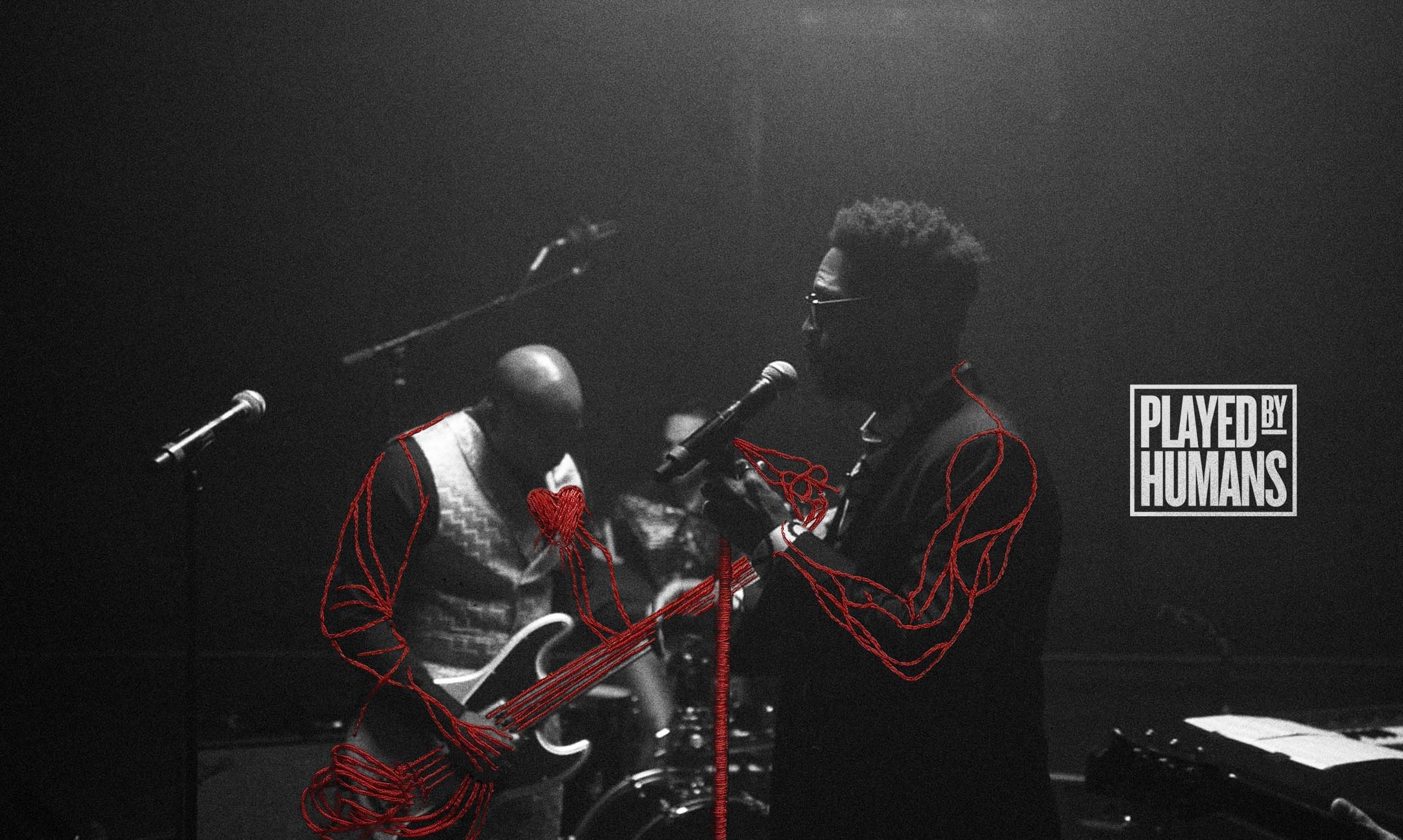
To that end, Los Angeles–based advertising agency TBWA\Chiat\Day—self-titled and trademarked The Disruption Company—is taking such labeling into the music realm, in collaboration with the label and booking team Jazz Is Dead, for its Played by Humans program of AI transparency in music. “We designed this stamp as a symbol that doesn’t reject technology, but celebrates humanity,” says Bruno Regalo, TBWA’s Worldwide Global Chief Design Officer and the originator of the digital marker, upon the program’s launch. “Inspired by advisory labels, we created something that feels trustworthy—visual assurance that there is a real person behind the music.”
If we’re talking about having humans behind the music, there’s no better place to start than the free-form mode of jazz and a modern, analogue-driven record label such as Jazz Is Dead. “We’re all in with Played by Humans as an idea, and all of the real-world implications that it can have,” says Andrew Lojero, one of the quartet of founders behind Jazz Is Dead. When the TBWA team came to the LA-based organization to be its “face,” Lojero immediately found virtue in the potential of labeling. “We’re just looking for transparency,” he says. “To me, this is about putting a label on our music in the same way that having labels on our food is important. Is this food organic? Is it non-GMO? How was it grown? Are there carcinogenic chemicals involved? This is a unique problem that we’re having right now with AI, and how we process what we’re thinking—what we’re doing—with something such as Played by Humans. Why would we have to wait however many odd years to have a transparent post-AI world? Let’s just do it now.”
Further notes on the creation and curation behind the Played by Humans program came courtesy of the TWBA team’s Head of Innovation Bert Marissen and its Creative Technologist Nat Wilkes. TWBA is used to working on “big ideas,” notes Marissen, regarding full-service ad campaigns for clients such as Levi’s and Gatorade, as well as their working on more intimate projects with Jazz Is Dead and designing the Played by Humans initiative. “We saw this problem—AI music flooding streaming services; Deezer claims that 75,000 fully generated AI songs a day are being uploaded—and wanted to correct that,” says Marissen. “The connective tissue between an issue such as this and our other work is that we deal with music a lot for our commercials and our branding. The humanity in that is crucial. Our partner Jazz Is Dead is the perfect embodiment of that human-made craft.”

“We designed this stamp as a symbol that doesn’t reject technology, but celebrates humanity...we created something that feels trustworthy—visual assurance that there is a real person behind the music.” — TBWA’s Bruno Regalo

Wilkes, like Lojero, isn’t necessarily against AI or AI-driven music—as long as he doesn’t have to deal with it. “I have not used AI-driven music in anything that I’ve produced, or laid any AI music into any of the tracks,” he says. “At TBWA\Chiat\Day, we’re all about the celebration of the human. Omnicom [TBWA’s parent company], as a larger entity with many partners, has potentially different opinions—we can’t speak on their behalf. At TBWA, we’re cheerleaders for getting real artists and real composers to author tracks for our content.”
After last year’s viral release of “Heart on My Sleeve” from what turned out to be a “fake Drake,” the TBWA team was spurred into action. “It really made me look into my Spotify playlist and genres like Afro house to realize how much of this is AI,” says Marissen. “I had no idea that I was listening to AI—and that’s the point. We’re not against AI. But as a listener, I should have transparency as to whether I want to hear AI-generated content or fully human-made music.” Moving from alarm to design, the Played by Humans tool and verification process is one where the TBWA team actually uses AI against itself in order to get to the nitty-gritty of its humanity. “Any artist can upload an album or singles,” explains Marissen. “AI will track it for AI artifacts—it’ll even find out if you used a platform such as Suno or ElevenLabs in your songs—and based on a confidence score, your product will go through the verification process and you get a badge that your music is, indeed, played by humans or it’s flagged as AI.”

“Why would we have to wait however many odd years to have a transparent post-AI world? Let’s just do it now.” — Jazz Is Dead co-founder Andrew Lojero

Bruno came to Wilkes, Marissen, and outside tech partners Pex for the technology to leverage his design goal to detect AI artifacts within all audio. “Even Norwegian throat singing, if that’s your vibe,” says Wilkes. “From there, it takes about 10 seconds per track review for AI markers and identifiers, and returned to the listener with its diagnostic. And the model is constantly improving as AI technology is developed and launched. From there, it’ll move along the blockchain—label or not—and remain archived as AI or human.” Marissen adds how constant updates in platforms such as Suno require that they and Played by Humans must work smarter to detect their progress. “That’s the cat-and-mouse game we’re up against,” says Marissen, “but we’re updating just as fast and generating feedback from the artistic community beyond the tool—as in, what do they need when it comes to verification?”
As Spotify looks to verify its human artists according to concerts held and merch lines sold, Played by Humans is keeping the smaller artists in mind. “That’ll work for the big guys—the Lady Gagas, the Beyonces,” Marissen adds. “They’ll get verified. But I think we want to see the playing field leveraged, which is why we made it free to use. With our tool, an indie artist can prove its humanity.”
After long discussions with JID co-founder Adrian Younge, Marissen and Wilkes again stress how Played by Humans is far from being anti-AI. “Technology is how we got hip-hop,” says Marissen. “And it’s up to no one to tell you what to listen to or how to listen to it. But you should know what is human and what is AI. We’re guessing that most people will be turned off to [AI music], as there’s less of a connection, and that there’s more to music than just sound. What are you connected to with an AI artist? You can’t go to an AI artist’s concert.”
Not yet, at least. But that’s another stamp for another day. FL
