
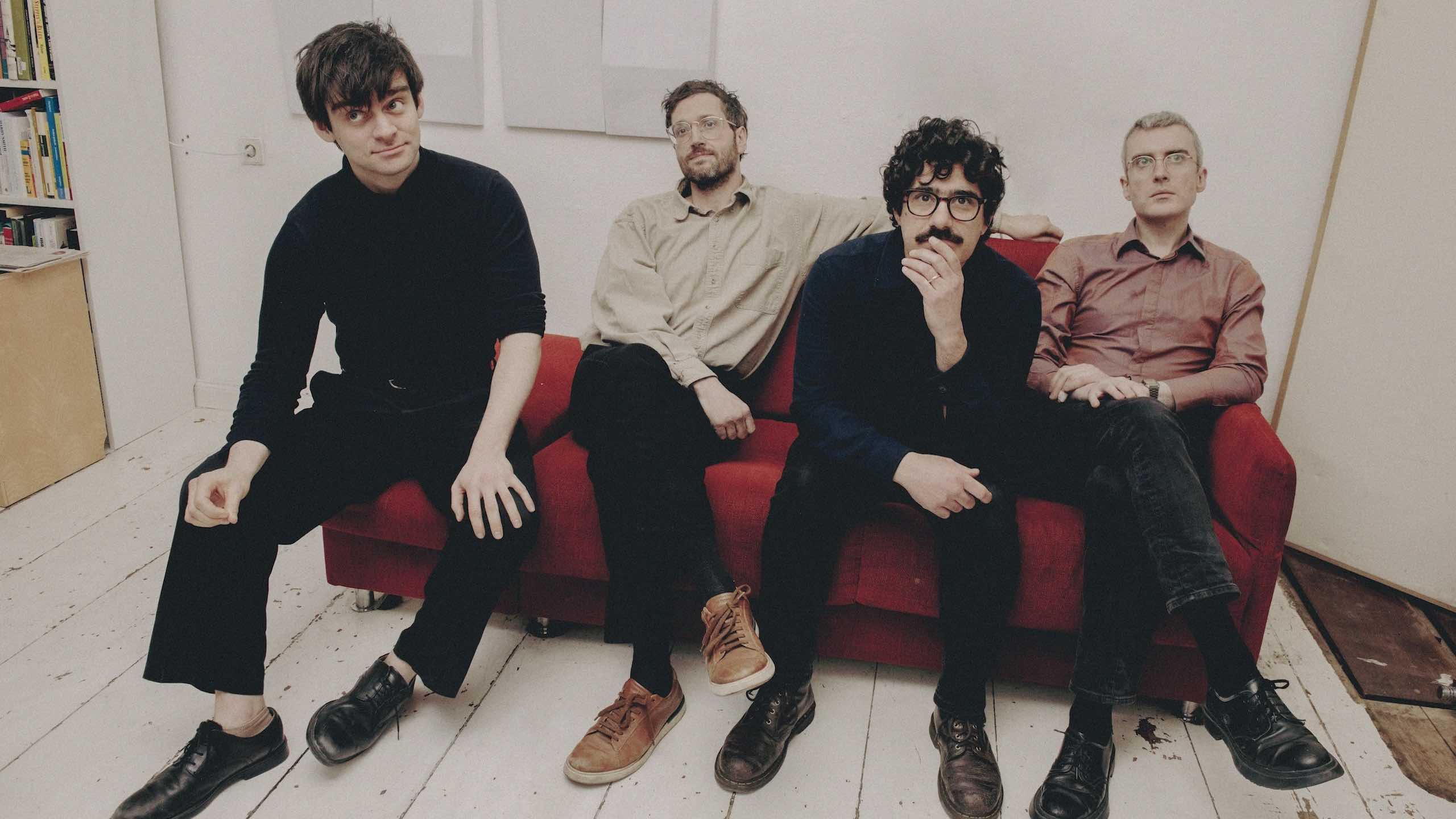

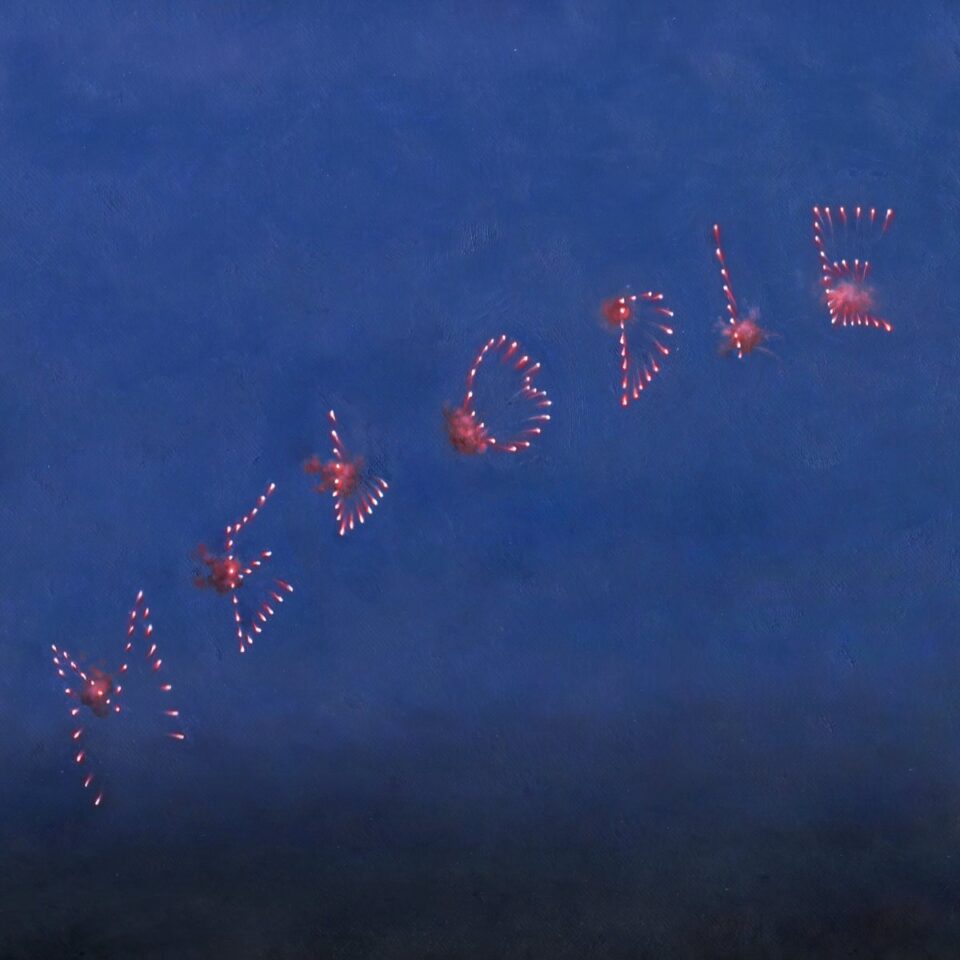
Six albums deep into a career of totalism, krautrock, mathy post-rock, and everything experimentally instrumental in between, perhaps Horse Lords’ most surprising creative decision to date came with their latest release, Demand to Be Taken to Heaven Alive!: vocals. Joining the band’s core quartet on these 12 lurching tunes are Nina Guo and Evelyn Saylor, whose voices are introduced on the minute-long a cappella intro as little more than another unconventional instrumental flourish as they’re fused into a single operatic soprano.
Elsewhere the record is familiarly minimalist and progressive (albeit with other new dimensions added to their sound: woodwind and horns sections), with the group continuing to sand down the epic song lengths of their earliest digital-age-classical material from a decade ago. In doing so, the band shares that their reference points for Heaven Alive! largely focused on music that’s rhythmically complex, rigorous yet elegant, and, above all, hard-grooving (and, perhaps even above that, music that contemplates the question, “What is it to be groovy?”). The eclectic resulting influences playlist features Brian Eno collaborator Michael Gordon, among other drone musicians working within the framework of classical music, along with the soft roots-reggae duo Love Joys to close things out.
With Demand to Be Taken to Heaven Alive! out now via RVNG Intl., check out the band’s full playlist below.
Ilessi, “Cativeiro de Laiá / Evém o Nego Paturi”
Rhythmic complexity at a sort of atomic level that grooves very hard but is basically unrepresentable in notation—is this 4/4 or 12/8? Yes! An early version of “After the Last Sky” attempted something similar, but the effect proved too fragile.
Michael Gordon, “Yo Shakespeare”
There is a ton of rhythmic play in our music. What would a three over five polyrhythm sound like distributed between the whole band? What if that triplet became the four-on-the-floor quarter note in the next section, and everything shifted around it? This is something I find inspiring about Michael Gordon’s music, that you can feel the rhythmic complexity against a familiar pulse, even when the pulse isn’t there.
James Tenney, “Harmonium #3”
A perfect sort of constant transformation where every new turn feels at once inevitable and surprising and like it could continue forever, Tenney’s formal rigor and elegant presentation is something we’re always trying to emulate.
Michael Henderson, “Time”
I was writing MIDI bass lines on headphones and ran into a line of questioning: “What is a bass and what is a synthesizer?,” further prompting, “What is it to be groovy?” This Michael Henderson piece lays out the answers.
Kadri Gopalnath, “Muraliya Naadava”
At times, when Andrew gets his just-perfect slapback echo going on his saxophone, the sax becomes a hyper-dimensional synthesizer stuck on a close-to-organ setting that’s referencing a saxophone. With this track, Gopalnath enters a similar geography.
Alex Ness, “Shruti”
The intensity of this short piece for solo viola, here played by Amy Cimini, is unmatched.
Murdina MacDonald, “Martyrdom”
Gaelic psalm-singing may or may not be an ancestor of the singing practice that informed our arrangement of “Eureka,” but it’s another, even more extreme example of familiar tunes (this one is called “Avon” in The Sacred Harp) being defamiliarized through heavy ornamentation and very slow tempos.
Jaap Vink, “Granule”
Although it might not sound like it, Vink is a minimalist of a type, asking, “How can a simple system generate engaging output? How much of a rotation is a shift in perspective?”
Love Joys, “All I Can Say”
A solid song that melts into air. The way dub explodes and reconstitutes the music as it’s happening is a constant inspiration, especially with this album that’s so concerned with looking at the material from many angles. This is a particularly haunting jam, and as always Wackies’ production is so sick.
