

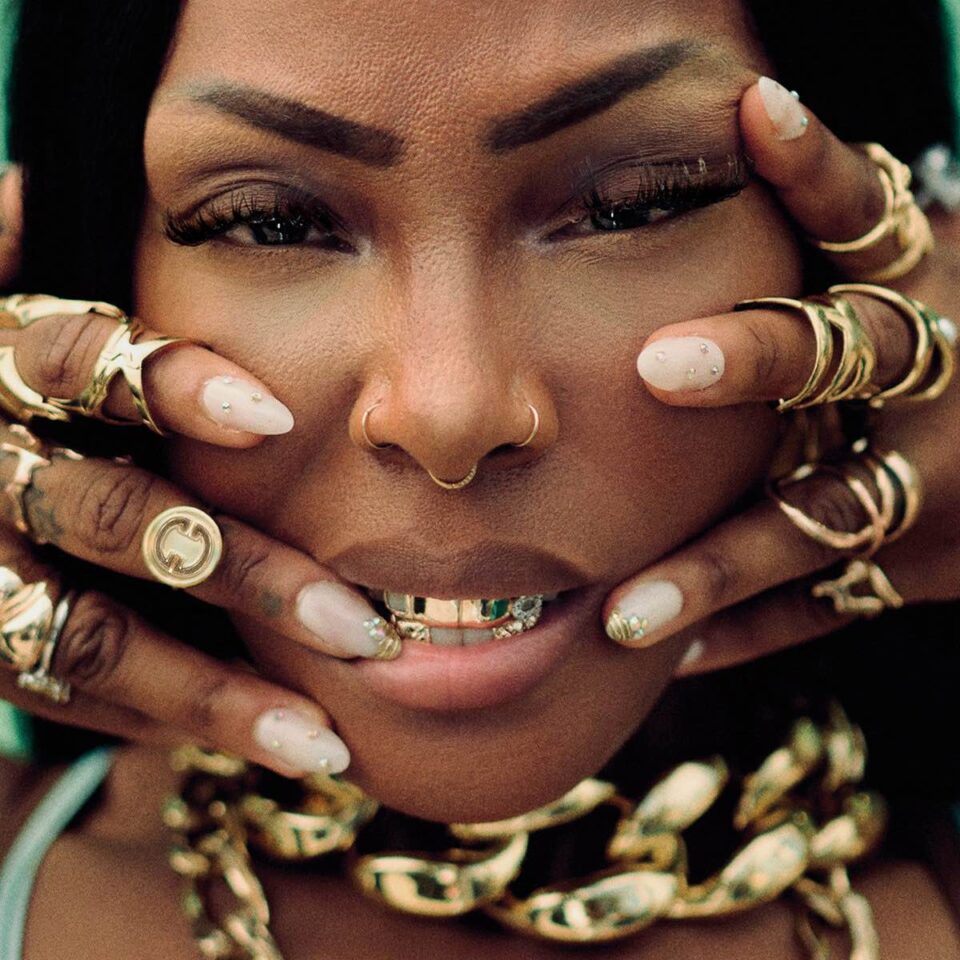
On a hot, late-June day in suburban Georgia, Jasmine Rose Wilson—the husky baritone vocalist, composer, and multi-instrumentalist Baby Rose—is sitting in her “happy place,” the sunroom at her mother’s house, where she’s soaking in an afternoon’s calm, at peace with herself and the immediate surroundings of her youth. “I love it,” she says, stretching and nestling into that phrase with additional self-satisfied syllables. Quietly content, cozy, and laughing, things will surely steam up shortly as her smoky brand of opulent, melodic, cutting alt-R&B finds release in her fire- and desire- (and guitar-) filled new album Yearnalism.
Once here, listeners used to the clarion studio frippery of the all-knowing tech whiz and her smart, signatory contralto/baritone statements on love and provocation will get hit with a side of Baby Rose previously unheard on 2023’s Through and Through, 2024’s EP-length collaboration with indie-skronkers BADBADNOTGOOD, or her GRAMMY-winning spin with Leon Thomas on his Mutt LP from that same year. More so than ever before, Baby Rose uses vulnerability within her lyrical palette the way a painter uses dense, greasy oils—something splashed, slashed, sprayed, and knifed into a textural, clicking, guitar-filled canvas of lean, mean, stark soul—on the paean to unrequited love that is “But, Nvm,” the defenses-up drama of “Dressed in Metal,” and the declaration of self that is “Jasmine’s Sonnet.”
Ahead of the release of her new album this week, we spoke with Wilson about picking up the guitar, the source of her audacity, and her PhD in Yearnalism.
Speaking to you now, you don’t sound like anyone else. Along with developing your voice in tandem with your writing, has this uniqueness of yours always been a blessing, or has it ever seemed like a curse?
I was definitely teased about the way I talk when I moved to North Carolina [as a kid]. But, as the voice I hear in my head, I never realized it was so unique. It wasn’t “different” or “interesting” to me.
You should hear it from my vantage point.
Kids are cruel, though. Especially in middle school—phew. That was some real development. Now, nobody can hurt me because I got all of the scars done to me there. And it’s cool, because when I think about that little version of me, and all of the times that I’d come home from school crying—it was so hard for me to make friends. Hindsight being 20/20, though, I can also recognize that I was coming into middle school from elementary school with no concept of what I was walking into as we moved to North Carolina at a weird time of the school year. Also, it was rougher there, and I wasn’t ready for the culture shock of kids cursing and girls being pregnant. There were a lot of elements surrounding why I was teased.
But the voice stayed pure.
That’s what I admired about where my head was at as a kid, the little version of me that was teased a lot—a lot. When I got to high school, that was my first rebrand. I wasn’t going to suffer as I did in middle school; I knew I had to do something. So I signed up for the talent show. That could’ve gone the other way, and so incredibly wrong. Middle school was rough, but high school was rougher. They will boo. It’s like the Apollo on steroids there [E.E. Smith High in Fayetteville]. But I signed up as a freshman, wearing my little church outfit, did an original song on this piano they rolled out after practicing in the foyer, and I won first place. From that day on, the bug got me. Everything snapped into place. I’m a singer. After that, all of a sudden, these kids saw the vision—now I sounded like Alicia Keys to them.

“That little pebble of extreme audacity that’s in my heart just keeps getting bigger. It even shocks me.”
Do you feel like you carry that audacity into adulthood?
I do. I just did live television—Jools Holland—for the first time, and I played guitar, which I really just started to play. And I killed it. That little pebble of extreme audacity that’s in my heart just keeps getting bigger. It even shocks me.
Why did you pick up the guitar all of a sudden? How does it feel?
Oh my God, it feels spiritual. Incredible. The mind/body connection. When I think about the portability of a keyboard, it just takes so much. And I love the piano. I can play the piano by ear, and I know theory, so I now can transcribe anything. But when I think about the guitar, and how easy it is for me to write at it, and sing at it—a new song like “Sunday,” the riffing—it’s intrinsic. Also, this is the first time learning an instrument where I wasn’t alone, where I had a mentor. We’re skipping the basics and going for the artistry. There are only so many YouTube videos you can process. The 88 DME doesn’t always work. The guitar? It’s like I’ve known her my whole life. And the piano? We’re more locked in than ever.
You called your guitar “her.” Is your piano also a woman?
She is, yeah. They’re my girls.
Do you write to what’s coming out of your head, your mouth, your heart, the instrument?
I definitely lead with melody first. Melody transcends language. Like “Ne me quitte pas.” That made me emotional before I even knew what the song was about: should I stay, should I go, the begging, the yearning. I could feel it. Or an Arthur Verocai song, in Portuguese, off of his self-titled album. I cry when I hear it. So melody is my driving force. The frequencies there ignite and inform every different emotion without saying a word. That’s the first part. Then I’m looking at what emotions are brewing from those melodies. That’s what informs the lyrics. Lately I’ve been trying not to [pack] any song with metaphors or make it super intricate—just be very simple. Like when I pray, I ask God to make it all plain and simple for me to understand. With this latest body of work, I wanted to offer the same simplicity—like, “This song is about letting go, this song is about holding on”—then letting it be a true documentation of desire that even a five-year-old could understand.
“I’m not a singer aiming for perfection. I like persevering that emotion, the initial uncertainty. That’s the secret sauce.”

As you’ve built from your debut 2017 mixtape to this album, has the process of displaying honest emotion become easier as an art form?
I think, yeah. With age, you gain self-knowledge. Also, it’s easy to do it for yourself when you’re in the middle of heartbreak. My first album was just that: raw, everything that I had on my friends’ hard drive. Through and Through I was going through getting dropped by my label, trying to find a new home. That album was a real representation of my anxiety at that time. Now, it’s not a matter of it being easier, but rather being more aware of my process. Realizing that nine of the 11 new songs were done in the last hour of the album’s recording session. Like, “Let’s do one more,” and winding up with these raw, emotional vocal takes being what I kept and building everything around that in post-production. I’m not a singer aiming for perfection. I like persevering that emotion, the initial uncertainty. That’s the secret sauce. You can’t produce that in post or re-cut the lead, not even on the 251, the Beyoncé mic. That emotion is bigger than me. That’s what’s throughout this album: leaving room for surrender, being a vessel for uncertainty.
I lecture on the topic of 21st century journalism regularly. How could I get classes going on Yearnalism? What does it mean to build songs around such subject matter?
It’s the study of and the research around desire in all of its forms, or as many as I’m aware of. I have a PhD in Yearnalism. I’ve been yearning in my music since the beginning, so I deeply understand what it means to put your pride all the way on the side to express how you truly feel. I wanted to portray the spectrum of it all. “Friends Again” and “Sunday” were the pillars, with the former being this really specific, messy scenario, and “Sunday” being about this very room right here—my mama’s sun room—and how it’s my place in the world to chill and just be. There might be a dozen fires to put out everywhere else, but when I’m in here, this is my piece of mind upheld. You could yearn to find home, whatever home means to you. You can focus your desire on unrequited love or the desire of working things out with somebody, or letting go of that which no longer serves you—with peace or with attitude, because they gotta be fucked up [laughs]. I just pull these moments from different points in time, like your journalism, and renovate them. FL

