


Judging by an older male critic’s uncomfortable squirming beside me during a scene in which our queer protagonist gets fingered while encircled by concession-stand snacks, I suspect Teenage Sex and Death at Camp Miasma won’t speak to everyone. For cult-horror nerds, queer folks, weirdos, and/or intellectual cinephiles who appreciate grindhouse ethos, though, it will sing.
Camp Miasma is as clever as it is outrageous, as funny as it is tender, simultaneously highbrow and lowbrow, horny and sincere. The word “miasma” (mai-az-muh), from the Greek for pollution or defilement, evokes the literal stench of decay, but the gore at this camp is anything but grim. The movie is a campy, blood-soaked ode to ’80s slashers, imbued with both reverence for the art of filmmaking and contention with the industry that makes it possible. Its kitschy, verbose title is matched only by its willingness to be too much: ridiculous, irreverent, and incredibly beautiful, a genre pastiche about the most intimate polyamorous relationship of them all—one between sex, death, and self.
Visionary writer-director Jane Schoenbrun described the film at Cannes, where it won the Queer Palm, as “Portrait of a Lady on Fire if it were set during a Friday the 13th sequel.” A log line has never been more accurate. It’s as if the nesting-doll metanarrative of Synecdoche, New York fused with the key plot points of Sleepaway Camp. It’s Cabin in the Woods with considerably more heart. As Sunset Boulevard is to noir, so Camp Miasma is to the psychosexual slasher. It’s Schoenbrun’s third feature behind their haunting 2021 debut We’re All Going to the World’s Fair and 2024’s critical darling I Saw the TV Glow. The first two films established their distinctive voice and aesthetic in arthouse horror—melancholic and unsettling, dreamlike in an iridescent, Lynchian sort of way, with pops of color. Camp Miasma is thus derived from that same atmospheric tradition, but is decidedly way more fun (think Robert Rodriguez, but gayer and more whimsical). It may also be their most commercially palatable feature yet.
The film follows Kris (Hannah Einbinder in her first leading film role), a meek writer-director who gets a shot at rebooting what she calls “zombie IP”—a horror franchise whose transphobic origin story she’s tasked with reinventing for studio bigwigs capitalizing on the industry’s booming nostalgia economy. She travels to the original shooting location for the Camp Miasma films to meet Billy Presley (Gillian Anderson—you know, Agent Scully), an aging scream queen turned recluse who lives alone on the old campgrounds. Billy mostly paints and sashays around her cabin in sequins and silky robes with perfect, bouncing barrel curls.
Anderson is an icon who effortlessly lends her charm and allure to the role with a Dolly-esque twang. She is hypnotizing. Hot on the heels of her performance on the HBO comedy series Hacks, Einbinder holds her own as she finds herself saddled up yet again next to a devastatingly beautiful, talented woman of a certain age. Einbinder and Anderson’s chemistry is charged with desire, but also with a genuine sweetness and attentiveness to consent, sexual anxieties, trauma, and the uncomfortable vulnerability of wanting (Anderson knows all about the subject matter; she’s literally curated books about it). Anderson also expertly avoids seeming too motherly or too predatory in the dynamic, instead inhabiting a seductive theatricality and familiar warmth. Einbinder is wonderful as Kris, a stand-in for Schoenbrun: a glasses-wearing intellectual, self-described pipsqueak who says, “I think I saw too many movies as a kid and it fucked me up real bad.” Schoenbrun has said the film’s comparative levity and joy mirror their own journey post-transition toward a better understanding of their identity and finally having good sex.
Sarah Sherman makes the most of her brief appearances as Kris’ squash-playing manager, and Jack Haven—who starred as Maddy in TV Glow—returns as Little Death, the film’s euphemistic killer donning an HVAC-vent helmet and wearing a clear plastic jumpsuit. The villain’s head accouterment seems inspired by the view from below during sex: the ceiling overhead. Haven does some incredible eye acting through an opening in the cumbersome headpiece that evokes a camera aperture—Little Death is both vent and optical device, watcher and watched. Their physicality evokes the manic glee of Gunnar Hansen’s Leatherface in the original The Texas Chain Saw Massacre, reaching a climax (teehee) in a bonkers one-shot killing spree set to Counting Crows’ “A Long December.”
The movie is a campy, blood-soaked ode to ’80s slashers, imbued with both reverence for the art of filmmaking and contention with the industry that makes it possible.
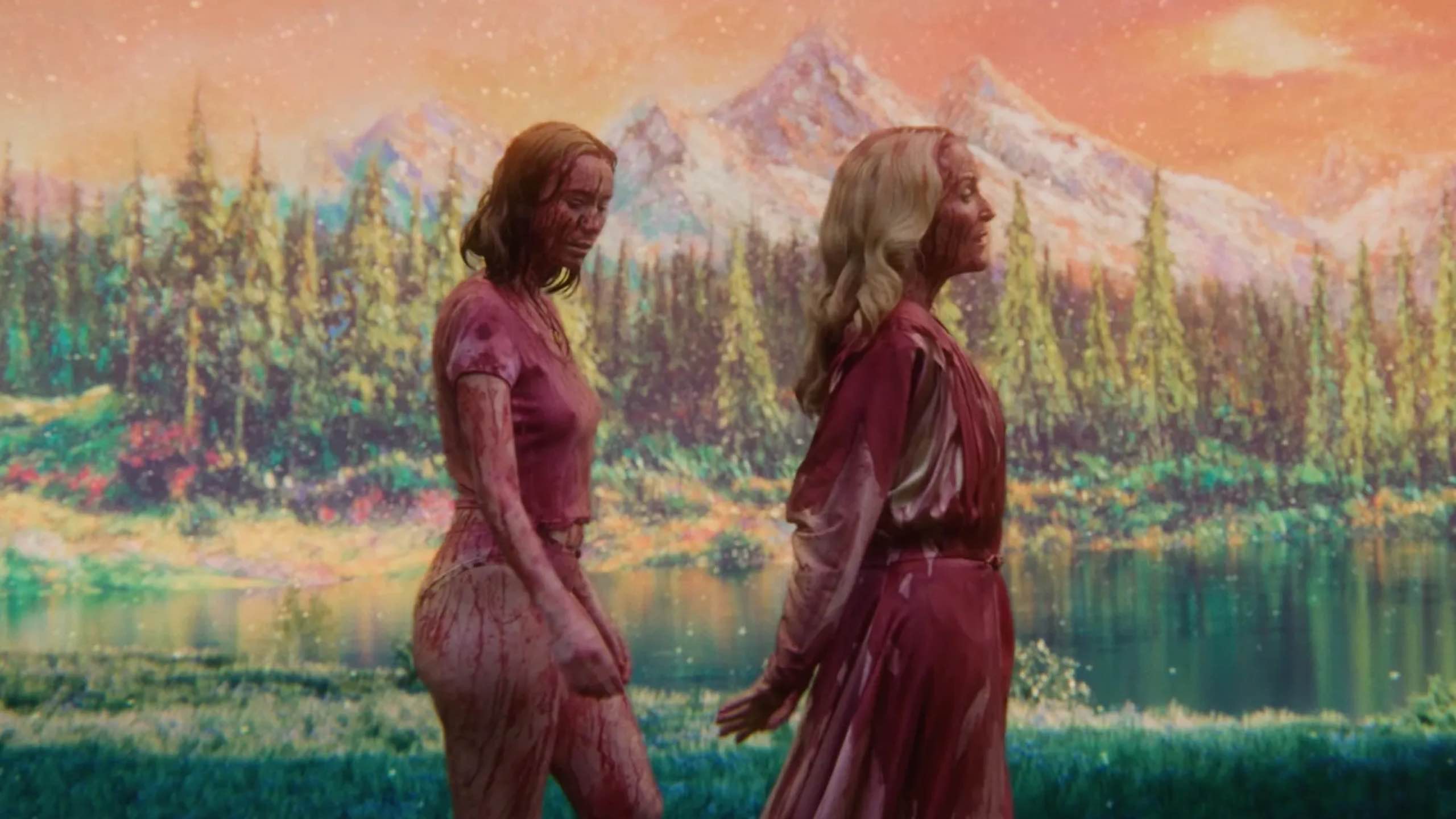
From the geyser of blood that greets the audience within the first few minutes to its painstakingly detailed opening credits, Camp Miasma announces itself as a love letter to the pleasures of physical media: VHS tapes of absurdly titled sequels; board games with instruction manuals; collectible Little Death figurines; an arcade game with options to “Run,” “Fight,” or “Scream”; posters with taglines like “Babes and blood.” It’s consumption—cinephilia rendered as junk food, in the best way possible. The metaphor runs through the entirety of the movie as snacks, candy, and even fast food surround the characters. There’s an erotic fried-chicken scene that elicited some of the biggest laughs, punctuated by a question from Billy: “Speaking of desire, do you like dipping sauce?”
Camp Miasma’s preoccupations are familiar to anyone who’s followed Schoenbrun’s work: the liminal spaces between self and media, the malleability of identity and gender, and the strange language of pop culture. But the surreal execution this go-round is gruesome and infectiously joyous. It’s a movie within a movie within a movie that repeatedly collapses the barrier between watching and participating, between the self and the media that reflects it back to us. At one point, the back of Schoenbrun’s head is briefly seen behind a camera as they’re making the very movie that we’re watching. There are moments that may challenge viewers to question how meta is too meta, but even at its most self-aware and academic, Camp Miasma is having too much fun to feel like homework.
The film is a cinephile’s dream through and through—not just in character, content, and allusions, but in execution, as well. Schoenbrun is the kind of film nerd who loves the weird shit they love with their whole chest. That care and attention radiates from every frame, from painted Pacific Northwest backgrounds rendered through optical-glass matte shots to the metacinematic split-diopter shot Kris calls out and Schoenbrun later reproduces in the film’s final scene. And don’t even get me started on Alex G’s dreamy score, Okay Kaya’s impeccable cover of R.E.M.’s “Nightswimming,” or the final, perfect deployment of Donna Lewis’s “I Love You Always Forever.”
Camp Miasma understands what the slasher offers audiences even when the movies are bad: ritual, repetition, fear, and the pleasure of fucking and dying. Sex and horror both require a kind of giving in: to fear, to desire, to vulnerability, to the possibility of losing yourself. Movies, art, and transcendental experiences all ask for the same thing. You have to surrender a little to be moved by them. You’ve got to die a little to stay alive.
