
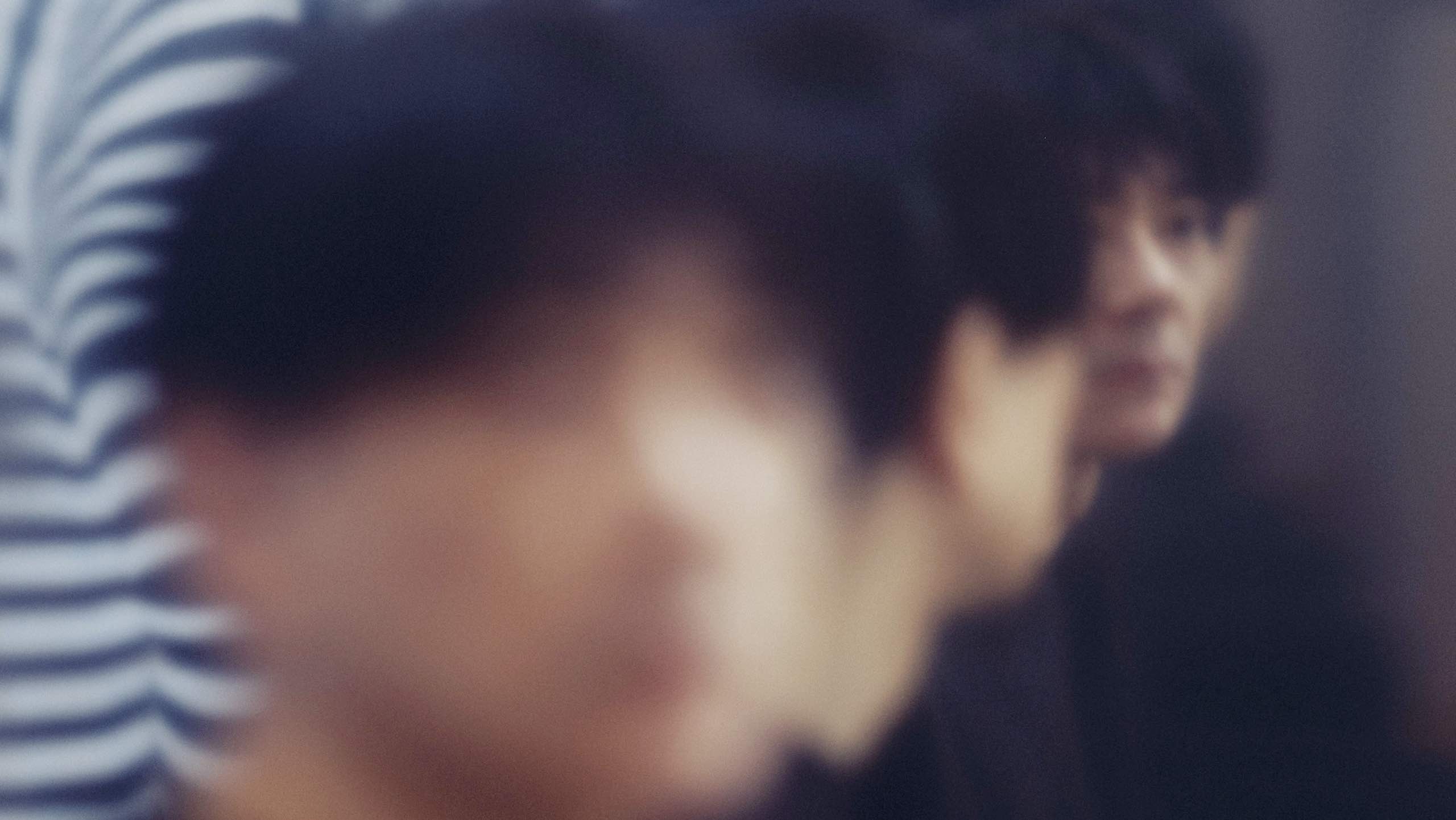

As an artist who’s been perhaps unfairly compared to Beck for three decades now, Cornelius has managed a much snakier discography over the years by comparison: Rather than ping-ponging between playful electronica and earnest folk balladry, each of the Japanese artist’s records have explored interesting subgenres like Sophisti-pop, math rock, ambient field recordings, and an array of avant-garde electronics. Yet with his latest album Refractions, it’s less about how he approached these songs in terms of genre than it was about how he could flip his usual ideas on their head.
As the record’s title suggests, the 10 songs featured on the project manage to tinker with the DNA of Cornelius’ long-held songwriting formulas, with the foundational experimentation having less to do with his musical approach than a broader rewiring of his artistic and intellectual impulses. This is a record made by someone questioning the fundamental laws of reality rather than merely tapping into new frontiers in electronic sound as pioneered by younger generations—someone who’d rather pursue alternate senses of consciousness than revisit the rulebook of our shared reality. It’s heady stuff, but as he explains to us, he couldn’t have arrived at Refractions had he not spent plenty of time researching quantum mechanics and theoretical physics.
Ahead of Refractions’s release this Friday, Cornelius broke down a few of his biggest non-musical influences on his latest chapter, which range from the spatial artistry of Olafur Eliasson to his questioning of the nature of reality. Each point of inspiration he cites affirms his mission statement for the album of turning our expectations inside-out by presenting us with a uniquely prismatic take on a classic Cornelius record. Find those influences below, and pre-order Refractions here.
Perception and the nature of reality
I’m interested in ideas surrounding the structure of the universe, the brain, and consciousness, including quantum mechanics, contemporary theoretical physics, the holographic principle, CTMU, and the zero-point field. I’m not an expert, of course, and I don’t regard all of these ideas as having the same scientific status. What interests me is the relationship between the observer and the observed world, how the brain perceives and constructs reality, where consciousness comes from, the possibility that a part may contain information about the whole, and the idea that multiple possibilities can coexist.
Perhaps we don’t experience the external world directly. Instead, the brain edits information received through the senses and constructs a different reality for each of us. In that sense, perception itself may be a form of refraction. Physics, consciousness studies, and spiritual thought were once considered completely separate, but recently they appear to be approaching similar questions from very different directions: Are the world and consciousness truly separate? And how is the reality we experience actually formed? I don’t think these fields are the same, but I’m drawn to the sense that the boundaries between them are becoming less fixed. This interest is reflected in the album’s image of a single source passing through a medium, branching, and appearing as different possible realities.
Olafur Eliasson
I’ve seen Olafur Eliasson’s exhibitions three times, and his work has had a profound influence on me. During the tour for my previous album, I had the opportunity to see his work again in Los Angeles for the first time in several years. His way of turning the patterns and spaces created by reflected and refracted light into artworks felt closely connected to the themes of my new album. I’m also drawn to the way his work makes us conscious not only of what we see, but of the mechanisms of perception itself.
In my own work, I think of refraction as the process by which a single thing passes through a medium, branches into multiple directions, and reappears in altered forms. This also connects to the idea of the multiverse, in which several realities emerge from a single possibility. In my case, the medium is not only light or a prism, but also collaborators and AI. When my ideas and materials pass through another person or a technology, they’re transformed and return as possibilities I couldn’t have reached alone. That process itself is what “refraction” means in this album.
Artificial intelligence
When I made my previous album, AI wasn’t yet widely available. Over the past two or three years, however, it’s spread with extraordinary speed and has already begun to change the way we live and work. Even this text was written with the help of AI translation. Until quite recently, I couldn’t fully express the nuances of my intentions in English, but now I can work with AI to translate, revise, and refine them much more precisely. This everyday experience has made the transformation feel immediate and personal.
I’m interested in artificial intelligence both as a creative tool and as a broader cultural phenomenon. It can produce unexpected combinations, while also revealing the patterns, conventions, and averages embedded within existing culture. Rather than using it to replace human intention, I’m interested in the friction it creates between control and accident, imitation and originality. At the same time, AI feels fundamentally different from previous relationships between music and technology, and there are aspects of it that I find genuinely frightening. It raises serious questions about energy consumption, employment, authorship, and the relationship between art and technology. Yet AI may also contribute to solving some of the very problems it creates. I think it’s important to engage with this contradiction rather than simply accepting or rejecting the technology.
On this album, I used AI as a device for creating alternative paths. It offered perspectives outside the habits and familiar gestures I’d developed over many years. I could then select, reject, rearrange, and edit those suggestions according to my own judgment. Unlike working with another person, there’s no emotional or social hesitation about discarding its ideas completely. In that sense, I treated AI as a collaborator—not one that makes decisions for me, but one that generates unfamiliar possibilities for me to respond to.
Writing a book on musical memory and discovery
Recently I’ve been working on a book that looks back at the music I’ve encountered from childhood to the present. Tracing those memories has made me think again about how different listening experiences accumulate, overlap, and gradually shape a personal way of seeing the world. Although the book is about music, the process of reconstructing memories and discovering connections between different periods of my life has also influenced the making of this album.
At the same time, the revival and expansion of streaming and archival culture have made it possible to encounter music from many different eras and regions with an immediacy that didn’t exist before. I’ve been discovering things such as 1980s post-punk from the Middle East, funk from across Asia, Zambian rock, and electronic music from South America. Encountering music whose history and context are unfamiliar to me has opened new paths in my listening and reminded me that the map of music is still far larger than I had imagined. Looking back at my own musical past while continuing to discover unknown music from elsewhere became an important influence on this album.
Mirrors, prisms, and Op art
Mirrors, prisms, and Op art have been important visual inspirations for this album. I’m drawn to the way repetition, reflection, and refraction can turn a simple form into something unstable, layered, and constantly changing. Geometric patterns can create rhythm, depth, vibration, and the illusion of movement, even when the image itself remains still. These visual processes are closely connected to the way I think about musical structure. A single element can be repeated, divided, reversed, shifted, or passed through a medium until it appears in a different form. I wanted the visual language of the album to make those structural ideas visible.
