
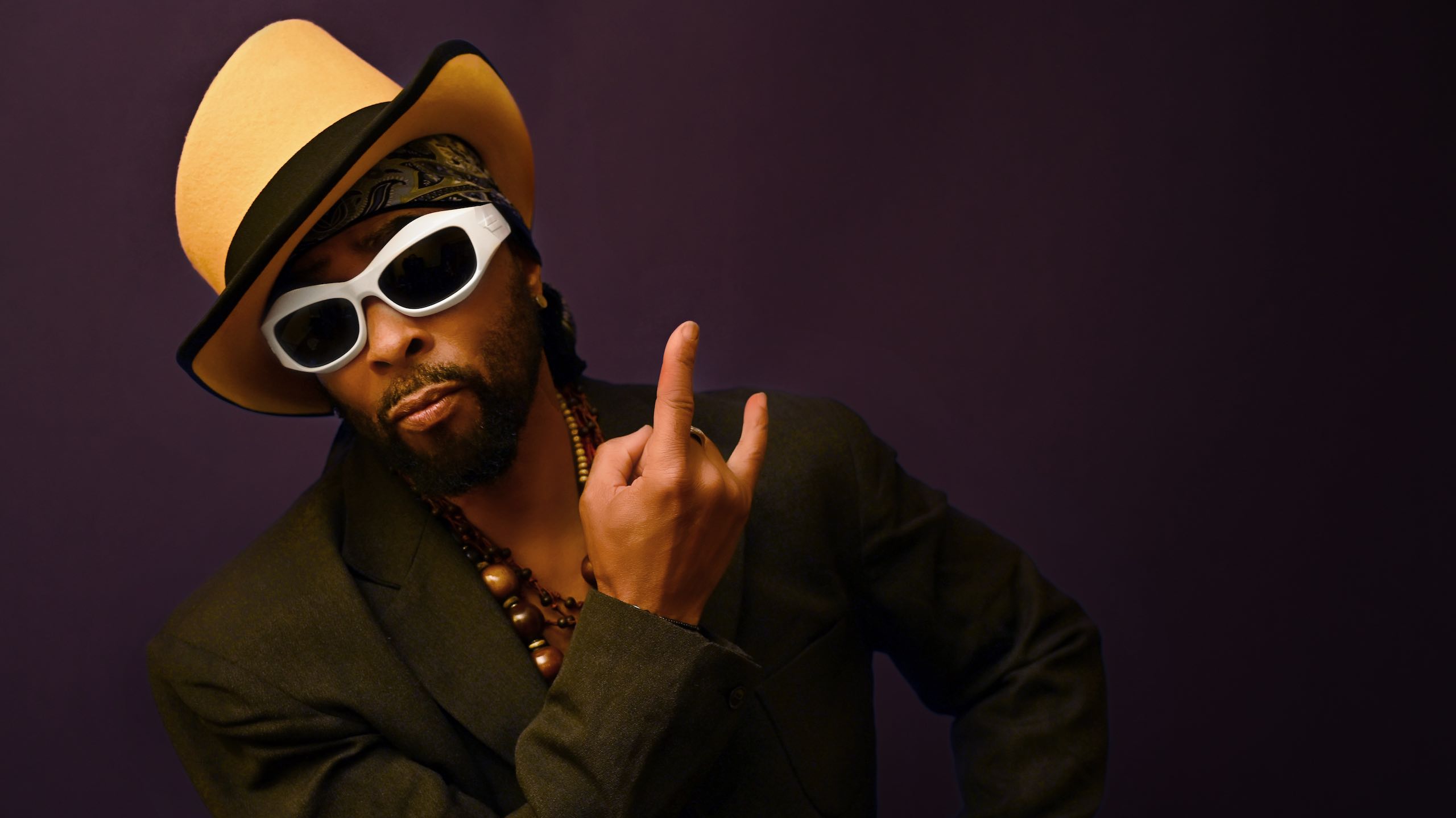

When the name André Cymone pops up among a list of new releases, you pay attention. Along with creating some of the most inventive experimental albums of the new-wave era, Cymone—as a solo artist, as Prince’s bassist dating back to their teenage years, as the producer-songwriter behind hits such as Jody Watley’s “Looking for a New Love”—was one of the men who made the “Minneapolis sound” by turning horn charts into synthesizer symphonies and bass lines into leaps of melody, harmony, and fluid improvisation.
Along with famously sharing a stage when Prince needed a live band pre-Revolution, the Purple One and his bassist shared an androgynous sartorial dress style and an autodidact’s sensibilities of picking up an instrument and learning it wholesale. Not so happily held is the belief that Prince shared Cymone’s songwriting without credit or compensation on hits such as “Do Me, Baby” and other tracks on 1981’s Controversy, though luckily the two made up—the former even gave the latter “The Dance Electric” for Cymone’s A.C. album in 1985. “He saw me play bass and drums and tried to play what I played, and I did the same with him on guitar and piano,” says Cymone. “There are unconventional guitar chords and piano inversions that Prince showed me that I still use to this day.”
Each solo Cymone album since A.C. got rougher and rockier—including his last one, 2017’s 1969. That is until now, with the release of his new, self-explanatory, hard-nosed The Resurrection of Funk with its litany of liquid rhythms and licentious lyrical character studies. With the record out now, read our brief Q&A with Cymone regarding his latest chapter, his role in building the foundation of funk, and his long personal and creative history with Prince—who he met in gym class.
What can you say about the late David Z in regard to building the Minneapolis sound together?
David and I had very different perspectives. He was an amazing engineer—great ears. His contribution came when Prince started doing his demo tape, and when I began doing stuff with Sue Anne [Carwell]. David helped us understand, sonically, how to make our sound solid. He had a way of connecting beats with the bottom end. We were doing that already, but in our own crude, primitive way before him. I mean, we were teenagers doing cassette-to-cassette recording. Luckily, the songs of ours were great—and I still have those tapes!
As you’re resurrecting the funk, so to speak, in 2026, the sound of Minneapolis in the present is a different one. How do you think your new album rises to the challenge of present-day protest and its raw emotion?
Attitude has always been a part of Minneapolis. Activism has always been a part of Minneapolis. The voices who were speaking to us when we were teenagers—local activists just as much as James Brown, Curtis Mayfield, and Sly & the Family Stone—were direct. We were young, but we were plugged in. And my mother was a community organizer—she was plugged in. It was fit for us to speak out on issues we saw happening around us, then and now. The Resurrection of Funk is about being part of my world, your world, and our world. Understanding what revolution is about and when it needs to happen. I also wanted to reawaken a music that hasn’t gotten as much shine as it should since two turntables and a microphone became the status quo, simplifying the funk and making musicians less relevant.
Do you think it’s fair to say that neither you nor Prince would’ve been who you wound up as without each other?
There’s no doubt we learned from each other. If you ask anyone who grew up around us, they’d be the first ones to say that when Prince began hanging with me, he changed. I was a loner then, as I’m a loner now, and he reached out. Fate puts you in situations you wouldn’t normally find yourself in. He just looked familiar to me when I met him. I remember we met in a gym class where I was having it out with the teacher. He told me that I was going to get us—the class—in trouble. “Who is this kid talking about ‘us’? What us?” The thing about his influence on me was that he kept me out of a lot of trouble I might have gotten myself into. I was hanging with a bad crowd before him, and I really did figure that I’d only be around until I was 21, if even that. Prince helped me stay on a path that was more positive.
There are several characters on Resurrection of Funk, and there’s clearly a story going on. Who is “Velvet Jones”?
I’d say that Velvet Jones is a woman. And Velvet Jones is a state of mind, a destination, an experience. Velvet Jones is a lot of things, a symbol or a muse for a writer—a Medusa, for certain. When I was doing this album, I had a few people ask me about putting a ballad on a so-called funk album. Some people mentioned how Bootsy [Collins] had this sort of ballad, and how George Clinton had his own kind of slow song. I always just do what I want to do, but in talking about it, the conversation opened me and I began thinking about what it would be like if you could speak from the inside of a sexual experience. That’s what Velvet Jones is to me.
When you moved on from Prince, the solo music that you put out was this oddly angular experimental new-wave thing. Would you say that Resurrection of Funk is the solo album that perhaps should’ve come out in 1982?
Absolutely. Prince is a genius, a best friend. I owe a lot to him. But the reality is, when you’re young, you often don’t know about things like publishing. When you’re in a band with somebody you’ve known prior to all this, when you come up with songs, you come up with songs together. There’s no “my song” situation until you realize that there’s a business attached to all that. Then it winds up on their album, people love that song, and the person at the center of that winds up with houses and cars while you’re still living at your mom’s house riding your bike. Prince and I were living in our own house together, and while I’m watching him doing his thing, I began concentrating more on me doing my own thing. My demo was funky. Hardcore funk. And it got lost. Prince said they accidentally erased it. Who knows what happened to it—until I can get into Prince’s vault, I’ll never know. I’d love to have gotten credit for that early stuff, but I wasn’t waiting around then. I went into a whole other direction for what I did at that point for a first solo album, and now there’s The Resurrection of Funk—part one and an upcoming part two—filled with stuff that I know how to do like no one else could ever do.
