
Hatsune Miku entered the world in 2007 as little more than a soundbank for Yamaha’s virtual vocal synthesizer Vocaloid and a drawing of an anime cyborg with two long turquoise ponytails, but she instantly found a massive fanbase that would turn her into one of the world’s first truly global non-human pop stars. Unlike other animated artists like Gorillaz, Hatsune Miku isn’t a piece of art, but an instrument—anyone with an iPhone or a laptop and the incredibly accessible Vocaloid software can “collaborate” with her to make her sing whatever words and melodies they want.
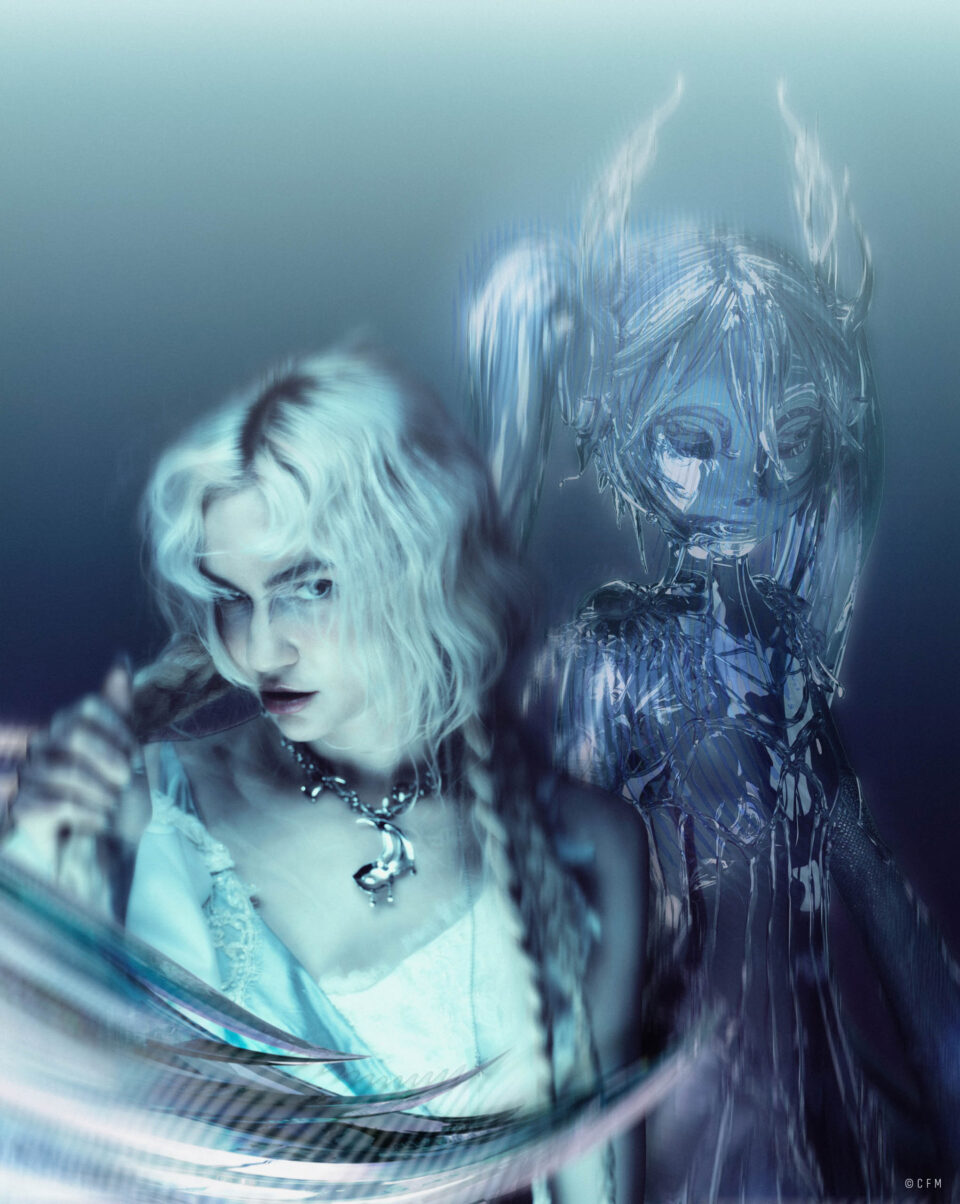
The upcoming compilation EMERGE M♡DE MIKU brings together some of the most popular producers in the Miku fan culture, such as hyperpop-adjacent artists Frost Children, George Clanton, Odetari, and slayr. The project’s lead single, “Miku Maxxing,” was a collaboration between Vocaloid producer SatapanP with the future-pop icon Grimes, who’s not only put out a song named after William Gibson’s neologism for a virtual pop star, but has also used AI to make her own voice into a publicly available soundbank. She’s also, unsurprisingly, a Hatsune Miku fan herself.
Ahead of the full EP’s release on September 25, we had five questions for Grimes about collaborating with pop music’s most famous anime cyborg and her own recent experiments with accessible vocal software.
As a sci-fi fan, not to mention an artist who’s spent time thinking and writing about this subject, what was it like for you to make a song with the closest thing we have so far to a real, pop-star-level idoru?
It was incredibly delightful for me—as you may know, I have a song out called “Idoru.” There are very few things I say yes to as quickly as I did for Miku. The whole thing has been surreal so far as it has been a giant team of people. There’s something really beautiful about the idea of a completely artificial pop star; it’s closer to the platonic ideal of the pop star. The pop star represents this completely artificial artform, in a good way—think rococo, or “art for art’s sake.” A popstar is a creation of complete and total optimized euphoria. In some ways, the popstar is the ultimate opiate of the masses. It was a real honor to work with Miku, as in many ways she’s the first real version of this concept.
“Miku-Maxxing” is a collaboration with SatapanP, who’s like a celebrity producer in the Vocaloid world, and also someone who’s really explored the possibilities of making music through avatars. What was it like working with them, and did you learn anything creatively in the process?
It was great to work with Satapan. They have the coolest style; I genuinely think they’re one of the best-dressed people I’ve ever met. We couldn’t talk much due to the language barrier, but my favorite part of working with them was when we began writing lyrics together. I remember asking him, “What do these lyrics mean in English?” And Satapan said they made them up and they don’t mean anything in Japanese, either. Satapan is truly living on the edge of their mind, which I respect and appreciate.
You released your own AI voice model in 2023, which let people license your voice to sing on their songs with whatever lyrics and melodies they want. What was that experience like for you?
It was a really interesting experience for me. It was equally negative and positive for fans, people I worked with, and me. A lot of people used it for scary, dark things and had me say terrible things, which I didn’t love. Over time, it began to feel invasive. At the same time, though, a couple of people wrote really amazing songs that I wish I had written. Whether it was a great lyric or a really good top line, I remember being so honored to hear foreign genius using my voice. We also created a pretty awesome economic model out of it where people could be paid. I was mostly honored that people made such amazing music from it.
You’ve also been critical of some of the ways AI has been deployed, especially when it comes to vocal cloning. Do you see a way forward for human artists to coexist in a mutually beneficial way with generative AI, or is it really the zero-sum game that a lot of people think it is?
I’m not super bullish on AI art, but I think there are some people that do it right, such as David Holz of Midjourney. Midjourney is investing their funds and research into building medical technology. I’m pretty disappointed that the AI community went for art first. Even before AI, we’ve been in a dark place, and what I see AI doing culturally is highlighting the problems we’ve been dealing with in the art world. We’re already dealing with the difficulties of making a living as an artist, human-made slop, and subscription services that barely pay their artists. Personally, what I wish would happen would be that more AI companies would follow the likes of Midjourney and Anthropic. For example, Anthropic has pledged to end flus and airborne viruses while other AI companies spread culturally nihilistic messages. The issue isn’t the technology, but people engaging in active abuse of nihilism toward the culture.
Will you be posting “Miku-Maxxing” on your LinkedIn?
I should post about “Miku-Maxxing”! This is definitely being discussed. I will talk to my team and be on it ASAP.