
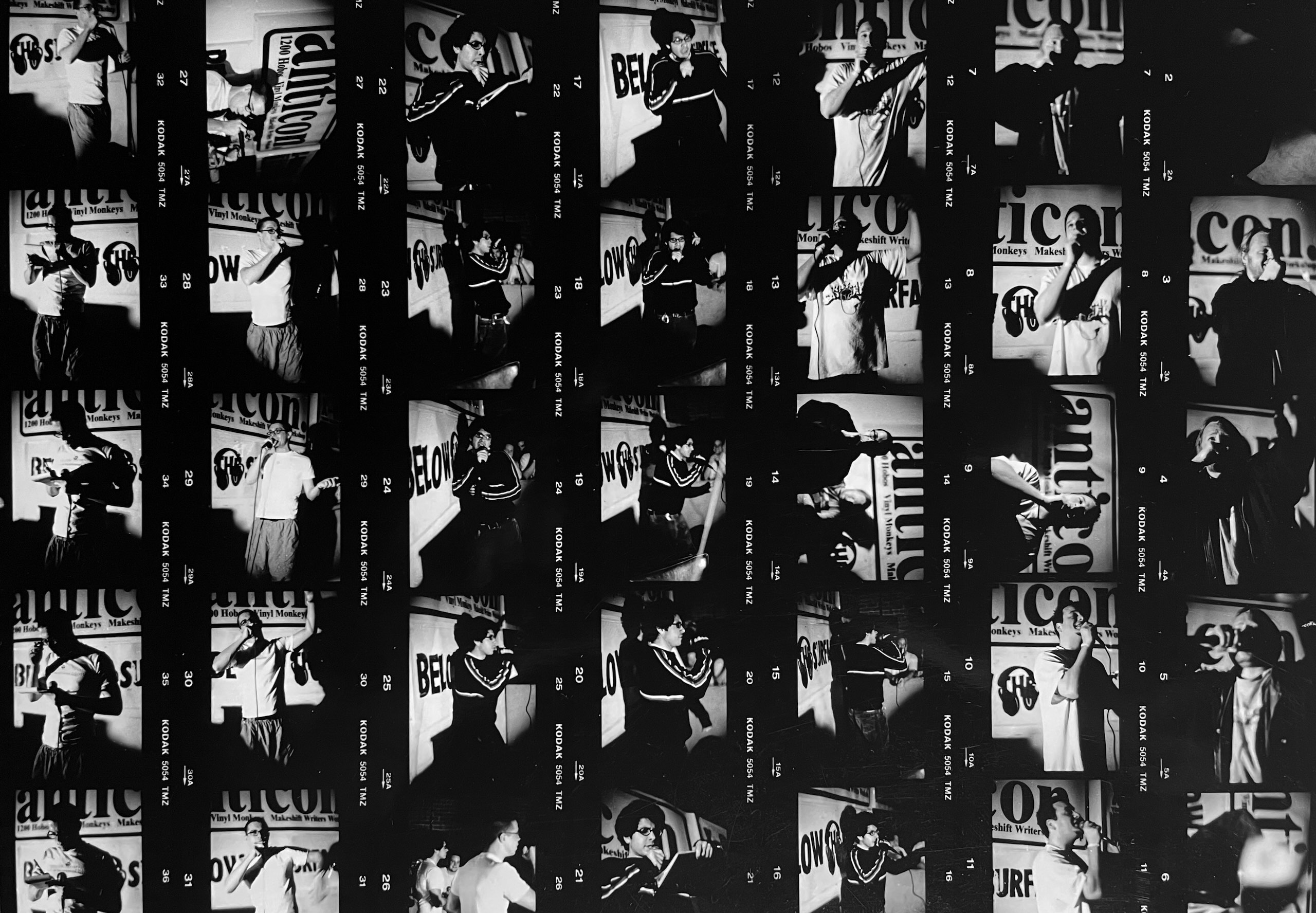


Independent rap has always been a place for outsiders and boundary-pushers, outcasts and nonconformists. This idea has perhaps never been more true than in the case of Anticon Records, the label that took left-field rap and moved it into the upper-deck bleachers. The collective was founded at the end of the 1990s by a crew of poets and musicians including WHY?, Sole, Doseone, Alias, Jel, Odd Nosdam, and Pedestrian. From the label’s early days to its eventual disbandment following the death of Alias in 2018, Anticon has attracted an unflinchingly loyal group of devotees, in addition to an equally passionate (though smaller) group of detractors uninterested in their vision of hip-hop.
Joseph Rathgeber, founder of Caltrops Press, tells the label’s story in its entirety in his new oral history, Catch Us Before We Fall Off: a [ch]oral history of anticon (Volumes 1 & 2). In addition to writeups on Anticon’s discography and plenty of rare and previously unseen photos, the pair of volumes also features extensive interviews with the label’s co-founders, signees, and collaborators, as well as other “prominent figures from the underground hip-hop scene.”
To celebrate the release of Rathgeber’s opus, we’re sharing an excerpt from Volume 1. Read the introduction to Catch Us Before We Fall Off: a [ch]oral history of anticon (Volume 1) below, and order the books here.
INTRODUCTION
We will never fall the fuck off—we promise.
—Freestyle Fellowship, “The Future?” (1991)
I will never fall off—I promise.
—Sole, “Prosperity” (1998)
Catch us before we fall off.
—slogan appearing on www.anticon.com (c. 1999)
Invoke the name “anticon” and you can anticipate an impassioned response. To some, anticon was an affront to hip-hop; to others, an advancement of the form. This antagonism was at the core of anticon’s musical compositions and their operations as a collective. Regardless of your position, the very existence of anticon typified the most contentious debates within the underground hip-hop community at the turn of the millennium, an underground hip-hop community that grew increasingly factionalized, in part due to the machinations of Sole and the emergence of anticon. Discourse around anticon centered on arguments of traditional and experimental approaches to the music; questions of authenticity, race, and appropriation within the culture; and the pervasive hypermasculine and homophobic attitudes within the community. The anticon movement, Hua Hsu once wrote, “embodies all the fascinating contradictions which both sustain and complicate the culture.”
anticon represented the potency and possibility of what underground hip-hop could be. anticon and their affiliates came from disparate geographic outposts—from places like Maine, Nova Scotia, Minnesota, and Ohio—far from any immediately recognizable hubs of hip-hop activity. They found each other and came together through unconventional means—through primitive internet services, tape trading, and long-distance telephone calls. Harnessing premillennial technology with postmillennial thinking would prove crucial to their success. anticon’s forays into other genres—out from the confines of even the most “alternative” and “experimental” rap and into the vastness of post-rock, electronica, indie rock, and ambient—reaffirmed and proved the expansiveness of hip-hop’s potential. In doing so, they did “advance” the form. It would be difficult to argue otherwise.
For all of anticon’s pretensions, they demonstrated a show-and-prove spirit, though their detractors often chose to ignore the origins of the dues-paying individuals who made up the collective. anticon advocated for “art” and “poetry” in their rarefied vision and version of hip-hop, but they also relied on irreverence to market themselves and employed caustic humor to fend off the attacks of their critics. These techniques endeared some while repelling others. Despite what some saw as racial misdeeds and social pratfalls, anticon’s espousal of radical politics was ubiquitous in their recorded music and public statements, in their habits and their performances—anti-war positions; anti-consumerist propaganda; the virtues of veganism; rebukes of wage slavery and techno- and theocratic powers, to start—ideology which allowed them to deftly pivot from a pre-9/11 understanding of the world to a post-9/11 understanding of it. anticon took risks—some careless, some calculated—deconstructing the notion of “biting” within hip-hop and displaying a willingness to blunder their way through business plans while remaining fearlessly enterprising in their efforts to be heard. All told, anticon epitomized an avant-garde moment and movement in underground hip-hop—bursting with unbridled ambition, inciting with insolent attitude, and blasting an angsty, surreal, and oftentimes revolutionary rap music.
Like most underground scenes, the underground hip-hop scene at the turn of the millennium was comprised of rejects—those whose music, style, or aesthetic was shrugged at or aggressively dismissed by the mainstream. These rejected voices chose to create according to their own inclinations with a DIY spirit removed from the binaristic commercial understanding of failure and success. They stopped sending out demos, ceased any appeals to the industry establishment, and muted any desire to “be down” with powerful figures. Instead, they built their own space, recorded music with like-minded MCs, DJs, and producers, released music through their own labels, and promoted the work through receptive channels. Underground scenes, according to Zachary “The Scribe” Smith, provided “an alternative to the corporate-controlled, risk-averse, talent-optional beasts that pass[ed] for contemporary rap.” This allowed hip-hop to take a “quantum leap toward a decentralized state of being.”
But even within an underground community made up of spurned artists, anticon found themselves further repudiated, which forced them to cleave an even deeper path. Like many, anticon made the decision to forgo seeking the validation of others. They found security and empowerment in the shared vision of a small community. They surrendered the notion of receiving offers from Rawkus or the hope of seeing their LPs stocked on the shelves at Fat Beats.
In Hip Hop Underground: The Integrity and Ethics of Racial Identification (2009), Anthony Kwame Harrison explains that underground hip-hop artists made “extensive efforts…to address topics that fell outside of commercial rap’s dominant conventions and to compose atypical rhyme schemes and lyrical cadences.” anticon did the same, though their aberrant thematic concerns, atypical patterns, and distinctive voices were deemed too “weird” or “artsy” even by the standards of the underground. Such words were epithets designed to marginalize anticon, and the most egregious epithet (“art fag”) was intended to offend, but anticon tirelessly subverted the intent of these adjectives and overturned the slur. Thelonious Monk long ago asserted that “weird means something you never heard before,” and it was George Clinton who described hip-hop producers as going full “artsy-fartsy” in order to make “noise sound good.” But we don’t need to venture outside the realm of underground hip-hop to find justification for anticon’s eccentricities and experimentalism. We can consider what Aceyalone proposed on A Book of Human Language (1998). anticon made concerted “attempts to redefine your hip-hop guidelines.” Jeff Chang has written about hip-hop’s capacity to “change the paradigm” within society and how hip-hop, as a culture, is prone to moments of rupture. The emergence of the anticon collective within the underground scene, I’d argue, would qualify as one such rupture.
Tom Johnson, composer and Village Voice critic of minimalism, claims that artistic movements aren’t the product of individuals; rather, “[t]hey are produced when a number of talented people happen to be evolving in the same place at the same time. If the situation is right, their ideas cross fertilize, hybrids are formed, these produce other hybrids, the procreation of ideas accelerates, and gradually real breakthroughs become possible.” Writing for The Wire in October 2000, Hua Hsu called anticon “a dream team of progressive, intelligent and damaged nomads” who were “ready to trade margin for center and take the music places never before nightmared.” In the San Francisco Bay Guardian, Mosi Reeves stated that “the collective [was] challenging preconceptions of what rap music is and what it can accomplish, artistically and emotionally.” Alternative Press attested to the fact that anticon’s “innovations [were] rearranging hip-hop’s DNA.” Muzik claimed that “you can be as suspicious as you like of the whole anticon thing, but you can’t argue with their music.” dose, meanwhile, once referred to anticon’s inchoate configuration of Sole, pedestrian, and Reverend Destructo as an “un-posse,” a “mixture of stupidity and creativity.”
anticon’s strange brand of hip-hop inadvertently, though perhaps predictably, led to wider audiences—their genre-bending sounds endeared them to fans who weren’t acculturated to hip-hop in the slightest. That appeal likely had as much to do with race as it did their music, and many of these newfound fans tuned in from overseas where the press coverage anticon received was often fawning if not unerring. Rob Young, writing for The Wire, once described anticon as a “kind of cultish collectivization, built on a shared mistrust of what and who the world wants you to be.” In the pages of Mojo, Ben Thompson wrote of the “special thrill” that only comes around “once or twice a decade” of discovering “not just a single new band, but an entire self-sufficient musical community.” Bay Area-based anticon, he went on, was the epicenter “of an underground hip-hop earthquake whose after-shocks will eventually reach us all.” His comments now seem prescient even as recognition of anticon’s influence has gone mostly unacknowledged.
In Charlie Ahearn’s 1983 film Wild Style, Double Trouble sit on a stoop, snapping and rapping back and forth and in unison. Lil Rodney Cee starts, Here’s a little story that must be told. Similarly and allusively, Ad-Rock’s Now here’s a little story, I got to tell over a suck of reversed 808s on the Beastie Boys’ “Paul Revere” is another invocation to the muses, to necessity. Slick Rick felt the same pressure to tell a tale on “Children’s Story”: Now here’s a little something that needs to be heard. All three MCs minimize the stories they relate by describing them as “little,” though no story is too small to tell—and these stories in particular, as if etched into cuneiform tablets, are certainly worth the time and attention. Furthermore, they’re urgent. They “must” be told—and not later, but “now.” These rappers speak of parables that can’t be postponed.
The stories we’re told aren’t always the ones we want to hear. For example, when Nas and AZ recreated Double Trouble’s Wild Style scene on a stoop in 1997 for a Sprite “Obey Your Thirst” commercial, the story was one of the rapid corporatization and branding extravaganza surrounding a newly discovered globally marketable culture. The vultures were circling. I didn’t want to hear that story, or, at least, I didn’t want to believe it. But there it was, broadcast on a loop on my TV screen, and so we processed it through our ruthless critiques. Hip-hop is “obsessed with criticism and self-criticism,” Marcyliena Morgan has said, “in an effort to both maintain and raise standards.” The culture engenders what she calls an “unrelenting system of evaluation and reevaluation.” Stories, of course, aren’t always convenient or comfortable. The story of anticon is one that I believe is imperative. To echo Lil Rodney Cee, it must be told.
