
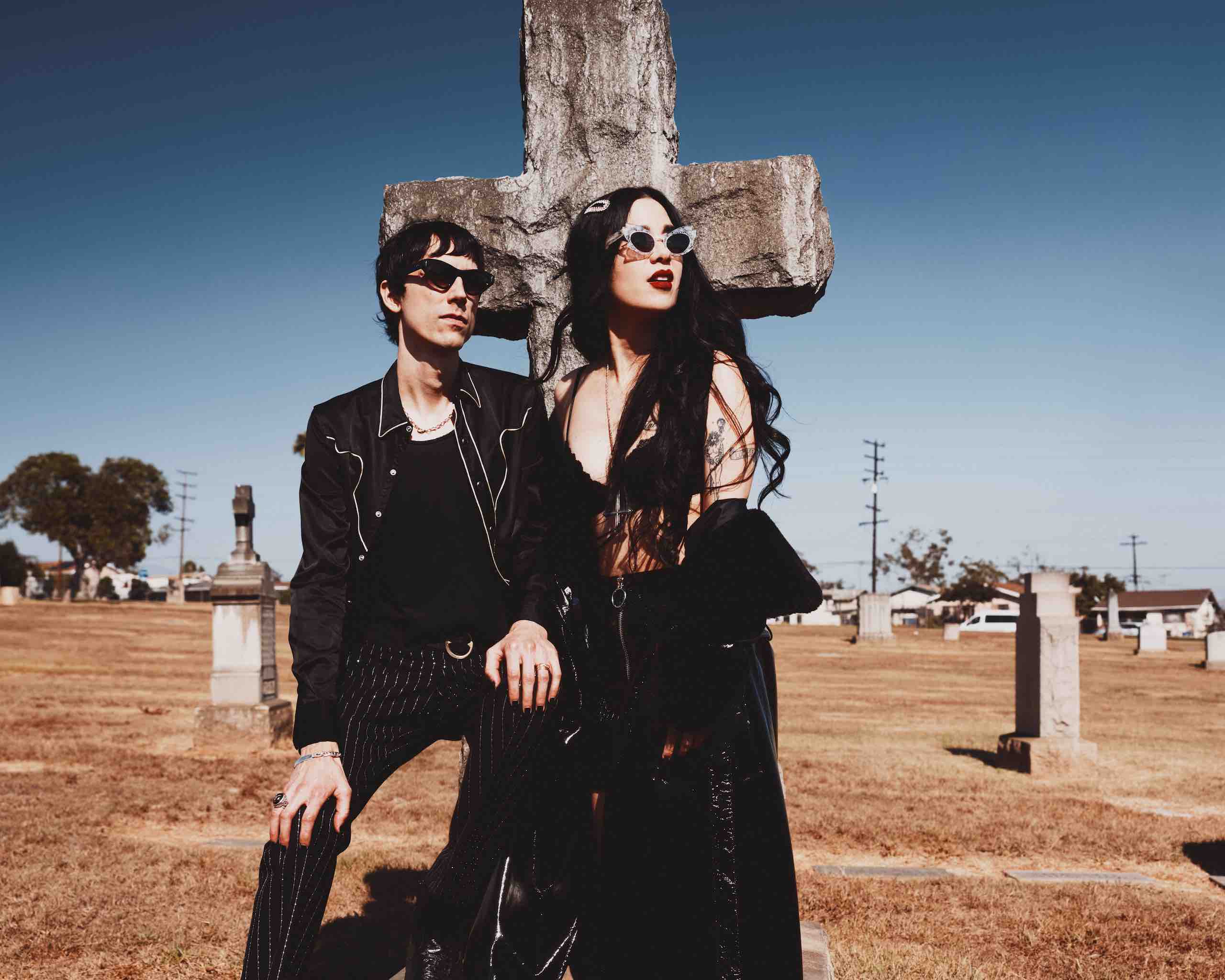

You likely know Satanic doo-wop duo Twin Temple from being booted off of Charlie Crockett’s recent tour, followed by Jack White inviting them to open a show for him. But this isn’t just a shtick: For all of their dark trappings and being “your friendly neighborhood Satanists,” Alexandra and Zachary James (vocalist and guitarist, respectively) are rooted in classic American rock and blues and have a lot of reverence for mid-20th century music.
That’s evident on their third album, Doomed Lovers, in songs like the dreamy title track and the twangy “Haunt Me” that one could imagine being used in a David Lynch film. If you grew up with Satanic heavy metal bands like Mercyful Fate, this music swings to the other side of the pendulum, lyrics notwithstanding (they do approve when I invoke that band). The new studio album was produced by Shooter Jennings, who has an outlaw-country pedigree but, like Twin Temple, enjoys mashing things up. They met Jennings at the group’s Wiltern show in 2022 and finally got to collaborate here. This union was literally lifesaving for this demonic duo, as they attest when they speak with me.
With Doomed Lovers arriving this week, read our conversation below.
How did you feel Shooter influenced the making of this record?
Zachary: We got to record at Sunset Sound—he’s a resident over there in Studio 3. We love the history of Hollywood recording and recording studios, and Sunset Sound is one of the last independently owned studios that’s still functioning as a professional studio. It was really cool to work in that space and it obviously influenced us a lot, just being able to be a part of that Hollywood history while it still exists. We wanted to dive into some of our mutual loves, and on this record you hear a little bit of country and stuff. We branched out a bit and explored some of the more countrypolitan sounds that we all love, like Patsy Cline and Roy Orbison. I think it was just an excuse to dive into that space and explore it together with Shooter.
I think there’s a country/hard-rock crossover in terms of audiences.
Alexandra: To us, it’s all the same, right? Look at Chuck Berry in the beginning: Is he country? Is he rock and roll? Is he both? I don’t know if we see such a division between these forms of classic American music. They all share a similar heart and soul, and that’s what we’re interested in pursuing.
With your ’50s music and ’80s satanic imagery, you’re getting the same kind of vitriol from fundamentalist Christians that I think the original rock-and-rollers did.
Alexandra: Absolutely. I think anything that rattles the cage, that reeks of rebellion or nonconformity, will be demonized. The music we play is very rock-and-roll, is very much like an outsider culture. It’s subversive. It’s transgressive. It’s meant to push back against rigid societal norms. We see the through lines from early rock and roll to what we do now. It’s like Tony Iommi—who does he love? The Beatles. But they couldn’t be The Beatles, so they were Black Sabbath. Or Glenn Danzig, who did he love? Elvis and The Doors. A lot of people think metal is completely different from doo wop or rock and roll. But the fact is it all goes back to source.

“Anything that rattles the cage, that reeks of rebellion or nonconformity, will be demonized. The music we play is meant to push back against rigid societal norms.” — Alexandra James

You sang “Let’s Have a Satanic Orgy” in Spanish last year in Los Angeles. Do you have a strong Latin following?
Alexandra: From what we’ve heard, there’s quite a big presence of Spotify listeners in Mexico, so we’ve really got to get down there and play. Living in LA, which used to be Mexico, it’s such a huge part of the culture here. I speak Spanish. It’s sick as hell to be cruising down the streets of LA and see lowriders going by blasting the oldies. That’s definitely influenced our mindset here, and there’s a lot of inspiration we take from Latin music. “Orgy” is usually using a Latin rhythm called the baião, which was actually picked up a lot in the ’60s when there was an interest in Latin music. You heard a lot of people incorporating those rhythms and grooves, everything from Leiber and Stoller with “Under the Boardwalk” to [Richie Valens’] “La Bamba.”
Can you imagine your new songs like “Doomed Lovers” and “Love You to Death” being played by a band in the ’50s?
Zachary: I would’ve loved the records, that’s for sure.
Alexandra: I think “Doomed Lovers” isn’t that far off structurally from something that would’ve come out in the ’60s on RCA in Nashville. We’re trying to keep a lot of these classic recording techniques, chord progressions, songwriting structures, and arrangement techniques alive. We’re not actually trying to reinvent the wheel, but we’re trying to push them forward because we truly love them. A lot of these ideas and the craftsmanship has gotten lost over time, which is really sad to us. This is one of the greatest elements of American culture that we want to preserve.
Many conservatives have been enamored with the repressive, vanilla, and whitewashed 1950s. Yet for all the conformity, the Red Scare, and the Hays Code, we also got rock and roll, Playboy, Betty Page, lurid horror comics, and sci-fi monster movies.
Alexandra: I think you just named the fundamental pillars of our underground culture and specifically what we love. That’s everything that we’re drawing from, to be honest. I think you really saw the rise of that in the ’50s and giving people who don’t conform to the mainstream majority a new voice, which I feel started with jazz and the blues in America. That’s when you started getting these cool subcultures that weren’t just mainstream vanilla culture.

“We branched out a bit and explored some of the more countrypolitan sounds that we all love, like Patsy Cline and Roy Orbison. I think it was just an excuse to dive into that space and explore it together with Shooter.” — Zachary James
What’s the most personal song on the new album?
Alexandra: I feel like “Doomed Lovers” is really personal. I allowed myself to say something on that song that maybe I wouldn’t say in normal life. “Monster” and “Nothing Matters” are dealing with grief, in particular. Not that our last records weren’t personal, but they’re our personal beliefs and ethos and things that we were thinking about. But I’m not sure I incorporated as many elements of our personal lives on the other records. We went back and forth on how much of our soft underbelly we wanted to show, but I think it’s important to us to evolve as artists, and it felt like the right thing to do to share these songs.
Zach and I need to create art like a fish needs to swim, and the music industry is riddled with setbacks. It’s actually really fucking hard to put a record out and put a tour on. Over the last four to five years, we’ve experienced professional setback after professional setback. It crushed us. Our last record we finished in 2020 and signed with a label that basically benched us for three years. We couldn’t put that record out. They had an option on the next one. We had completed two records in that span of time, and we literally couldn’t put it out. By the time we got it out, we had to buy the record back at a premium with a bunch of money tacked onto our advance. It crippled us financially. It’s really frustrating as an artist to put something out four years after it was completed. We’d made another record after God Is Dead which never saw the light of day. Then we reset our entire team, which is challenging.
Sounds like it.
Alexandra: Personally, we got sober, and we lost some close family members that were really pivotal in my life. We lost our dog, we had a bunch of health issues. We really just got pummeled. Our lifeline is making music, and that was literally taken away from us. I sunk into such a deep depression during that time, and we really didn’t receive any meaningful support from the industry. Just thwarted at every turn. It was one of the hardest periods of my life dealing with all of those elements all at once.
The silver lining was we became friends with Shooter before all that was happening. He and his wife have just been such a huge support. At that time, we had no label, we had no management, no one wanted to sign us. We basically did a slap job on putting God Is Dead out. It was handled so frustratingly for us. [Shooter] was like, “It doesn’t matter, just come to Sunset Sound, you guys are great.” Zach and I told Shooter we don’t think we can do this anymore. It’s too depressing, and honestly, our mental health is suffering. I think we need to quit.
He encouraged us to make this record. He even gave us the keys to Sunset Sound when he went on vacation with his wife. That made such a huge difference to us, getting to work in such a legendary environment. The Rolling Stones have been here. It just felt like a dream. We started our own label, we put it out ourselves. We’re managing ourselves. I think it really reconnected us to what we love about music and what’s so beautiful, and it was so fundamental in healing us. I don’t think we ever realized that a producer, in many ways, is not [about] finding sounds, but being a person pushing you on the road to Mordor—being like, “Just take one more step.”
“We started our own label, we put it out ourselves. We’re managing ourselves. I think it really reconnected us to what we love about music...it was so fundamental in healing us.” — Alexandra James
You had all this turmoil in your life, and yet you do this soothing music now with these lush strings.
Zachary: Yeah, I think we tried to capture some beauty.
Alexandra: We just wanted to make something beautiful, and strings are so romantic. They cut to a kind of sadness and weeping sensibility.
Zachary: We like heart-wrenching strings, for sure.
Alexandra: We wanted this record to yearn. FL

