
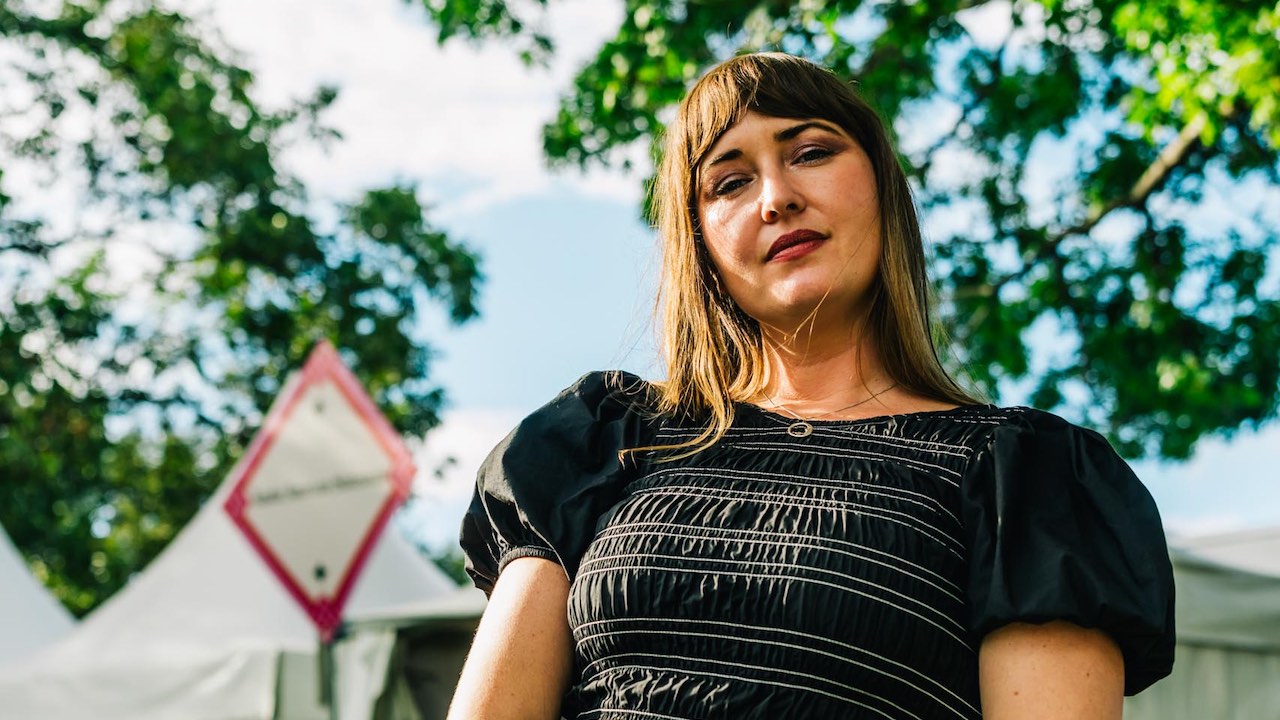
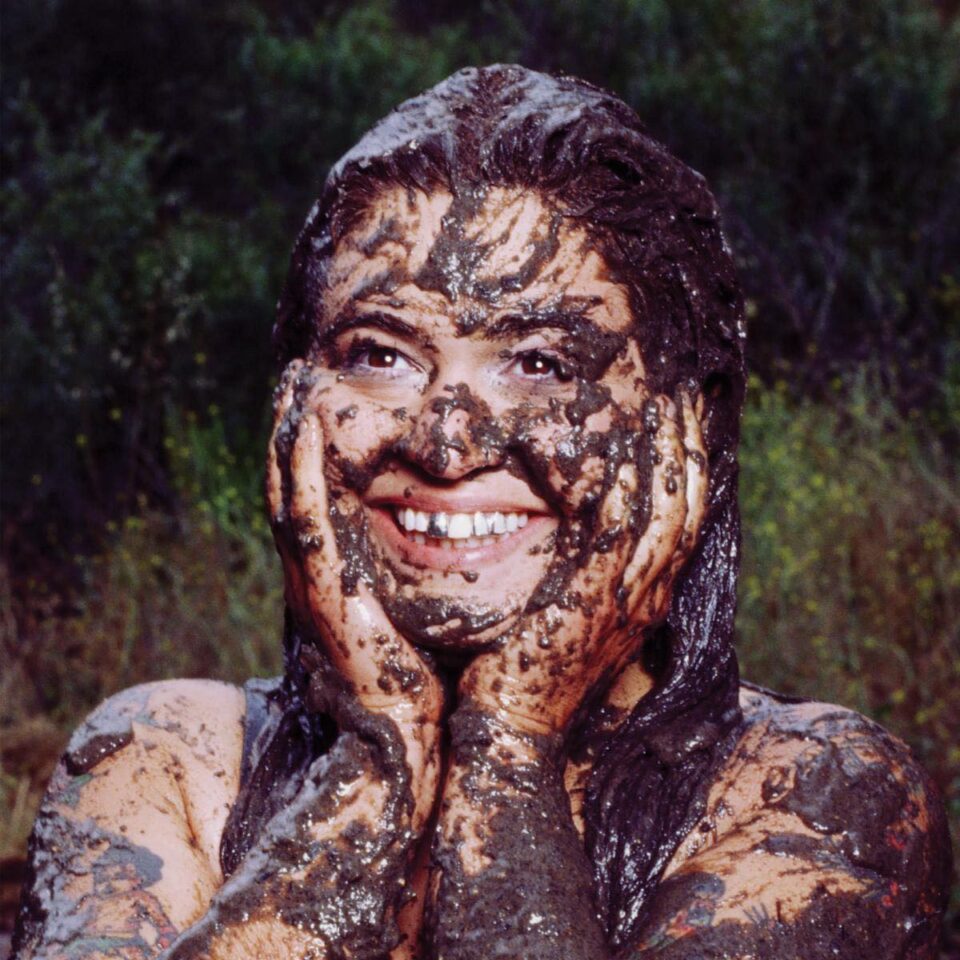
A Mile South of Heaven marks Jess Williamson’s first solo album she’s written since teaming up with Waxahatchee on their lone collaborative album as Plains. With the new level of exposure her voice achieved in the aftermath of 2022’s I Walked with You a Ways came the burden of finding a sense of balance after figures like Jack Antonoff had suddenly begun taking notice of her music half a decade into living in Los Angeles. It’s that balance she explores on this new record, one that reflects a life split between the bustle of LA and the calm of Marfa, where her partner lives—far away from the glamorous parties she’s found herself attending.
More than any of her previous albums, Heaven is the work of an artist able to view herself from a perspective outside of her own, leaning into the literary influence of Joan Didion and Pam Houston to reflect on the life she’s built for herself and the sense of transience she can’t help but revert to regardless of her setting. “I could move between worlds without ever fully belonging in either one,” she ponders in reference to her dual citizenship as both Texan and Californian—and surely something a little more existential, as depicted in the lives of her songs’ characters which are all versions of their creator on some level.
Sonically, her new album feels far more Texan than Laurel Canyon, much in the same way that Williamson herself can never fully escape her roots in the Lone Star State. With the twanging indie-Americana album out today via her new label home of New West Records, stream along and read her track-by-track breakdown of A Mile South of Heaven below. You can also grab a copy of the record here.
1. “Goodbye to All That”
One of my favorite essays is “Goodbye to All That” by Joan Didion. It’s about leaving New York after eight years and how “it’s distinctly possible to stay too long at the fair.” In my eighth year of living in LA, I felt it was time to leave. I wrote this song as my farewell to LA, but songs are powerful in sneaky ways, and the song itself changed my mind. I realized I wasn’t finished with life in LA, so with a little bit of logistical Tetris, I still keep my place in LA and a place in Marfa.
2. “High Heels and Blue Jeans”
Being on tour has its own special way of amplifying whatever else is going on in your life, and this song was inspired by times on the road over the years when things felt hard. There are moments in life, for us women especially, when the only way through is to put your makeup on, get dressed up, and carry on. I’ve had nights on tour where I was going through something in my personal life and fighting back tears trying to do my eyeliner before a show. I feel a big responsibility to the audience to give them the best show I can, and an even deeper gratitude that they showed up in the first place. So no matter what I’m carrying, it’s on with the show. I wanted the chorus to feel like a celebration, because that’s exactly what being onstage is for me. Whatever else is happening in my life, I never lose sight of what a privilege it is to get to do this job.
3. “Country Mile”
A few summers ago, I read the short story collection Cowboys Are My Weakness by Pam Houston. I’ve had a long history with her short story “How to Talk to a Hunter,” which I stumbled across by accident in a high school English class, but I finally got around to reading the whole collection. I was deeply moved by the women in those stories. They live in the rural American West, and they’re strong, earthy, a little wild, and drawn to men who are the same way. When I wrote “Country Mile,” it felt like I was writing a short story inspired by my own life, but also by Pam Houston’s characters. It’s easy to see other people clearly and judge them for their flaws. It’s much harder to recognize those same things in yourself. Writing this song in the third person, as if it were about someone else, became a way of looking at my own behavior. That’s why the last chorus shifts into the first person. It’s the not-so-subtle reveal that when we write about other people, we’re usually writing about ourselves, too.
4. “A Mile South of Heaven”
Imagine that there’s a road to heaven with signs along the way telling you how much farther you have to go. But somewhere around the one-mile sign, you see that the signs just keep going, and heaven never gets any closer. I lived that way for a long time, always trying to get closer to some impossible goal. Eventually I realized that not only are the goalposts always moving, but all that striving can make you miss what’s right in front of you. And besides, a mile south of heaven is pretty close.
5. “Tracking the Tropics”
I was in a situation where my confidence had really taken a hit, and all I wanted to do was get in my car, drive as far away as I could, and be back at this one particular little honky-tonk bar in East Austin where I spent so many weekends with my friends throughout my twenties before I moved away (the bar is still there—shout out to The White Horse). It’s a song about wanting to escape, and longing for a simpler time and for the people and places that make you feel truly known and accepted.
6. “Dark Day in Dallas”
This one is about my mom. I wrote the first line over a decade ago, but I could never find a way to turn it into a song. I think the subject just felt too personal and too important and I couldn’t get it right. Last August, I was in Upstate New York with four other songwriters: Courtney Marie Andrews, Lola Kirke, Cornelia Murr, and Katie Pearlman. We spent a week writing together, and on the very last night I brought in this lyric I’d been carrying around for years: “I remember how you worked like money could save us, and how you weren’t so wrong about that.” Cornelia had spent time with my mom before, so she already had a sense of this truly legendary woman who raised me, and I think that helped carry the song along. We were all in tears as we wrote it together, the four of them helping me find the words to tell my story, and each of us thinking about our own moms.
7. “Hum of the City”
I’m kind of a wanderer by nature, and this song is about my complicated relationship with the idea of home. I’ve spent years feeling pulled between the excitement of life in the city and the peace of a more rural life, never quite sure where I belong. There’s a romance to being in hotels alone. I love checking into my room, going down to the hotel bar, and talking with the bartender. I once checked into a hotel and realized I was staying in the very same room I’d been in years earlier (room 12, from the song) during a completely different season of my life, right before a major breakup. There’s something uncanny about the anonymity of a hotel room holding such a personal memory. The song imagines a conversation with the hotel bartender, asking him to change the music. Sometimes contemporary music feels a little weird if you happen to have history with the person singing it. But old country music always hits.
8. “Texas Time”
A lot of Texans, myself included, refer to our time zone as Texas Time, instead of Central Time. I started spending so much of my life in West Texas after I fell in love with my boyfriend, and this idea of “Texas Time” became shorthand for a different pace of life, one that’s slower and a little less concerned with all the things that can seem so important in Los Angeles. And being with someone who feels like your ride-or-die makes it a little easier to not care as much about what other people think.
9. “Someone Else’s Horses”
This is a song I originally wrote for my last album, but when it came time to record it, I realized it wasn’t finished. I always felt like there was something special about it, so I came back to it later, made some structural and lyrical changes, and now it’s one of my favorite songs on the new album. As time goes by, songs become portals into another version of yourself. I feel pretty far away from a lot of the emotions that inspired this song now, except for the part about “the banquet with the good ol’ boys.” As a woman in music I felt for a long time that I had to work twice as hard to be respected. I spent years comparing myself to all the dudes with gear, thinking I wasn’t good enough because I didn’t have a studio full of equipment or the technical skills they seemed to have. I eventually learned that none of that has anything to do with being a good songwriter or a talented artist.
10. “Legends Die”
I was driving back to Marfa from Dallas, and for the last couple of hours I found myself alone in the pitch-black desert. That’s when I realized my headlights weren’t working properly, because I could barely see. There was nowhere to pull over, no gas stations, barely any cell service. I figured out that if I just kept my wheel lined up with the long white line on the side of the highway, I’d eventually make it home. I spent the next few hours in a kind of trance, following that line. And the line started to become a symbol for all the striving I’d done throughout my career, clinging to something, thinking it would get me where I wanted to go. Around that same time, I was taking a hard look at the people in my life and seeing who was really there for me. Some of those realizations were painful. When I finally made it home, my boyfriend had flowers on the table and a glass of wine waiting for me. It was one of those moments that put a lot into perspective, and I felt overwhelmed with gratitude for the person waiting for me at home.
11. “Battle Scar”
I grew up as the poorest kid at a private school full of wealthy families, and I always felt like an outsider trying to fit in. I’m incredibly grateful that my mom worked so hard to send me there. It gave me a great education and probably kept me out of a lot of trouble. But I also carried that feeling of being on the outside into adulthood, trying to become whatever version of myself I thought would earn someone else’s approval. This approach got me into some painful situations. The part in the chorus that says “it hurt like a cigarette” is about not being a victim. If you know something is bad for you but you keep going back for more, eventually you have to admit that you’re hurting yourself. I spent a lot of years hoping people would become who I wanted them to be instead of accepting who they actually were. It’s a simple idea, but “when people show you who they are, believe them” is one of the most important lessons I’ve had to learn.
12. “The Gem and Mineral Show”
At the end of 2023, I was shocked to see that Jack Antonoff tagged me on Instagram because my song “Hunter” was his most listened to song on Spotify that year. A couple of weeks later, he invited me to his GRAMMYs afterparty at the Chateau Marmont with just a few hours’ notice. I couldn’t believe it. I wore my nicest dress from tour and went by myself, because I wasn’t sure if I could bring anyone. That night, I found myself meeting some of the biggest names in music, including Taylor Swift, who I refer to in the song as the “Queen of Americana.” The whole night felt like a surreal dream.
The next month, my dog Nana’s health took a sudden turn for the worse, and she died. My boyfriend and I buried her on his family’s land in Terlingua, up on a cliff above the little adobe cabin his dad built by hand in the 1970s. I spent the next month and a half in Marfa driving out to visit her grave as often as I could, trying to move through the sea of grief. One weekend, I stopped at the Alpine Gem and Mineral Show on my way to see her. Wandering through the booths of crystals and fossils, I realized I felt like a tourist—and not just there in rural West Texas, but back at that party, too. Like I could move between worlds without ever fully belonging in either one.
There’s a botanica in Ojinaga, Mexico, just across the border from Presidio, that sells a special candle called a Velón. It has 21 wicks and a small firework inside, so after it burns for a while, it explodes. A few weeks after we buried Nana, we brought several prayer candles and a Velón to her grave and left them burning. When we got back down to the cabin and looked up at the cliff, the candles had illuminated a perfect outline of Nana—her face, her body, and the curve of her tail, up on the cliff.
