

At the end of Chinatown, Roman Polanski and Robert Towne’s powerful treatise on absolute power corrupting absolutely, resides a big life lesson couched as a weary warning: don’t look back. Screenwriter Towne’s punctuation is an omen offered up as a mournful quip, a portent of how all of man’s folly fails him, a heads-up to quit while one is ahead. In many ways, it would’ve been wise for Quentin Tarantino and Brad Pitt to have heeded such advice. 2019’s Once Upon a Time in Hollywood was a perfectly sculpted meditation on transitory states—changing mores in and outside of the movie business, the evolution of male bonding—with a deconstructed timeline and a fun, fairy-tale ending.
Leaving well-enough alone might have been best. But sleeping dogs rarely lie down too long, and the next thing you know, we have The Further Mis-Adventures of Cliff Booth with David Fincher directing Tarantino’s script—a really good folly, but maybe something of an unwise one. An interesting correlation where LA-derived noirs are concerned is how Chinatown’s famed parable on greed—with its script still held as a paragon of clever, literate virtue for film school students—also got turned into a sequel in 1990, with Towne’s script for the Jack Nicholson–directed The Two Jakes pushing its action up a decade. Now that was a really unwise folly.
The motivation behind Cliff Booth is that Pitt’s pragmatic titular hero has moved from being the readily devoted stuntman and personal lackey to Leonardo DiCaprio’s vain Rick Dalton that he was throughout Hollywood to becoming a relaxed-fit, cooly detached fixer for film studio problems. Got a loose-screw actress or a drug-addicted actor? Booth will make it right. An older, softer, not-that-much-wiser, but still sage Booth has aged gracefully, if not entirely painlessly as he lives with his codger of a father (Peter Weller) in Marina del Rey and does whatever job Hollywood needs, big and small.
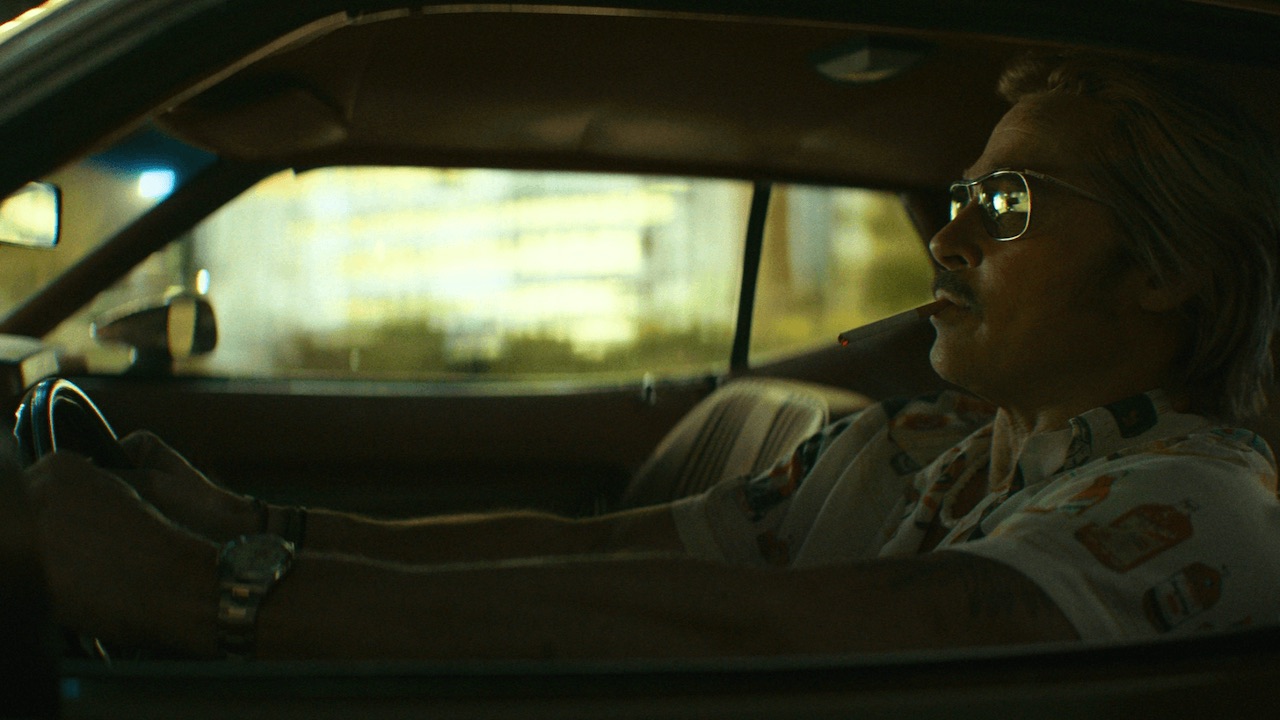
To that effect, Pitt’s lived-in, ragged, rugged, not-a-lot-of-action figure is content being a gracious good guy and a violent bad guy. And Pitt plays him as such: laconically, living the dream, even if the dreams happened to have gotten smaller (echoing Norma Desmond’s sentiments from yet another delicious classic Hollywood-set screenplay). Pitt’s chill-pill performance is masterful, all subtle grace and aw-shucks mannered, until he isn’t. And even when processing ultra-violence, Pitt’s Booth is still mellow.
Like its predecessor, Cliff Booth looks at a compacted moment in time: June 1977, in the midst of Star Wars’s mega-successful, game-changing release in contrast with the first film’s countercultural 1969 and its summer of Charles Manson. Within the new film’s vibe—and there’s plenty of vibe to speak of—there’s an insistent array of Tarantino-esque Easter eggs to signal his sly script’s constant involvement with Fincher. The new film’s patina—unlike Tarantino’s initial vision of a fading yet still primary-colorfully opulent Hollywood of the late ’60s—is now more golden-brown with grayish shadow, more in line with its aging anti-hero’s embedded tan.
After a fast, furious beginning that borrows elements from the vicious Blaxploitative shoot-’em-ups of the 1970s, the main action of the new film revolves around a mean-tempered, vertically challenged TV star (Scott Caan’s Charlie Peter, who, like Rick Dalton, has a thing for war stories and Western serials) and his impossibly tall agent (Elizabeth Debicki’s icy Karen), both of whom have their own peculiar, differently physicalized needs for Booth’s services and their own quirky ways of expressing desire. While Peters needs Booth to counteract the hitmen he’s hired to kill his wife, Karen wants Cliff as both a kinky boy-toy and as a sounding board for her off-base criticisms of popular film. Yes, Karen was a film critic, once, whose analyses are so off-the-mark (e.g. that The Godfather and Butch Cassidy and the Sundance Kid were overrated) that you’ll think she’s a stand-in for Tarantino himself.
Which brings us to the biggest question: How does decidedly non-kitsch Fincher play to Tarantino’s ostentatious strengths and vice versa? Tarantino famously runs hot while Fincher runs cold. Meeting in the middle, therefore, creates something warm (not lukewarm, thankfully) and mellow-toned between them that portrays each man’s love for the medium’s past. Fincher directed Mank in 2020 as a tribute to his screenwriting father and to script god Herman J. Mankiewicz, about the latter’s development of Citizen Kane. Fincher’s had Mank on his brain since the late ’90s, and likely loves cinema as much as Tarantino does without blathering on about it so much.
Which, in a way, has something to do with the way Cliff Booth—the film and Pitt’s character—winds up, as it never works as hard (or to any real conclusion) as Once Upon a Time in Hollywood did in making its leaps from actual history into fantastical but oddly successful lore. Maybe if Mis-Adventures worked harder, it would’ve held high that first film’s magic touch—something that personifies, to quote another iconic flick, the things that dreams are made of. But it doesn’t, and instead of great, Cliff Booth is merely good. Oh well. Here’s looking at you, kid.
