
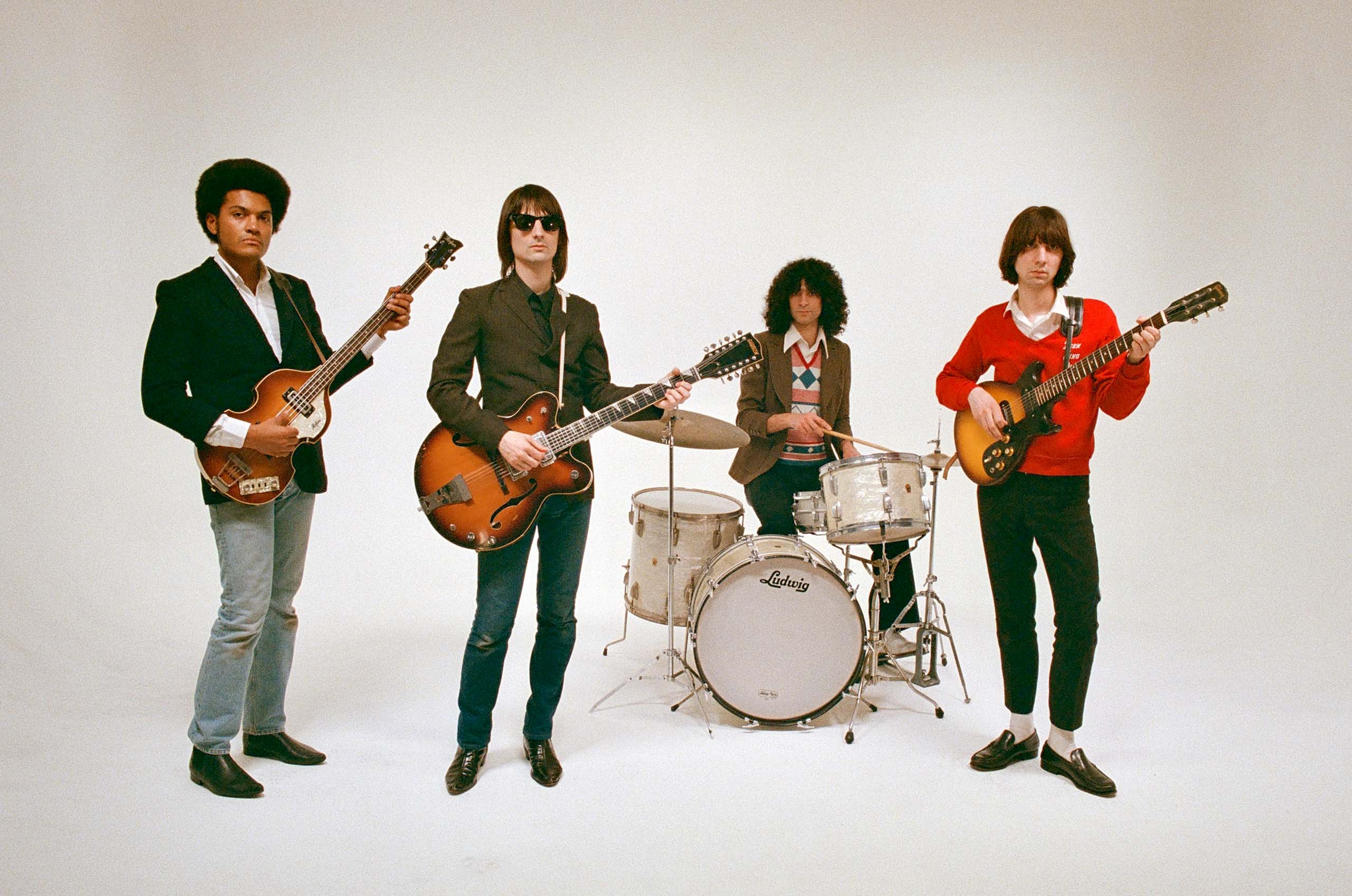


Ever since their 2016 debut, Do Hollywood, and all the way up through 2024’s A Dream Is All We Know, brothers Brian and Michael D’Addario—the singing, writing, producing center of The Lemon Twigs—created a somehow-original brand of power-pop whose addresses swung from swinging London 1964 and the baroque New York City of 1965 to fantastic LA in time with the Wrecking Crew for 1966 and all things Brian Wilson and Phil Spector. In the eyes and ringing harmonic voices of the D’Addarios, the word “pastiche” isn’t just a positive affirmation—it’s a canonization.
One ballads-heavy debut solo effort from Brian, one Record Store Day album done in service to their dad, and several years of steady touring have changed the game for The Lemon Twigs going into their newly released sixth album, Look for Your Mind!. While its charmed melodies and chiming arrangements still swing to the vibes of Carnaby Street, Greenwich Village, and Gold Star Studios, the stories that fill their latest record sound ripped from today’s headlines and tomorrow’s heartbreaks. Unlike their prior hermetically sealed, otherworldly catalog, Look for Your Mind! is an open-air kaleidoscope of sonic colors and lyrical constructs that feel more grounded, earthen, and very much of-this-world. Or at least the parts of this world wearing Beatles boots and struggling with present-day paranoias.
With Brian alone left to tell the brotherly tales, we got to the sweet center of The Lemon Twigs.
The Lemon Twigs is coming up on its 10th anniversary. What can you tell me about evolving the project’s sound since Do Hollywood?
Michael and I are two different songwriters, but we’re always looking to unite [those differences]. Have guiding principles. That’s usually based on a sound, because when it comes to lyrics, we don’t typically discuss those with each other. We give ourselves space to develop lyrical ideas on our own. I think that recently we’ve been really turned on by playing live, transposing what we do in the studio to the live setting.
Because yours is such a studio-based sound.
Right. On our previous records, we never paid any attention as to how that would translate live and treated them as separate things. Now, the processes have become intertwined, and after developing what we’ve done on stage for a time, we wanted to bring that back to the studio. We’ve really gotten a lot of enjoyment being two people just playing.
The stories on the new album are very present, or take place contemporarily. How did that happen?
There’s been an opening—this thing where we’re more open to the world around us—that happened through the process of touring. Just coming in contact with more people. That’s become really important to us. Maybe not as important as, say, activism, but playing out to people has become vital and more worthwhile. So, unconsciously, getting out more may have something to do with those lyrical changes, but really it’s those things that have just been on our mind. Previously I guess it was all just about us creating our own escapist world. However, that doesn’t work after a certain point.
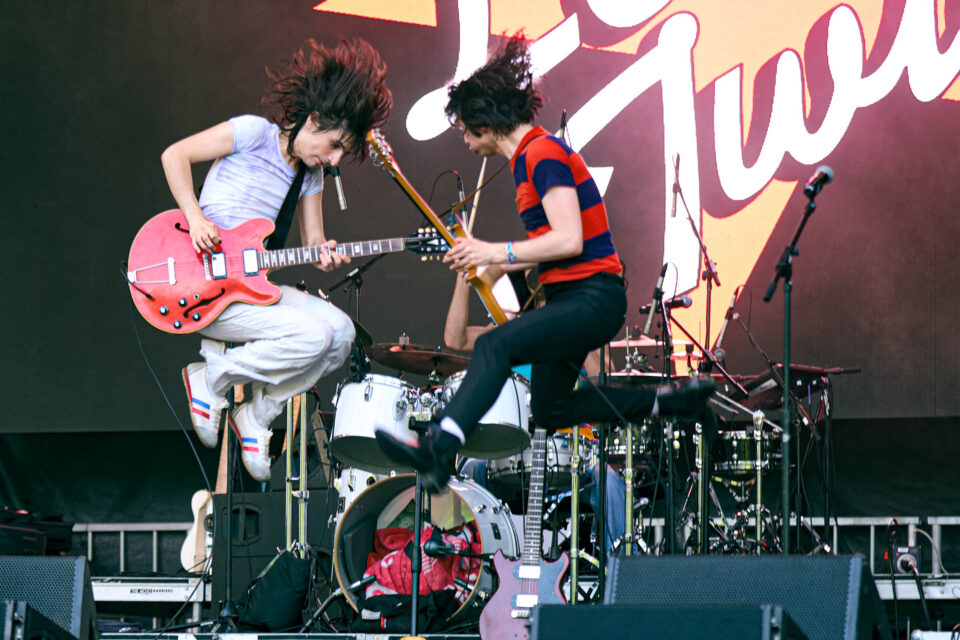
The Lemon Twigs at Governors Ball 2025 / photo by Dutch Doscher
“Previously I guess it was all just about us creating our own escapist world. However, that doesn’t work after a certain point.”

The Lemon Twigs
]You two recently released The Songs of Ronnie D’Addario, where you covered the music of your dad with him involved. Do you think doing that album placed a certain punctuation on that relationship, a line of demarcation?
It’s closing the book on a lot of things we left unfinished for so long. My solo record last year did the same thing, in a way—closed the door on old material. The new album was new songs recorded this year, pretty much. The last few albums really were more compilatory, while this new one is present, new, and fresh to us. I’m enjoying that immensely. I really don’t love playing songs that are that old anymore.
How did you finally come to record and release your solo album?
Michael really drove me to complete that material, because many of these songs could’ve been on previous Lemon Twigs records. I think we really were both just striving to move ahead with only fresh material. And the weakness of that solo record is that there are a lot of ballads thrown on there.
Aw man, I love the ballads.
Me too, but it was a means to an end—just putting them all on one album. It’s a struggle thinking about all of these songs that I wouldn’t want to take on stage, as I’d really rather move an audience with more upbeat songs. It’s a good record, though. I think I’d prefer to be an artist who doesn’t overthink his records, as if it had to be its own huge statement. If that’s going to happen, I think it would happen on its own.

I think you’re being unkind to yourself on this count.
I’m my own worst critic. Then again, I’ve seen worse critics of me [laughs].
It’s your talent as arrangers that really make what you do as a unit special. But on the song “Joy” you brought in Sammy Weissberg to do your orchestration. How’d that happen?
I did do an arrangement—some of which stayed, actually—that wasn’t completely up to snuff. I arranged it super close to the guitar part, and I wanted it to feel broader. Michael met him in some club; they got on pretty well, I listened to his stuff, and that was it. He brought in these interesting romantic chordal changes and added a jazzy sound to the choruses. I retained the part that I wrote for the horn middle. The whole ending he wrote, and we collaborated. We sent notations back and forth like producers would mixes.
“I’d prefer to be an artist who doesn’t overthink his records, as if it had to be its own huge statement. If that’s going to happen, I think it would happen on its own.”
The Wrecking Crew’s heft has forever been a part of your sound. On this new album, however, it’s heavier and rougher-edged.
I demoed so much of that on my phone with a sugar packet and an unplugged bass, did all of the arrangements and the harmonies. And then when we got home from touring and into the studio, I wound up playing the instruments, one by one, with Michael and me singing all the parts. Maybe it’s because we recorded it all so quickly—I mean, we did the orchestrations all in one day. It actually was so un-Wrecking-Crew-like in the way we recorded it all, but we’ve listened to all of those records all of our life, and Michael—who’s a huge Phil Spector fan—mixed it and got the reverb just where he wanted it.
With Michael not here, is there anything you wish to say about him that you might not be used to expressing?
He’s just a really good arranger and good producer, but he doesn’t have a good poker face. That’s gotten us into a lot of trouble with other artists, because he offends them all the time and can’t help it. Then again, I think we need that within our organization, because I’m the ultimate yes-man to everybody. He keeps us on track. FL

photo by Eva Chambers
