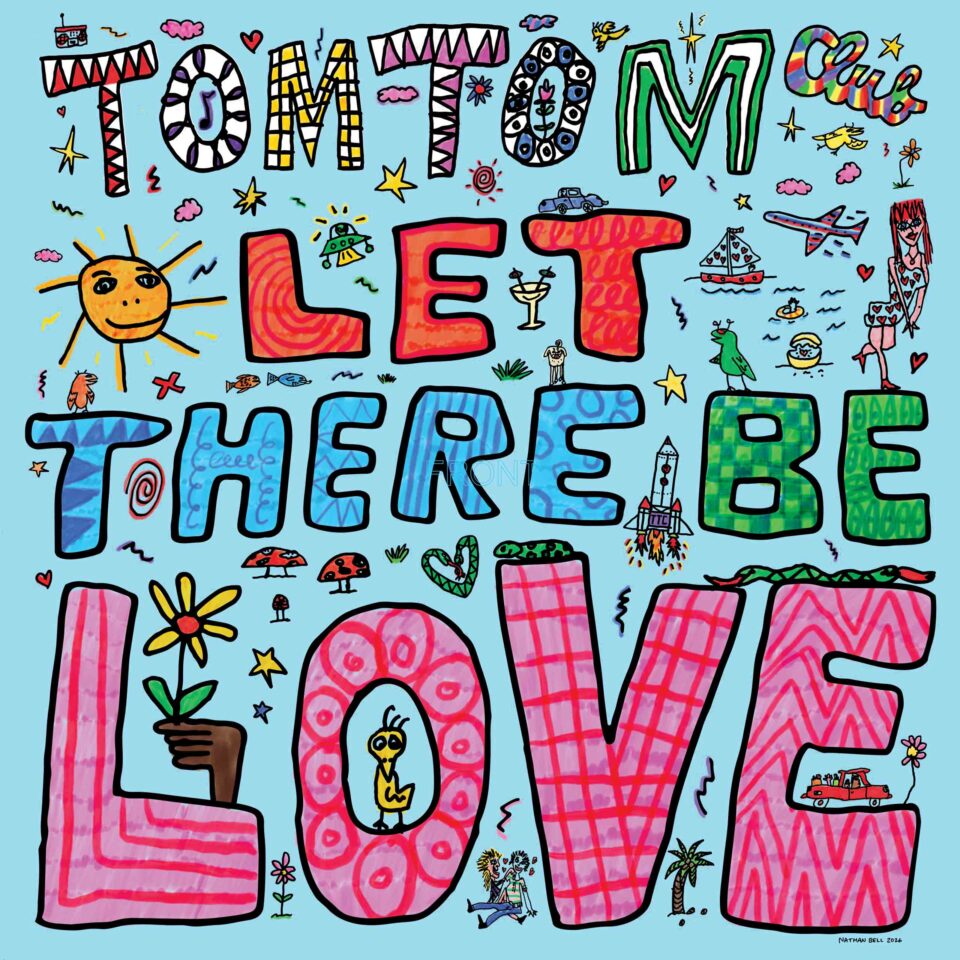




According to drummer Chris Frantz and bassist Tina Weymouth, there’s a menagerie that surrounds them and their home as we speak. It’s not just the ghosts of big white suits past, the punks and funkateers with whom the married twosome played, or their renowned family members, some of whom fill the seven LPs of their Tom Tom Club’s new box set, Let There Be Love. Together with them on this afternoon in Connecticut is Bowie, an American Staffordshire Bull Terrier, tiny Kiki de Montparnasse, a Beagle, and Blossom the Possum, a rehabilitating rescue animal who wandered into their yard and is waiting to heal before she’s let out into the wild again.
Along with these pets, Weymouth discusses her singing sisters with whom she shared vocal duties in Tom Tom Club, other famous Weymouths (journalists Lally, Katharine, and Pamela Alma) who held a piece of the now-tarnished Washington Post’s legacy, their fellow Talking Heads David Byrne and Jerry Harrison, members of Kraftwerk, and more. “It’s a lot,” says Weymouth, laughing about their 50-plus year trajectory as marrieds, band mates, composers, and leaders.
But first, a question beyond the borders of the geniuses of love: Considering that 2012’s Downtown Rocker EP is their most recent album as a pair to fill the Let There Be Love box, will Frantz and Weymouth only express themselves during our conversation as Tom Tom Club? “We’ve actually been thinking of doing something for a long time, but wondered what we would call it,” Frantz offers. “And this may still ring true: an all-electronic album—something we’ve never done—in tribute to Kraftwerk, where we call ourselves ‘Chris und Tina.’”

Tina Weymouth circa 1980 / photo by Michael Grecco
“Although I don’t know if we could only do one thing based on only one sound,” says Weymouth of their possible electronic epic, considering the jumbled jungle-funk, reggae, disco-dub, and hip-hop mix of Tom Tom Club and the brittle art-rock-meets-gospel quirk of Talking Heads. “I like a little more leash to my tether.”
Before going even further into their music, there’s the subject of all that’s happening at the Washington Post: the Bezos and Trump brotherhood, the sudden lean toward the right from what Weymouth and Frantz remark is a “history of the left, of helping the disadvantaged, disenfranchised, and union workers.” What do they feel is their legacy within all things Washington Post in connection to Weymouth’s family members, all totems of the heralded newspaper long run by the doyenne of American news publishing?
“We knew [publisher] Katharine Graham intimately—Kay, to us—and I was a bridesmaid at my brother and [Graham’s daughter] Lally’s wedding. I love their children, Katharine and Pamela, who happen to be carrying through the family’s legacy really beautifully. She’s not happy about the way the Post is bending to an authoritarian regime. We wish that it could remain as it was established by Kay. But, as you know in life, nothing lasts forever; we’re hoping that Mr. Jeffery Bezos changes his direction, but it seems as if he lives in a bubble.”
“Kay Graham used to write Tina and I little notes whenever a story on us ran,” says Frantz. “‘I see that you were in our magazine.’”
“Such a lady—I wish I could’ve followed in her footsteps, but I think I was just too much of a punk,” says Weymouth with a laugh.

Talking Heads circa 1980 / photo by Michael Grecco
“We were a studio concoction at first, until we did Talking Heads a favor. Because Talking Heads couldn’t get shows in Japan and other such places if we didn’t add Tom Tom Club to the bill.” — Tina Weymouth
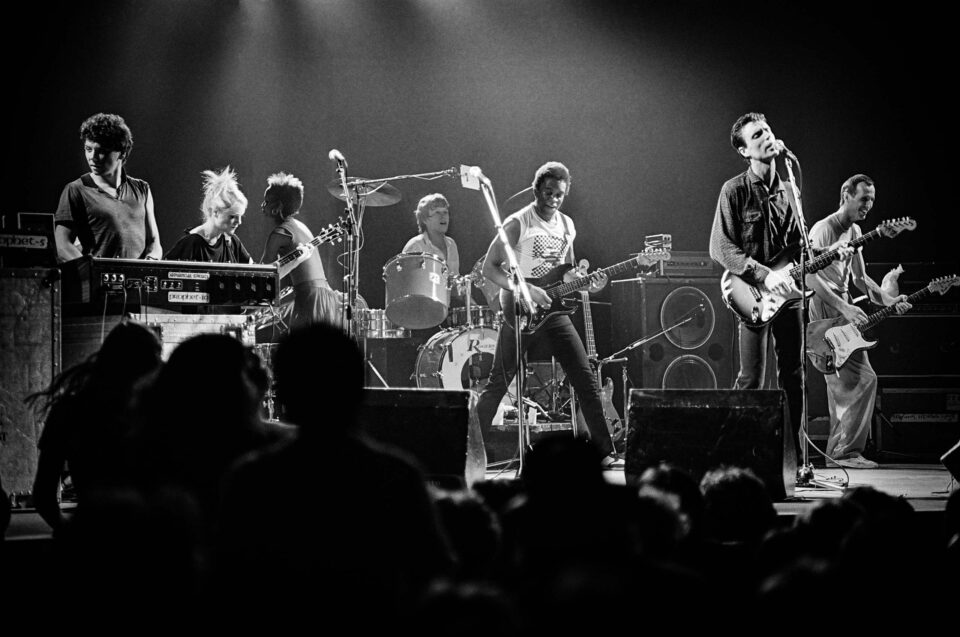
Members of the band The Talking Heads perform live in 1980 in Boston, Massachusetts.
Punk is where we first got to know Weymouth and Frantz with Byrne in 1975 (Harrison was a later addition to Talking Heads in 1977). In fact, it’s because of Byrne and Harrison making solo albums apart that we got Tom Tom Club in the first place, whose 1981 self-titled album contained their mega-hit “Genius of Love.” “We were a studio concoction at first, until we did Talking Heads a favor,” recalls Weymouth. “Because Talking Heads couldn’t get shows in Japan and other such places if we didn’t add Tom Tom Club to the bill.” Speaking on the improvisational raucousness of Tom Tom Club in a live setting, she giggles and adds, “We were like a bunch of wild pirates—all for one and one for all—as opposed to having someone control everything. That was the most satisfying way to get things done.”
“We were a studio concoction that happened because Talking Heads went on hiatus in 1980 with David and Jerry recording solo albums,” Frantz confirms. “But when we asked to do our thing, [Sire Records president] Seymour Stein told us there was no money left for a Chris and Tina album. So our manager, who was friends with [Island label head] Chris Blackwell—who we knew from recording at Compass Point Studios—understood the value of a good rhythm section, invited us to do a single, and if that worked, we could do an album with him.”
The single, “Wordy Rappinghood,” set the agenda for everything Tom Tom Club would become with its meta lyrics and its tangled web of squirrely electro-disco, dancehall, and Japanese new wave, as well as elements of sing-song-y nursery rhymes and twisted linguistic raps. “I was so nervous about making that song that I drank too many piña coladas the night before and played terribly the day after,” laughs Frantz.
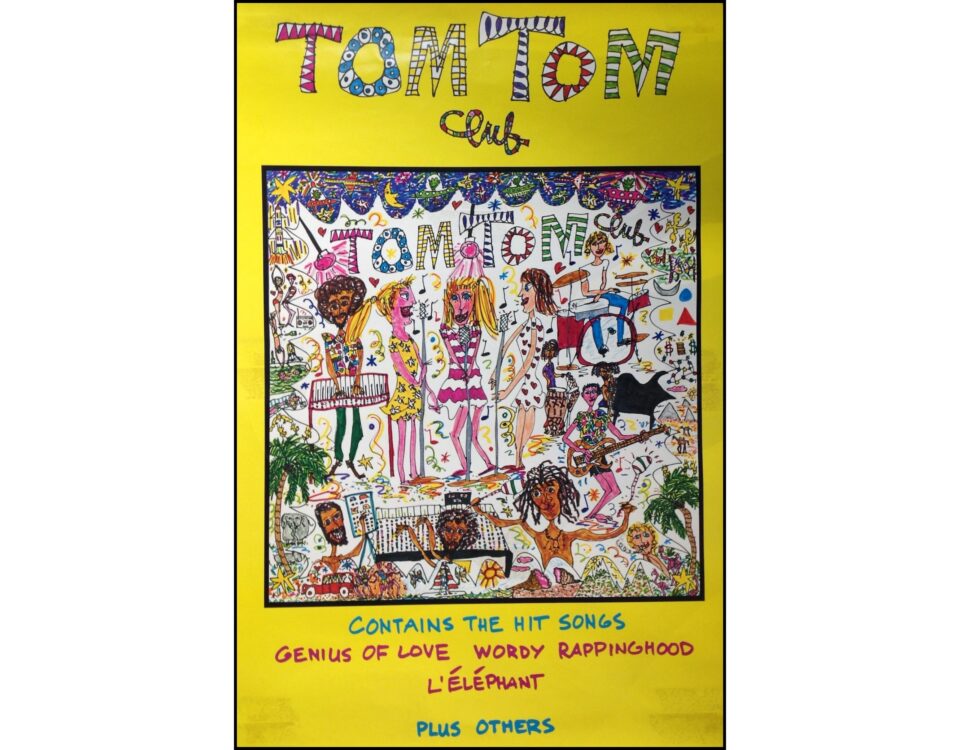
Tom Tom Club 1981 promotional poster
“Chris [Blackwell] thought that we were going to kill each other—but he loved what he heard immediately, didn’t get in the way, and told us to make a whole album,” says Weymouth.
“But she was nervous about singing lead, as she wasn’t a singer singer,” states Frantz.
“My voice was too tiny, too thin,” says Weymouth.
“So she rapped, which was still reasonably new then,” says Frantz, who notes that this was mere weeks before Debbie Harry rapped her way through Blondie’s “Rapture.” “We recorded Tina rapping from different distances to the mic, and that sounded great. We also brought down her two sisters, Laura and Lani, to help us with vocals. And they all remembered a song that the three of them sang as students in France: “Rom som som rom som som / Koooni kooni kooni rom som som.”
“We locked arms and sang that song as a joke,” says Weymouth. “But the crew in the studio loved it and took us seriously. I was born with a lung condition, so sadly [a bigger singing voice] is not to be. But Lani has that classically trained voice, and Laura has that pop voice that can imitate any style. And mine was the raspy, breathy voice. The blend worked.”
That blend continued through several additional Tom Tom Club albums before Lani and Laura split, each of which faced various challenges. Frantz looks at 1988’s Boom Boom Chi Boom Boom, the shifting-membership ensemble’s third album, as Tom Tom Club’s most complicated project due to the quickly changing landscape of the record business. “The label always wanted us to make more songs,” says Frantz. “Or the UK wanted something different from the US label. Or the British pressing was terrible. Or everything needed a remix, but they wouldn’t let us do it.”
“Or we had three girls pregnant in the ensemble at the same time,” adds Weymouth. “Hormones. Then again, I had just had a child and gotten out of the hospital when we recorded the second Tom Tom Club album. People were really breathing down our necks with expectations on [1983’s] Close to the Bone. It met our expectations, but it didn’t have the same flow as the first one because the first had no expectations. It just happened naturally.”
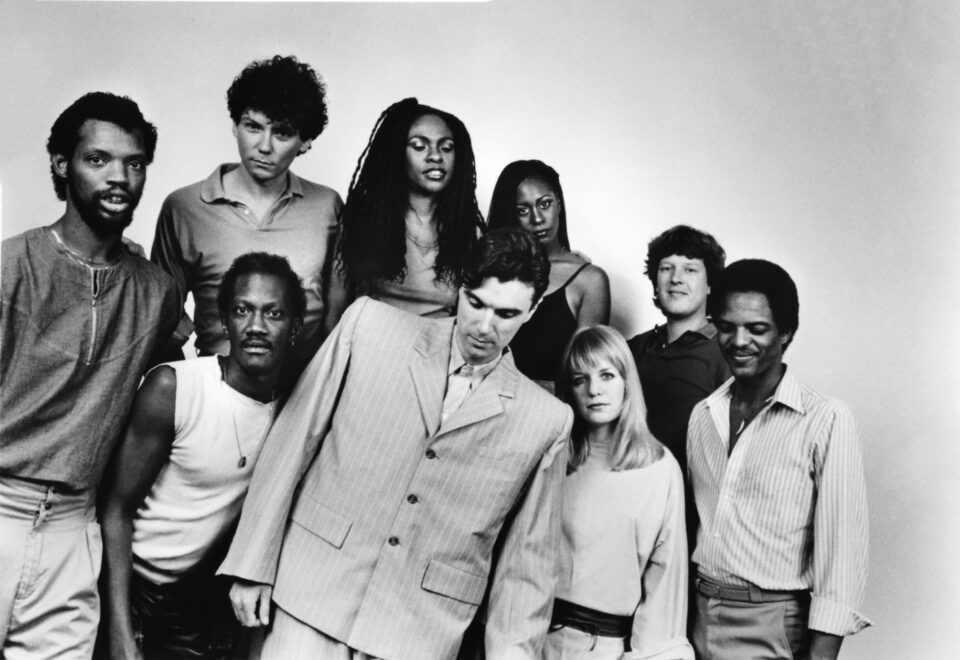
1984: The Talking Heads line-up for the concert film ‘Stop Making Sense’ (L-R Steve Scales, Bernie Worrell, Jerry Harrison, Ednah Holt, David Byrne, Lynn Mabry, Tina Wemouth, Chris Frantz and Alex Weir) pose for a portrait in 1984. (Photo by Sire Records/Michael Ochs Archives/Getty Images)
“[Stop Making Sense] makes people get up, dance, and forget their problems. That’s a great thing for a band to be able to do.” — Chris Frantz
Rather than conclude on the pointless question of a reuniting Talking Heads—because, honestly, it would never be the same as it ever was—we close by discussing the foursome’s reunion in 2023 for talk shows and screening appearances around A24’s 40th anniversary remaster of Stop Making Sense, their historic live concert film from the late Jonathan Demme. “I’m happy that we did do that, because that film makes people get up, dance, and forget their problems,” says Frantz of the positive vibes of reuniting for a worthy reason, such as reliving Stop Making Sense, big suit and all. “That’s a great thing for a band to be able to do.”
“I agree; it’s a funny film. There’s weirdness in it,” chimes Weymouth. “The Tom Tom Club segment is my only regret. We did that, in part, so that David would have time to change into the giant suit, but we should’ve extended it in the film—it wasn’t originally intended to be in the movie, either—from just ‘Genius of Love’ to include ‘Wordy Rappinghood.’
“And,” she adds, “the big suit was hilarious.” FL