


My Morning Jacket’s Jim James has always been a seeker of truth within nature. From the reverb-drenched rock of MMJ’s breakout 2005 album Z to the psychedelic soul of his solo catalog as exhibited on 2016’s Eternally Even, the Louisville native spends his days tracing the invisible threads that connect humanity. His latest solo venture Wowed Out was born from an era of profound collective disorientation, abandoning traditional rock architecture for something entirely more radiant and untethered. It’s a record that demands you turn off your phone, close your eyes, and surrender to its meditative sounds.
Yet the creation of such an expansive sonic universe started all the way back in 2010 after a failed film soundtrack project. When we connect on a video call, the three-time GRAMMY-nominated songwriter is incredibly serene. He speaks softly from his brightly lit home office, surrounded by bookshelves and his own colorful music. Our conversation naturally drifted from the recording of Wowed Out to broader existential questions.
Ahead of the record’s release this Friday via ATO Records, read our conversation below.
Given that Wowed Out had you reconstructing old film scores, what was it like opening up some of those files and seeing what was basically a different person?
It was really cool. I wrote a bunch of themes and scores and stuff with Brian Reitzell, who’s an amazing composer. He played drums and percussion, and we had such a good time doing these little score pieces. Then I got fired from the film, which was great because the film turned out not to be that great, and we got to keep all the music. I’d made rough mixes at that time of those pieces. Over the years I’d listen to them, because I always liked them a lot, but they were just instrumental scores.
Then, about a year ago, I was working on the song “Lost Child,” which is the only song from the record that wasn’t part of those scores. Something about the vibe of that song made me think about the scoring projects, so I dove back into those. I just had this wave of inspiration where all the lyrics came out, and all the vocals came out. I recorded all that stuff at home in my studio and just really got lost in it. I’d work on a piece, expand it, walk with it, have more vocals and more ideas come out, and I did some more guitars and keyboards and stuff and sang all the vocals.
Then I had a really cool experience mixing it with Emily Lazar, who’s mastered our last few records. I asked her for her opinion, as a friend and a colleague, if the mixes sounded good or if they were terrible. She said, “I think it’s cool, but why don’t you send me the stems and I’ll see what I can do with it.” And then she totally just opened up the sound so much. It was really great working with her in that way. I love sampling music, and I love resurrecting things that you thought were lost. That’s one of my favorite themes in music. A lot of my favorite music is stuff that someone made a long time ago for their church or something that didn’t get any recognition. It’s cool when you can resurrect those kinds of things later.
“A lot of my favorite music is stuff that someone made a long time ago for their church or something that didn’t get any recognition. It’s cool when you can resurrect those kinds of things later.”
For me, going through my mom passing away, the last few years I’ve been revisiting that, but now I’m at the point of, “Hey, it’s time to let that go.” It’s part of me now, but I don’t need to recount it over and over because it just doesn’t send me to a good spot. Was this album a similar vibe for you?
I feel like music helps us forget about time. Music helps me disappear. I feel like this happens a lot with song ideas. I’ll have a song idea I wrote 10 or 15 years ago that didn’t make sense at the time, or we didn’t use it. But then, for whatever reason, the idea will come back up. I think that stuff is in communication with the universe or your muse or whatever you want to call it. I try to listen to that stuff. It’s kind of like you’re always walking along gathering seeds, but you never know when the right time to plant them is. Some of the seeds you plant won’t ever grow or take off, but others will feed you for a lifetime. They’ll keep growing. It’s wild.
What were some of the things you enjoyed when you handed those stems over to Emily?
Emily just has such a fun personality to work with, is such a funny person, and brings a beautiful light anytime you work with her. There’s just something about mixing and mastering—there are all these qualities that you can’t really put a finger on. Whatever she hears, I love, and I don’t usually challenge it. Sometimes with other mastering engineers it can be an arduous process. They send it back, and you’re like, “I don’t know, this is weird.” But it’s also intangible; a lot of times you don’t have words for it. I feel like working with her is effortless. Like all my favorite people I’ve worked with, you just get into a flow with them, and the vibes are just good. All the conversations are good, there’s never any weird energy, and you don’t have to walk on tiptoes because what you got back wasn’t what you were expecting.
“You’re always walking along gathering seeds, but you never know when the right time to plant them is. Some of the seeds you plant won’t ever grow or take off, but others will feed you for a lifetime.”
“Home Green” has a very meditative vibe, almost like a mantra. I ended up putting it on loop along with the rest of the album and going on walks. I wanted to get your thoughts on nature and getting out of the cycle.
Obviously, none of us would exist without nature. We are nature. But in our modern world, we think of nature as something other than us—we don’t realize that we’re part of it. I think for people, no matter where you live, just stepping outside your door and feeling the air is crucial. For me, nature is part of the songwriting process. None of the songs would get written if I couldn’t go outside, listen to them, and sing them while walking. It’s a moving, walking meditation. Every album or song I’ve ever made, that’s part of the process. The universe sends the idea, and then I’m this person called Jim who’s trying to deal with life on Earth. I get this idea from the universe, from where I think we all come from, and then I filter it. A big part of that filtering is walking, being out in nature, going to my favorite trail or the park, or just walking around the block. That generates the energy that moves the song along.
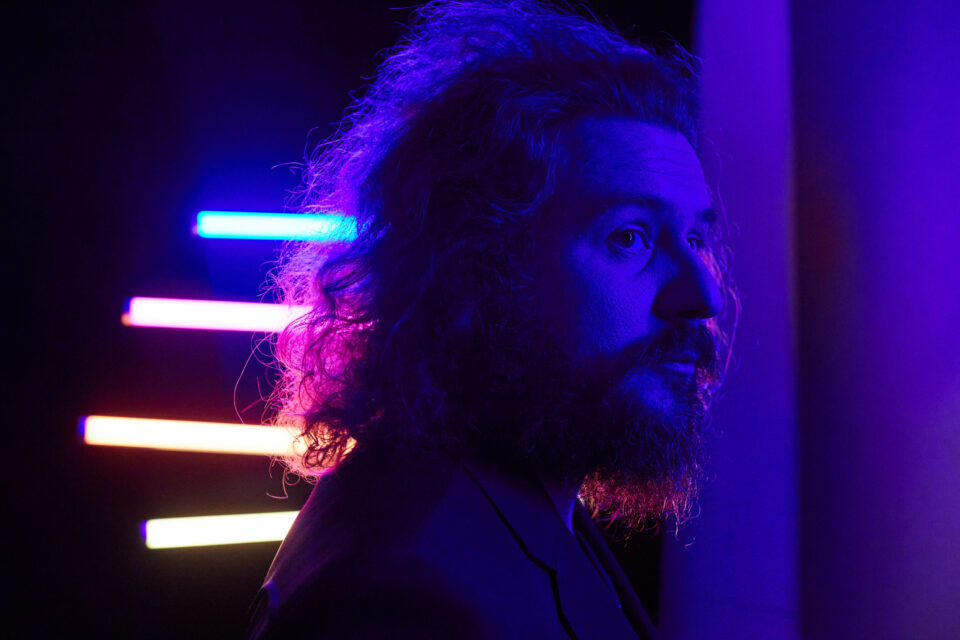
photo by Danny Clinch
There’s been a trend over the past year or so of needing to disengage from phones. I definitely heard that on Wowed Out.
I think about the phone as an amazing tool, and I compare it to a hammer and a nail. If you need to hang a picture on your wall, you take the nail, use the hammer to hit it a few times, and then you’re done. But I feel like we’re just hammering and hammering and hammering, driving the nail through the wall, and we’re still hammering the wall, and pretty soon the whole house is gone because we won’t stop hammering.
I’ve been trying to keep my phone Bricked. I can’t pull out my phone and look at all the things that are distracting, but I give myself time to look at it in the morning when I’m having my coffee. Then I Brick it again, so I don’t look at it throughout the day. It’s kind of the same with the news or your email: If we think about the pre-phone days, everybody got their newspaper and looked at the news in the morning. It’s not helping looking at it all day long. That’s destroying us, because we don’t know how to stop. It’s a battle we’re all fighting, and I wish there was some way to turn the phone back into a helpful tool.
“For me, nature is part of the songwriting process. None of the songs would get written if I couldn’t go outside, listen to them, and sing them while walking. It’s a moving, walking meditation.”
The track “Whole Heart Into It” felt like it was about being committed to bettering yourself. What were some of the challenging parts of this album that you brought yourself back to?
That’s something I’ve been able to give myself through a lot of therapy and self-work: trying to learn how to love myself. There are times when I’ll hear something from the past I would’ve done differently, but then I know that when I look back, I put my whole heart into it. I tell myself, “Well Jim, maybe you wish you’d done this differently, but you know that when you were doing it, you tried your best.” So you just let it go. You know you weren’t slacking off.
I feel like we’re so good at naming what’s wrong. I’m trying to be in a practice of naming when things are good. That song is an effort to name that. It’s just a quick story of meeting somebody and falling in love and getting to a beautiful place where you just love your life. I was thinking about that song in the context of relationships, too. It’s so hard to find the right relationship that when you do, oftentimes you’ll begin to realize it’s not right for you, but you’ll stay anyway. I wrote that song as a relationship was ending. It caused me so much pain because I loved the person so much, and they loved me, but it just wasn’t right. I had to love myself enough—and them enough—to let it go and walk away. I think a mistake we make is thinking we’re being nice to somebody by staying in a relationship we don’t want to be in when the kindest thing we can do is end it in a loving way.
Sometimes it takes some time to make that step, and you just have to surround yourself with good people that will listen to you.
I hope it doesn’t sound like I think I’ve got it all figured out, because I don’t. I’m still struggling and still riding the horse, but I feel like I’ve made some progress. I’ve found a therapist I really love, and I’ve made some real strides to quit drinking and things like that, which have made my life significantly better. I like to talk about that stuff because I like to encourage people who might be considering therapy or making a change. FL
