
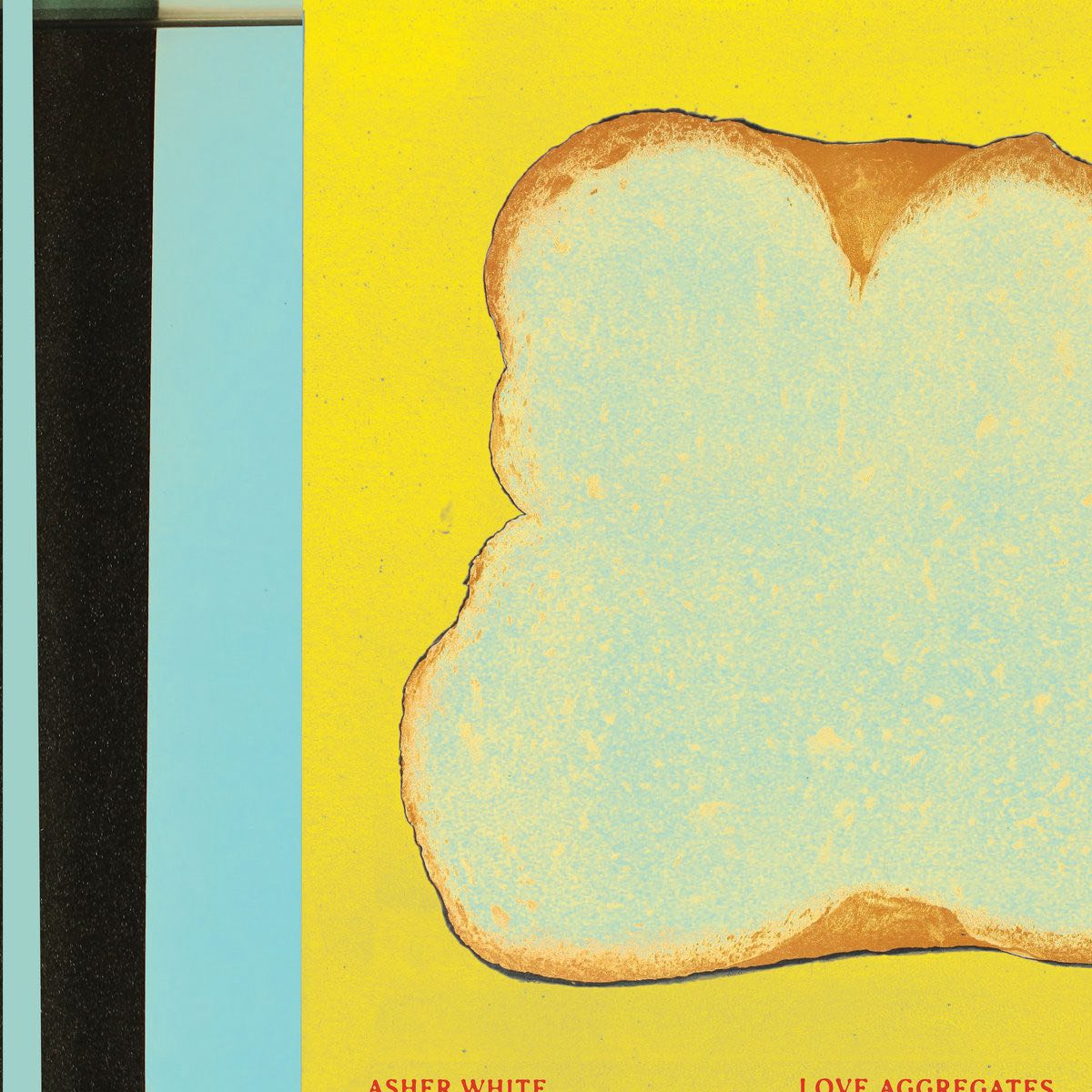



Asher White
Love Aggregates
JOYFUL NOISE
“How can I dull the emo blade?” That was the question on Asher White’s mind as she was refining the songs on Love Aggregates, all too aware of the clichés surrounding both a breakup and post-breakout album—which this follow-up to last year’s 8 Tips for Full Catastrophe Living technically qualifies as. It’s tempting but fruitless to try to contextualize the new album as White’s most personal, tempering the chaos of its predecessor and infusing her lyrics with autobiographical details after covering Jessica Pratt’s 2012 debut track-by-track earlier this year. But whether you frame it as a reaction to gathering momentum or a proper introduction, it’s hard to listen to Love Aggregates and not understand why White was gushing about it in interviews before her previous effort was even released. Dulling heartache and eschewing melodrama are just some of its achievements; here, the songwriter hones her craft by offering a subtle vision of resplendence in the midst of an apparent lack, sifting through all the (vintage) tools at her disposal.
As for the figurative knife? Here’s “Memory Patient (Motor Cycle Angel)” with a theory: “What’s done in bluff just sharpens the blade.” So White writes in earnest, with gentle understanding toward (former) loved ones but not the shamminess of trying to be the bigger person. And she knows the graciousness of her words depends on the color of the page they butt up against: the psych-funk of “My Day at the Casino” softens its blows with various linguistic choices—passive voice, compassion via the royal “we,” disclosing the petering of desire “by revelation’s woe”—but also musical ones, not least of which is the only use of trombone and trumpet on the record. Heartbreak’s jagged edges are still augmented through White’s odd chord shaping on the upright piano; the genuine emotion, almost stereotypically, in Mari Rubio and Lila Lifton’s violins. Taking a similarly jubilant, ’80s-inspired path is “The Eagle Is No Omen,” another balm against self-destructiveness.
So what happens when White does strip things down at the risk of sounding maudlin? “White Castle Sad” proves she’s learned a thing or two from covering Pratt about the simple magic of a delicate voice over finger-picked guitar, like pencil over lined paper. Compared to the compounding intensity of a song like Ada Lea’s “damn,” its final lines, “Damn the lighter, better singers / Damn the moving parts,” punctuate the idle passage of time, how nightly silence amplifies nostalgia. White does anything but wallow in the stillness, though, as fractured as it may be: feedback and white noise are her companions as much as any other instrument on the record. The pregnant pauses in “Reverie for Work” and “Atoll” are among the most beautifully decorated moments on the album. So what if the protagonist is just “not ready to see this sublime” on “Jerryboy”? Half a minute of orchestral pop reverie unfurls anyway, “fake” (per the liner notes) as the leading harpsichord may be.
“No one will tell you what happened / And they won’t write it down over islets under palms / Where the sun burns the scorn from the pages,” White sings on “Atoll.” Yet she captures something elusive about the way stories proliferate and thrum in our bodies; the sound of a prepared piano may automatically trigger an emotional response, but why else would the bass—not just on “Memory Patient,” but also “Health Techniques”—invoke such feeling? After all, the muscles of a song can be fragile, too, and love, even dissolved, can leave us with so much more than a broken heart: it expands the synapses in our brain, connecting past and future selves. In short, love aggregates (take the title whichever way you want, but it certainly defies the teachings of Nazareth). When White repeats “I was yours for a little while,” it’s not a matter of emphasis but an accumulation of brief yet immeasurable synchronicities, just like the record is not a grand statement but another small miracle in her ever-evolving discography.
