
Was it just me who assumed Buddy was a dog? References to the recurring character are scattered across This Is Lorelei’s catalog, as are clues pointing to his canine form. Buddy bites the narrator (“I still feel his teeth”) on the title track from Box for Buddy, Box for Star, the 2024 album that got way more ears on the long-running solo project of Water From Your Eyes’ Nate Amos. During that album’s joyfully zippy “I’m All Fucked Up,” a dog eats his lunch, someone chases his dog, and then his “body’s on the ground with the dogs outside the pound.” The pooch(es) are unnamed, but Buddy is quite a canine moniker, I’d hazard, getting out the red string and corkboard.
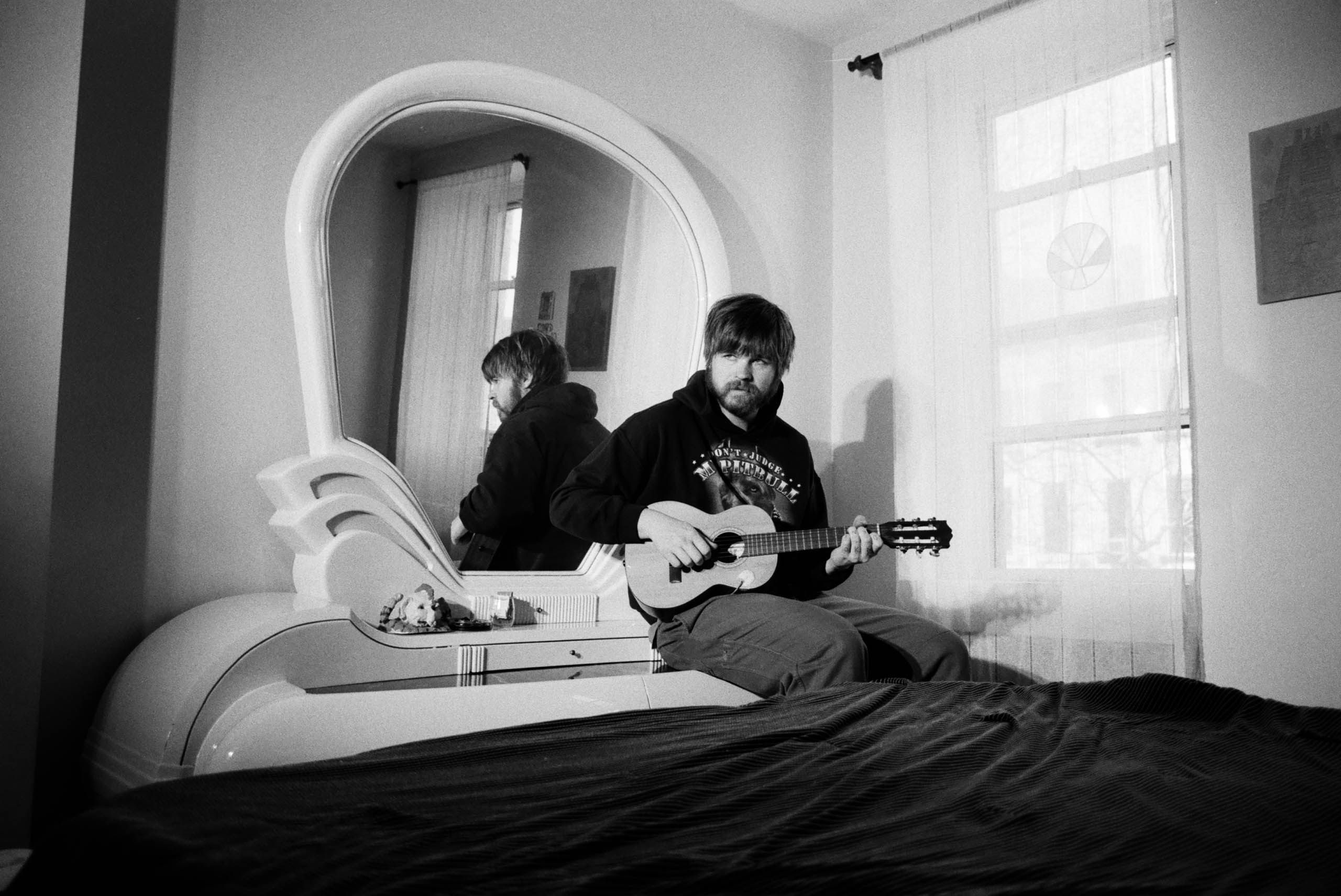
Then there’s the electro hypnotica of “Perfect Hand,” surely implying a dog’s POV of the benevolent ear-tickle master—not to mention that same narrator-dog tells us he isn’t rolling nowhere without his ball. “I guess more recently I’ve thought of it as a bouncing ball on a karaoke screen or something, but I also always have no idea what any of these songs mean,” admits Amos, phoning in from his Bed-Stuy apartment. It’s pretty early, but he’s the kind of guy who always gives what-time-is-it? energy—the bedhead; the favored “or whatever” suffix and “I guess” prefix applied to each sentence.
He remembers that “Perfect Hand” was written the same afternoon as “Bring Back My Dog,” from 2022’s EP #31, in the midst of some reminiscing about the yellow lab who accompanied him from fifth grade through his mid-twenties. “It kicked my ass when that dog died. It’s been 10 years. I guess ‘Perfect Hand’ is a song about instinctual and unconditional love, and that’s something that does exist with pets, so it’s rolling around in there. The idea of the dog with the ball, and the ball being the total apple of the dog’s eye, is just the greatest fucking thing. But it’s funny because I’ve never thought of it that way before.” It’s a theme of his new record, The Singer in My Band: open-to-interpretation lyrics splashed with double meanings and red herrings, some deliberate, some accidental. “They’re designed to be a playground for the subconscious mind of the listener—there is no right or wrong.”
Anyway, turns out his dog’s name was Bach, short for Rickenbacker. So who’s Buddy?
Amos has said that the title Box for Buddy, Box for Star translates to “coffin for the past, music box for the future.” Buddy is sort of his addiction demon, then, a part of his id that he wants to bury. The record elasticated from the likes of “I’m All Fucked Up,” bottling the whirlwind energy of an endless, euphoric night-turned-whole-summer, all the way to brittle comedown capsules. “You left me to drink, I thought I’d die in my sleep / But I’m healthier now / And I’m happier now,” is the exhausted but triumphant conclusion of the story from the widely covered “Where’s Your Love Now.” “In hindsight, I’m very worried it could easily be misconstrued as romanticizing self-destructive behavior, which is not what I’m trying to do,” Amos says of the last record. He’s especially conscious of that given Lorelei’s reach is ballooning and its audience skewing younger. “I think it’s just a very different set of criteria [nowadays] than, ‘What do I put into my Bandcamp diary project?’”
“[My songs are] designed to be a playground for the subconscious mind of the listener—there is no right or wrong.”
The premise of Lorelei—first-wave Lorelei, at least—is fundamentally at odds with the music industry’s framework. His “Bandcamp diary project” didn’t have editing, second-guessing, traditional release cycles, or even a “proper album” until 2024, and that was the project’s 67th release. That makes it all the more impressive that Amos has been able to move from a first-take bedroom experimentalist (dancing like no one’s watching) to a careerist singer-songwriter who’s increasingly considered one of our best. And all without losing it. The songs keep getting better.
Five years ago, he tells me, it didn’t matter what he said or strummed—few were listening, and the next EP would drop a month later anyhow. Now, he’s not only being considerate of his audience, but making sure the songs are ones he can happily live with for a year. You’d think that would involve a lot of genre leapfrogging, but while Box established its two polar ends—sing-strum Americana and hypno-loop Postal Servicing—and gradually closed in on a golden mean as you went down the track list, The Singer in My Band is all cut from the same parent style.
These are songbook songs, road songs, character songs, American songs. Less filigree than Craig Finn, warmer than John Ross, bubblier than MJ Lenderman. Track two, “Oh No Now My,” is probably the most OG Lorelei track here—weird, uneven, clumsy in a virtuosic way—but it’s also the outlier. Overall, the record begs to soundtrack daytime hours, a smushing of harmony-rich sunshine pop and endless-highway alt-country that’s way more consistently joyful than Box (even during the existential questions posed to his sister on “Hey Sarah Is It Gonna Rain Forever”). These are the kind of folk standards you can play anytime, anywhere. They’ll be relevant decades on. “I do love making music this way—it’s new and it’s fascinating, and I think I’m learning a lot,” Amos says of the one-album-at-a-time format. “But I also really miss the freedom of how I used to make music. It’s weird. At a certain point, it was like doing that in pursuit of trying to make more of a career out of it. And now that I have a career doing it, I’m just trying to figure out ways to get back to how I used to do it.”
He used to do it in Vermont. He’s previously cited the song “Holo Boy” as a watershed moment: the first thing he made in Chicago, home at the time, rather than at his parents’ house. But for Singer, he headed up to the woods again. Partly because he wanted clean vocal takes, the instrumentation bare enough that it no longer provides shelter from stray foley. “There are some Lorelei albums where there are a lot of sirens and street noise that I just let be in it, and I think that works for what those albums are. But when you’re building music on a computer and you’re the only person playing it, I feel like leaving the parts loose and not recording too many times is the only way to get a little bit of that organic vibe. You have to figure out tricks to make things feel like they’re breathing.” So he thought things through then trusted first and second takes, no “doodads.” No synth pad Band-Aids, either.
“I think it’s just a very different set of criteria [nowadays] than, ‘What do I put into my Bandcamp diary project?’”
Despite Amos’ collaborations with many of the biggest gets in the biz—Jeff Tweedy, Waxahatchee, Tim Heidecker—only three other people, all family, play on the new record, a move that strikes me as significant if not a little subversive. There’s his father Bob (“the best banjo player I know”), his sister Sarah on vocals, and his partner Al Nardo (she’s the bassist who sways from side to side on stage with Lorelei and Water From Your Eyes). That’s Nardo singing on “And I Haven’t Seen My Love in Quite a While,” a brilliantly witty tragicomedy structured around back-and-forth couplets.
Having no marquee-name contributors seems deliberately aligned with the overall mission: Nate Amos accepting that he can’t hide anymore, minimizing distractions. “A lot of the production tendencies in earlier Lorelei stuff were meant to deflect focus from me as a person—lots of bells and whistles, disguising the voice in different ways—and that was part of the fun of it. But that feels fundamentally incompatible with all of a sudden being the face of a project. If I’m doing that, then it doesn’t make sense to hide within the project.”
As ever, the songs are fun, obtuse, character-led short stories with a very loose overarching narrative if you dig for it. “If I was going to lean into a character in a narrative way, then I needed to make sure that it sounds like me singing it,” Amos says, perhaps suggesting this work is more autobiographical than ever. The narrator of the title track fixates on Chicago, the “fucking awesome” cultural underdog where Amos spent many crucial years. But the way he sings lines like, “If I can make it to Chicago, I ain’t ever gonna leave,” the lyrics rolling over clattering bluegrass banjo, you can hear the intensity, an iceberg of lived experience that means you couldn’t swap out the Windy City for any other.
“Watching Heaven Fall,” more than any other track, encourages you to dust off the English major hat. He sings of seven bars, seven bandits, seven dreams through sun-kissed harmonies, over a plinky strum-storm. It’s one of his “chaos road” stories, he says, having written the album while blasting across other countries with WFYE. “The vibe was getting run out of this town by other criminals, because you took too much Xanax and did some fucked-up shit at this bar,” he explains. As for everything coming in sevens: “Weirdly enough, there’s a lot of numerology and astrology nods peppered throughout the album. Seven isn’t a huge thematic presence in it, but 27 is. There’s some weird shit buried in if you pay attention to the numbers.” There’s the year 1999 on the opening track, as well (a popular year for songwriters in the 21st century). “That’s 27 years ago right now, the year the album’s coming out—so bullshit like that.”
Between the red-herring number stuff, the recurring characters (not just Buddy: Genevieve and Billy have starring roles, too), and the frequent references to bands, singers, heaven, money, the road, and cars, it’s evident Amos could write a truly unbeatable concept album, some Illinois-level epic. I often think about Mike Kinsella saying “I could write the best emo album ever”—could but doesn’t need to. Amos is the same: He could write the most cartoonish, thrillingly everyman concept album. And maybe he has here, in his own way—a record of misdirects, but concocted with a lot of soul and resulting in some timeless storytelling. It made sense to title it after himself this time—the real throughline in all of this.
“Buddy, you broke me / I wanna go home,” Amos sang back in 2024, his tormentor laughing while Amos cries. On this record, though, Buddy is the one crying—all night, the lyrics reveal. He’s a jerk, a kid in the dirt, Amos sings on “The Kid with the Crown.” Somewhere along the road, Buddy became subordinate. “It’s not gonna lead anywhere, though. It’s all mental. There’s not some secret hidden,” Amos says to dorks like me, tacking red string up on the corkboard. Then, kindly, as if realizing it’s maybe not so scammy after all, he adds: “There are paths to navigate, but it’s about the journey, not the destination, man. You’d think someone would have thought of that phrase before.” FL
