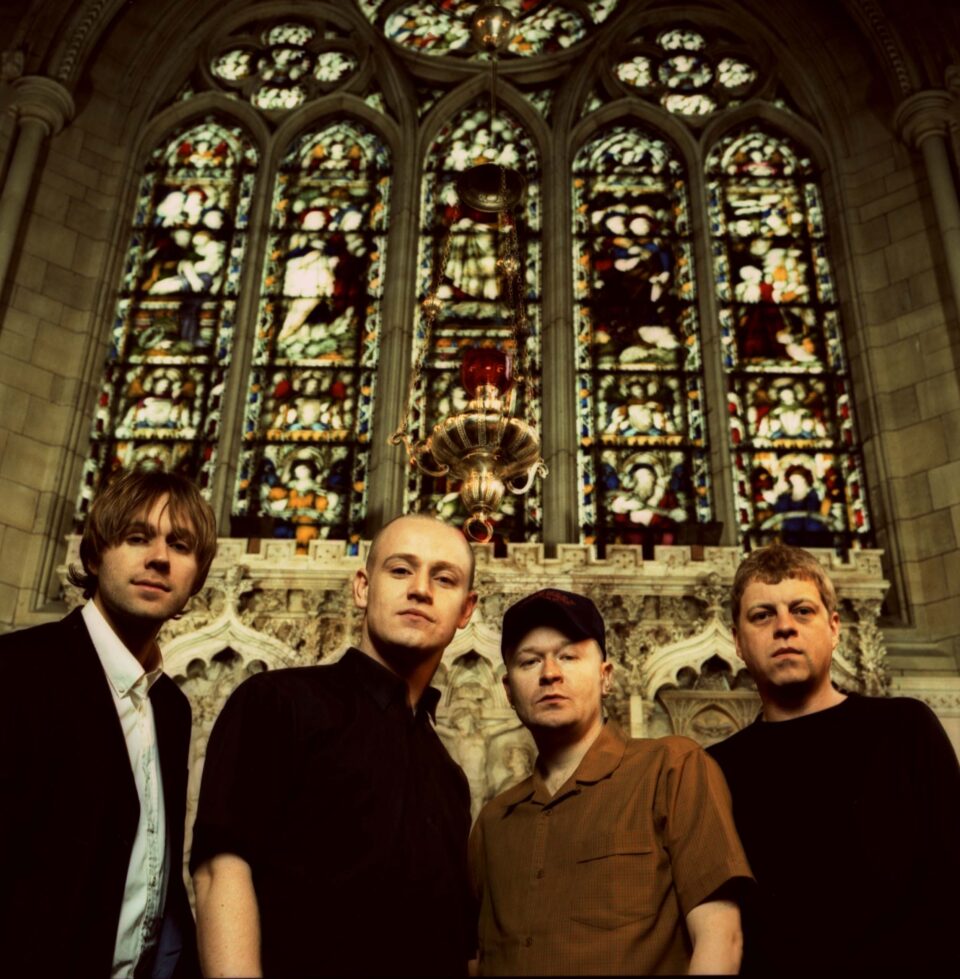




The great Britpop debate of the mid-’90s—Oasis, Blur, Suede, Pulp—isn’t complete without mention of London’s Gene. The band’s wittily theatrical lead singer Martin Rossiter actually had more in common with Britpop’s predecessors The Smiths and Morrissey than the Gallaghers or Albarn as the band coursed through the UK’s Top 20 with singles such as “Olympian” and elegant, eloquent albums such as Drawn to the Deep End.
Ultimately busted apart shortly after their fourth album in 2001, with Rossiter splitting for careers in solo songwriting and music education, Gene reunited in 2025 as a one-off for the 30th anniversary of their debut album, Olympian, selling out shows instantly and recording a victory-lapping live LP. And then they just kept going: In the midst of a set of dates in North America this month, they’ll be taking the stage at Darker Waves festival in Huntington Beach over the weekend alongside Soft Cell, Adam Ant, Simple Minds, Psychedelic Furs, and Morrissey.
Ahead of this weekend’s festivities, we caught up with Rossiter for a quick round of 5 Questions.

I recall that you were loath to be associated with the whole Britpop movement at its start because you were a socialist and you regarded yourself as more EU than UK. In a post Brexit universe, where do you stand?
The world needs genuine democratic socialism, not cookie-cutter socialists in name only. I’m sensing a small change around the world where capital’s control of the means of communication is a little looser than it once was. What this allows for is socialists who can communicate their ideas effectively to become surprisingly popular. Look at Mamdani in NYC—he’s actually acting like a socialist and is one of the most popular politicians in the world. Income inequality is so obscene now; Musk’s worth is equal to the poorest 43 percent of the world population. That’s untenable. Education is key: The more educated the population, the more they see that socialism is only scary for people who want to stay rich in their bunkers.
Did the success of Oasis, Pulp, and Happy Mondays’ reunions create incentive to bring back Gene in any real way, or was it just you missing the rest of the band?
No, I still loathe them with a passion you can barely begin to imagine (I’ve just realized that my British sarcasm might not travel well across the Atlantic…). We’re all being kinder to each other and realize that we don’t have to die on every creative hill. And the reason [for Gene reuniting] is far more prosaic, I’m afraid. It was really just a case of being asked and thinking, “Why not?” We’re not really celebrating any anniversaries, but we are celebrating all our music. Also, we’re writing—I don’t think I’d be happy with pure nostalgia. What we do needs to feel visceral, vital, and, dare I say it, joyful.
What’s your take on everything that Gene was across all four of its studio albums, and how do your feelings about your sound differ from what you felt back in the day?
I definitely have songs that I listen to more than others, but if you asked all four of us—or four fans, come to that—we would have wildly different top 10 favorites. What we’ve all learned, I think, is that there are four different “rights” in Gene. What’s right for me might not be for Kev, and so it’s purely subjective.
Why did you steer yourself away from making music and into educating about music? And what’s it like now being out of education and crafting music on a more full-time basis again?
I miss the routine, to be honest, but I certainly don’t miss working for an organization that values their bottom line far above the education of the students. I didn’t stop making music—just not in the public eye. For example, I wrote the music for a BBC drama and have worked with a huge number of young musicians. I loved teaching, and I’ll confess I learned as much from the students as they did from me. I’ve become a backgammon expert; I can kill any plant merely by trying to care for it, and I’m an amateur psephologist. None of that is relevant, of course, but it wouldn’t be me if I answered every question as I should.
Has age altered the Martin Rossiter stage presence in regard to what we might see at Darker Waves?
We all ache more. In fact, you can measure someone’s age by the volume of the noises they make as they rise from the sofa, and I’m currently operating at 102 decibels. However, on stage, I can still waggle my arse with the best of them. Los Angeles was always kind to us, too; long may that last.