


He’s a paleontologist, obsessed with understanding relics of the past and unsettled by the uncertain future that kids evoke. The boy who mocks his love of dinosaurs, the boy who worships him—they all annoy him. Look at him beam, at the buoyant way he moves, when he first sees the dinosaurs resurrected, a herd of titans in their own bucolic home, impossibility munching on the leaves from the top of the trees. Then, when push comes to shove, and the less benign of those creatures show up, defying extinction with their sharp teeth and prodigious appetites, he’s forced to protect two kids from the creatures he’s spent his life studying—loving—and he does so with the stalwart dedication of a Hollywood hero. Not with bulging muscles or heavy firepower, but with nerdy intellect. In life-threatening and inexplicable crisis, he develops a soft spot and gets tough in a way our action movie stars rarely are.
In Jurassic Park, which became the highest grossing movie of all time in 1993, Sam Neill plays a leading man so very unlike the marquee movie stars of the previous decade. He’s middle-aged, he’s not physically intimidating, he runs away from threats that he can’t possibly beat (imagine Rambo fighting a velociraptor). When he performs daring physical acts, it’s truly suspenseful because this is a geek unaccustomed to such action, played by an actor American audiences didn’t then associate with ass-kicking. Neill is playing a different kind of hero; while the spectacular dinosaurs, birthed by groundbreaking CGI and unprecedented puppetry, are the draw here—and with Jeff Goldblum providing the sexiness—it’s Neill’s tender, unusual performance, his evolving relationship with the innocent kids, the blossoming paternal bravery, that is the heart of the film.
Neill put together as eclectic a resume as an actor possibly can. He first turned heads with 1977’s Sleeping Dogs, which was the first film made in New Zealand to be shot in 35mm, and, possibly because of the presence of Warren Oates, received overseas distribution. In 1981, he showed with aplomb his skills at playing freaks—sad, angry, fucked-up men mired in existential agony—with Andrzej Żuławski’s Possession, which for a long time was known only by the arthouse film crowd and dedicated horror fans with a perverted love for finding in the tenebrous, tantalizing depths of the genre the weirdest stuff they can. He plays the troubled husband of a troubled wife who finds solace in the unctuous tendrils of a gooey monster, to his horror—to his jealousy. Neill returned to the malfeasance of matrimony as a sad, angry cuckold husband in The Piano in 1993, the same year he fought dinosaurs. No slimy monsters this time. Possession makes you forgive The Final Conflict, the third Omen film, from 1981, which wastes Neill.
Neill appeared beside Mel Gibson in the Down Under war film Attack Force Z, and beside Martin Sheen in the Cold War spy drama Enigma. He’s great in both. In 1983, he was nominated for a Golden Globe for his turn as Sidney Reilly in the UK TV series Reilly, Ace of Spies, a performance that makes you wonder what Neill would’ve been like as 007. His first major cinematic action role was Robbery Under Arms, though it didn’t quite cross the pond, and for his work in Evil Angels (a.k.a. A Cry in the Dark, a.k.a. the film that gave us “The dingo’s got my baby!”) he was nominated for an Australian Academy of Cinema and Television Arts Award for Best Actor in a Leading Role. Neill’s acclaimed performance led to Dead Calm, which established his ability to front exciting movies with American audiences, which then led to his first blockbuster, The Hunt for Red October, in which he plays Sean Connery’s Soviet sub commander’s righthand man. His dream is to live in Montana; sadly, he never gets to.
In Jurassic Park, Neill plays a leading man so very unlike the marquee movie stars of the previous decade. He’s middle-aged, he’s not physically intimidating, he runs away from threats that he can’t possibly beat.
He was again nominated for the AACTA Award for Best Actor for 1990’s Death in Brunswick, a Golden Globe in 1991 for One Against the Wind, and both an Emmy and Golden Globe playing the title wizard in 1998’s huge, $30 million miniseries Merlin. After Jurassic Park fully certified his big-budget Hollywood credentials, he also starred in Paul W.S. Anderson’s would-be blockbuster Event Horizon in 1997; it cost $60 million and made just over $40 million, but has, like most of Anderson’s movies, found a fervid fandom. Neill plays another smart scientist, this time joining a deep-space rescue team to investigate the enigmatic disappearance of a spaceship sent to the Neptune area. By the end, he’s an eyeless hellspawn, very creepy, very unlike the good-guy paleontologist, and he relishes the change of character. Fun fact: Neill requested that the Australian union flag on his uniform be replaced with the Aboriginal flag because he thought that’s how it should look in 2047.
My favorite of Neill’s films, and the one that allowed him his deepest performance, densely and subtly layered, is John Carpenter’s In the Mouth of Madness, which barely made back its $8 million budget in 1994, about half the budget of The Thing, and, compared to Jurassic Park the year before, just peanuts. Slowly and belatedly accruing a devoted following—much like Event Horizon—In the Mouth of Madness delves into Lovecraft’s nightmare realm of impossibilities and ineluctable cataclysm, constructing a province of lunacy where the familiar rules of reality are worthless—a small town as the dominion of a prehistoric presence, and an evil that predates dinosaurs. Evil gains power through the proverbial pen of an immensely popular horror novelist, Sutter Cane, a mad prophet of the printed page whose fans become rabid, bewitched by his cosmic horror novels about ancient iniquities coming from the deepest dark.
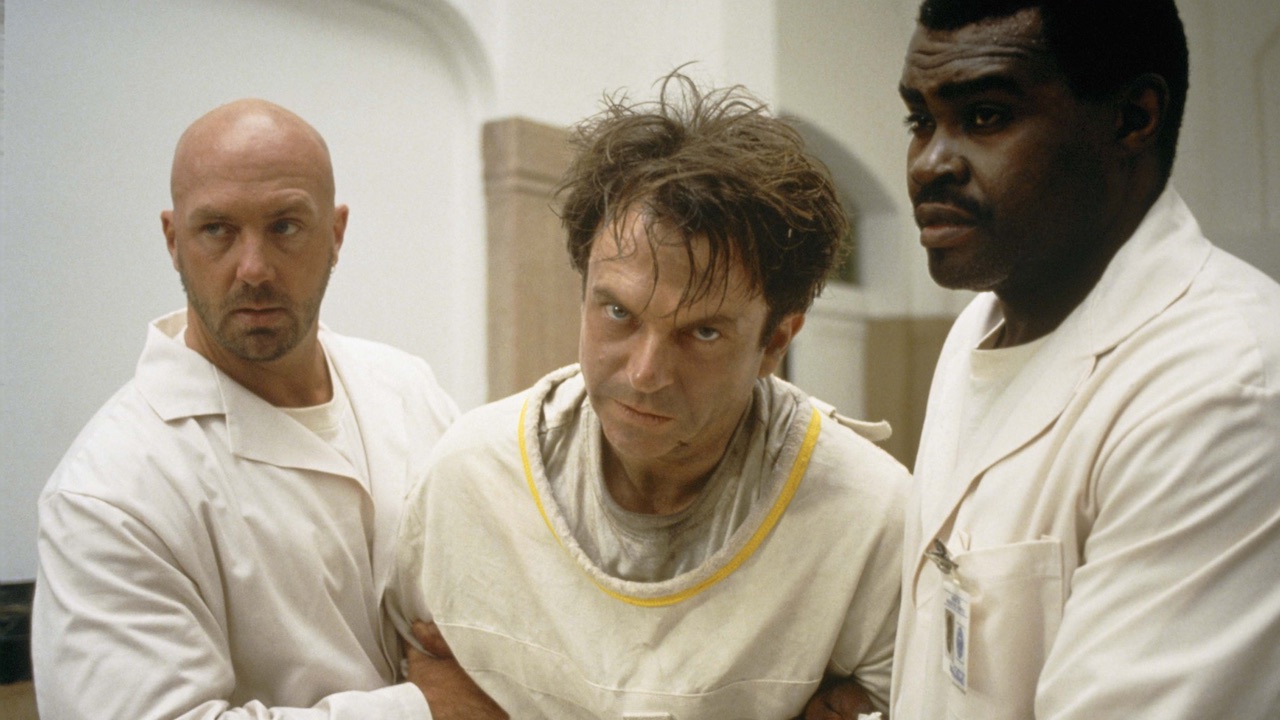
When the writer (the century’s best-seller, we’re told) goes missing, Neill’s insurance investigator and Julie Carmen’s editor go looking for him and end up trapped in a town that doesn’t exist. The film opens with a montage of apparatus printing and stamping and slicing and collating sheets of paper into books; in Lovecraft’s world, technology and knowledge and storytelling are dangerous. Next we see Neill being locked up in an asylum, tossed into a room with padded walls that he promptly festoons with crosses scribbled in black crayon. David Warner shows up as some kind of authority figure, whom we can assume is of some importance as John Glover’s doctor says that things out there must be getting pretty bad if they sent him, and Neill tells his story with the requisite preface that it sounds crazy, but is true—a technique Lovecraft, like many 19th century writers, often employed.
Late in the film, we see fleeting glimpses of the abominable creatures chasing him down a hallway with gaping maws for mouths and teeth gnashing. Yet the film’s strangeness isn’t really about big scary monsters and obscene violence, but rather minor details and occurrences: a kid/old man perpetually peddling his bike along a dark, empty highway; a windmill oscillating in the breezeless night; a painting that seems to change on its own; a pack of children chasing a dog. And everything in the town, from the kind old woman who runs the B&B and chops her husband into coleslaw to the Byzantine church where the evil resides behind wooden doors that throb and ooze, comes from the novels, fiction giving birth to reality. Cane becomes God of his own world. What would Barthes make of the film’s central scribe, a dangerously popular penman of horror that corrupts everyone who reads it, becoming God of his own world? A world made of words impervious to the threat of man and God, a new reality manifested from print on paper.
And then, as so often happens, the story makes it to the movie theaters. Words made image, hell here now. “Do you read Sutter Cane?” becomes “Do you watch Sutter Cane?” In the end, Neill can only sit in an empty movie theater with his bucket of popcorn and watch himself on the screen, his life someone else’s fantasy, and laugh into oblivion. FL
