

The sky, gray and murky with ash falling like a corruption of snow, hangs impermeable over the gloomy remnants of a razed city. Thick whorls of gloom might come crushing down at any second; everywhere, a feeling of emptiness and doom. The buildings sit like husks. Unsure of what’s going on, and looking like hell—pale and baggy-eyed—James is compelled by the unending past, the immutable nature of love. He walks down the empty street, the black asphalt faded like echoes into the smothering slate-hued sky through which no sun has any chance of shining.
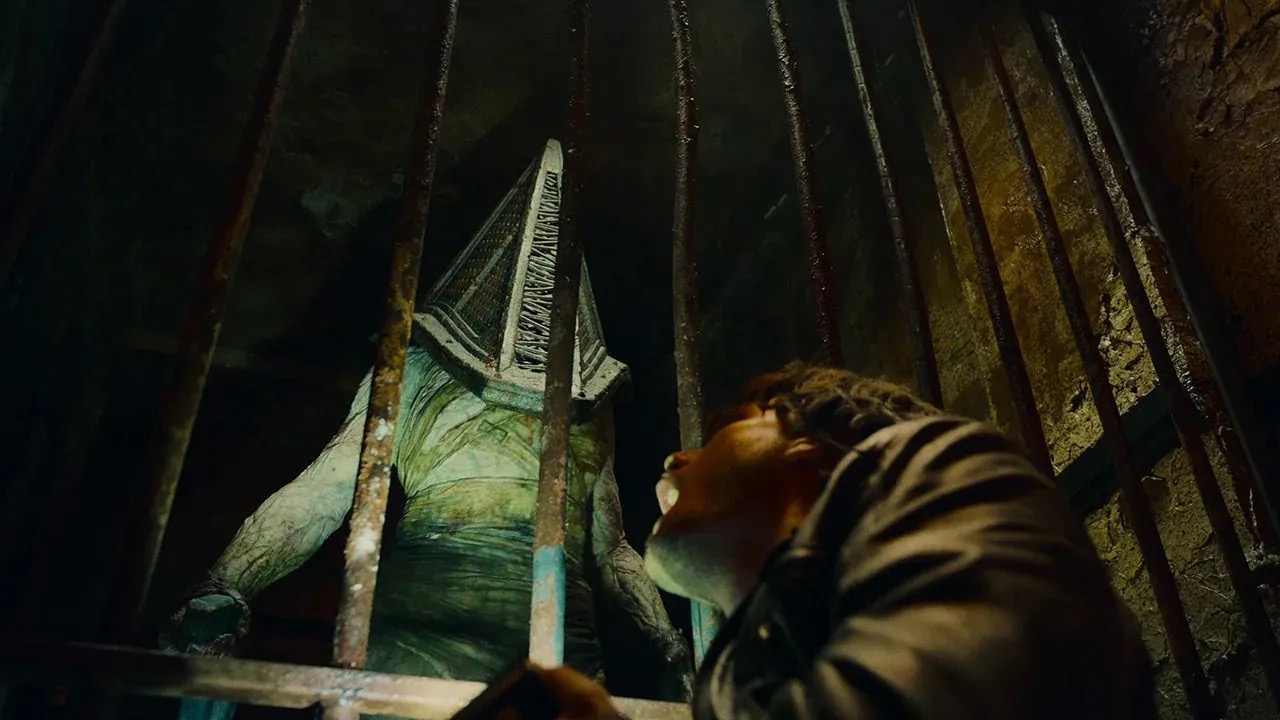
And then, monsters. Armless, sexless monsters moving jerkily, spewing what might be scolding tar, or boiling black blood. Silent Hill is a damned town, but somewhere here is the answer. He can’t quit. Monsters, giant insects with impossible sucking mouths—none of it matters. He has to know.
Zach Cregger’s Resident Evil may be the more popular video game movie this year, but Christophe Gans’ Return to Silent Hill, the sequel to his 2006 Silent Hill, is by far more audacious, a work that uses digital filmmaking in bold, exciting ways. It’s a beautiful tragedy unconcerned with typical Hollywood narrative tendencies, yet remains rooted in the experimental nature of cinematic history. It is at once an American genre would-be blockbuster and a digital continuation of techniques dating back to the advent of the medium.
It begins normally, with flashy shots of James flying across serpentine roads looping around the mountains, all tall green trees and bright sunny sky. He’s smoking a joint and rocking out. He almost runs over a woman waiting for the bus, then offers to give her a lift. They fall in love. Doomed love, a foundational story for literature and film. These early moments establish the kind of world—the sense of Hollywood familiarity, almost generic filmmaking—that Gans will soon pervert with a different cinematic style.
Then we’re in a bar. James—now a bibulous, grieving failed artist—gets turbulently thrown out of bars, talks with who we assume must be his therapist, and dreams of love and death, better days doomed. From beyond, his dead girlfriend calls out to him. Calls him back. To Silent Hill. She—the town—beckons. Gans uses shots and edits that are only possible with digital filmmaking, a rebuttal of the normalcy of those opening moments which are both sad and gorgeously abstract.
Gans’ aesthetic and formal techniques expand upon the approach of the silent “trick films” by Georges Méliès (as well as Victor Sjöström’s The Phantom Carriage), which used technology unique to film to entertain, as all great films must. To create unbelievable worlds. Gans’ film is pervaded by a sublime gothic atmosphere akin to the one of Jean Epstein’s classic The Fall of the House of Usher. The mood of Poe—the sly, deranged humor of his horror—is very much alive here. Whereas Cregger tries to put unreal abominations into a believable world, Gans uses unrealistic digital in such an expressionistic way that the lack of believability works.
All of this is to say that Gans is working in a style that’s both modern (e.g. using so much CGI) and necessary as a part of the unending evolution of genre filmmaking, something new and weird yet familiar enough that its audacity is entertaining rather than off-putting—if you’re willing to follow him on this strange journey. What’s happening means less than why it’s happening, and how. It follows a distinctly cinematic logic—more interested in the psychological or spiritual in sustaining an air of eerie melancholy—than in standard narrative architecture. As much as any more respectable American film this year, Return to Silent Hill is full of stunning, startling, beautiful images, imagined and realized with passion.
Cregger’s Resident Evil is much more straightforward. Bryan, a medical courier ferrying organs between hospitals, is asked to bring a mysterious package up to a hospital ensconced between masses of trees on a mountain, navigating twisty, snowy roads. He hits a woman who is for some unknown reason out in this vast nothingness, and tracks her down. Of course, things begin to go wrong; the unnatural happens; horror ensues.
Fans of the Resident Evil franchise were, to put it mildly, unkind to Paul W. S. Anderson’s adaptations—especially the later ones, in which he merely used the vague ideas of the games to create increasingly strange works of nearly avant-garde junk art. Cregger eschews experimentation and runs forward with the single-minded goal of generating excitement. Bryan narrates in stream-of-consciousness musings as he tries to survive, recalling the way a gamer talks to themself while playing. The movie doesn’t much resemble any one game, and that has irritated some diehard franchise fans (but why would we want the movie to be like a game when the games already exist?). Yet in its straightforward and modest way, it’s about as good as a Resident Evil movie aspiring for mass popularity can be. We’re probably never going to get a Resident Evil as insane as Retribution again.
And yet, it’s Gans who made the more exciting film. It currently has an impressively abysmal rating of 1.4 on Letterboxd, which by now is a better representation of moviegoer consensus than Rotten Tomatoes or IMDb. There’s something amusing about an artsy Frenchman as talented and singular as Gans pouring his heart and $23 million into a sequel of a video game movie that wasn’t particularly loved 20 years ago, and which has had very little lingering influence.
Gans is a passionate fan of Lovecraft. He directed the best part of the Brian Yuzna–produced 1993 anthology film Necronomicon, flaunting his skills and having a ball with the ooey-gooey stuff, visually imagining the cosmic audacity of Herbert Philips’ existential horror. Return to Silent Hill is something like a spiritual kin to that film, with its transmogrifications of the body, the profound malaise lacing the dread, the sense that this world is cruel and hope is pointless. And yet, Gans doesn’t abandon hope entirely. He finds in love a reason to go on, even as reality seems to be crumbling like a desolate structure ravaged by unforgiving time.
